

Who needs a virtual data room in New Zealand?
A four-person medical-device startup in Dunedin, pre-revenue, has a promising sensor and a term sheet on the table for a NZD $4m Series A. On a Thursday the lead fund’s analyst asks for “the diligence pack”. By Friday the founders have emailed a zip of patents, an unsigned clinical protocol and a live cap table to three separate inboxes, and nobody can now revoke that access or say who forwarded what.
That team needs a virtual data room far more than a 150-person firm that never lets a sensitive file leave the building. Why that is true is the whole point of this guide.
Most people meet a data room the way the Dunedin founders are about to: on their busiest week, the instant an outsider asks to inspect the confidential core of the business. This guide runs the logic backwards, from the deal and the dollars, so you can place your own situation on the right side of the line before the request lands rather than after.
Why does the deal, not the company size, decide who needs one?
Company size is the first lever people reach for, and it is the wrong one. What actually creates the need is a single specific event: confidential documents have to cross your company boundary to people you do not fully control, and you need to be able to shut that door again later. A ten-person orchard business selling for $3m runs exactly that exercise. A large firm circulating a board pack internally does not. The org chart never appears in the test.
Start with the money, because the money settles most of the argument.
A room is cheap against the transaction it protects, and the cost of running a confidential deal through Gmail and a shared Drive scales with the value on the table. The figures below are indicative NZD ranges from deals in the New Zealand market. Read them for the ratio between what a room costs and what it guards, not for the exact dollar, because that ratio is what makes the call obvious. A small NZ business selling for $1.2m carries the same exposure profile as a large firm selling a division for the same figure.
| Situation | Typical value (NZD) | Outside parties with access | Data room warranted? |
|---|---|---|---|
| Selling an SME (trade sale) | $500k to $10m | Buyers, their lawyers, accountants | Almost always |
| Startup seed round | $500k to $3m | Angels, a lead VC, legal | Usually |
| Series A and up | $3m to $30m+ | Multiple funds, DD advisers | Yes |
| Property syndication | $2m to $50m | Dozens of retail investors | Yes |
| Mid-market M&A | $10m to $100m | Competing bidders, advisers | Yes, non-negotiable |
| Board / governance pack | n/a | Directors only, internal | Sometimes |
| Sharing a proposal internally | n/a | Your own staff | No, a folder is fine |
Run your eye down the last column and the rule writes itself: the moment access crosses your boundary and the documents are commercially or personally sensitive, the case is strong; while everything stays internal and low-stakes, ordinary file sharing is fine. The deal sets the need, and the deal is agnostic about how many people you employ.
So what actually is a virtual data room?
Here is the clean version, because the term gets used loosely. A virtual data room is a secure online space where you publish a structured set of documents and grant named people time-limited, permissioned access, with a full log of who opened, viewed or downloaded each file. That single sentence already contains the test for who needs one.
Permissioned access, plus an audit trail, for parties outside your walls.
If you want the mechanics in full, our plain-English explainer and the piece on how a data room actually works unpack them. For the decision in front of you the definition is enough. The chart below ranks the NZ groups that reach for a formal room against those that do not, which is the same boundary the table just drew, in one picture.
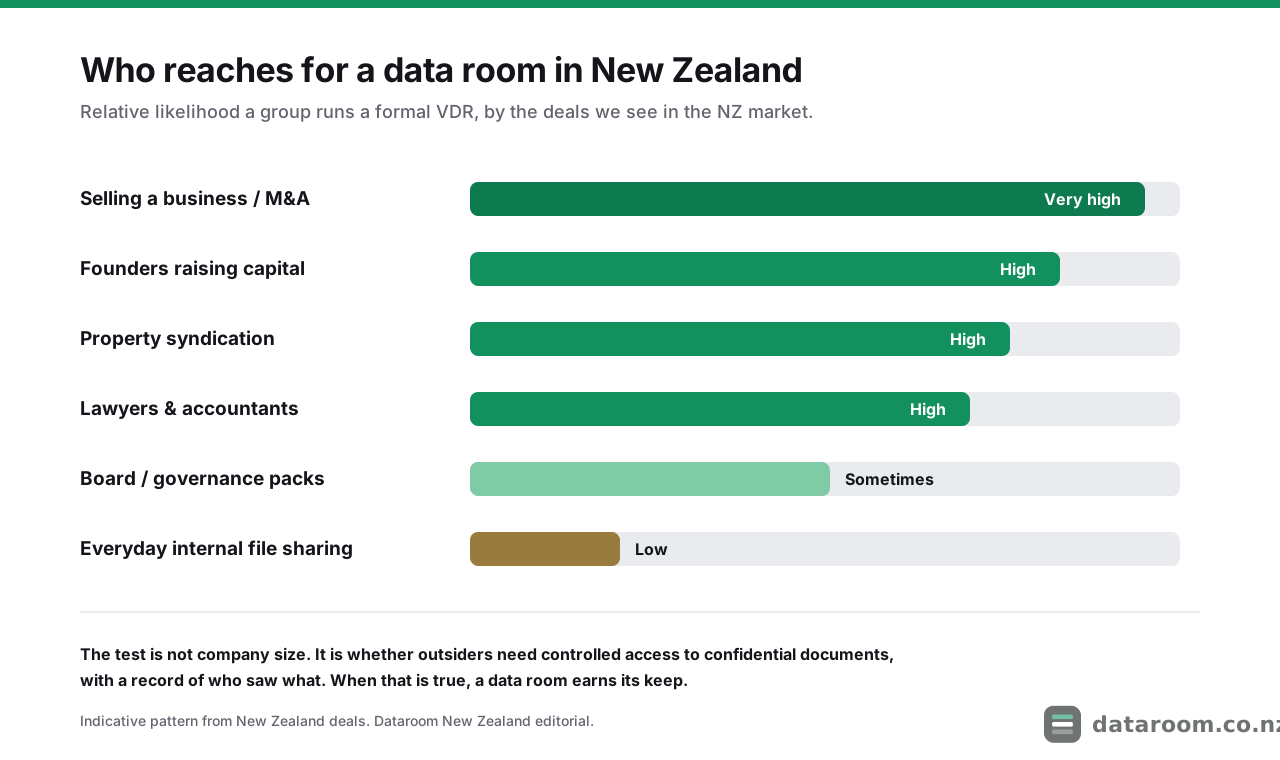
The gap between the top of that chart and the bottom is confidentiality plus outside access. It is never size.
Which signals say it is time to open one?
You rarely wake up wanting a data room; something forces the question. In New Zealand, five signals cover almost every case, and if one describes your next few months, treat the room as a when rather than an if.
The first is a sale. The instant you invite a buyer to inspect the guts of the company you are running a disclosure exercise, and disclosure without control is precisely how a confidential customer list ends up with a competitor who walked away from the deal. The data room side of selling a business is where first-time sellers underestimate the work most.
The second is a capital raise, where staging matters as much as security. An interested fund should see more than a first-meeting angel, and that is a permissions problem a plain folder cannot solve without a lot of manual copying and hope.
The third is many small parties at once, the textbook case being property syndication, where forty retail investors each need the same information memorandum and none of them should see another’s details. The fourth is a legal or regulatory obligation: the moment the documents carry personal information, the audit trail stops being a convenience and becomes evidence. The fifth is simply a counterparty who insists, because increasingly the other side’s lawyer will not accept sensitive material any other way.
If a document is confidential, an outsider needs to read it, and you might one day have to prove who did: that is the whole test. Every other detail is just sizing.
Who honestly does not need one yet?
Knowing who can skip a room is as useful as knowing who cannot, because paying for control you never use is its own small waste. The matrix below runs each situation past the three questions that actually decide it. Two or more ticks on the right, and a room earns its place.
| Situation | Confidential docs | Outside parties | Audit trail needed | VDR recommended |
|---|---|---|---|---|
| Selling your company | ✓ | ✓ | ✓ | ✓ |
| Raising a seed or later round | ✓ | ✓ | ✓ | ✓ |
| Property syndication | ✓ | ✓ | ✓ | ✓ |
| Adviser handling client deals | ✓ | ✓ | ✓ | ✓ |
| Sharing a board pack internally | ✓ | ✗ | ✗ | ✗ |
| Sending a quote to a customer | ✗ | ✓ | ✗ | ✗ |
| Storing your own team's files | ✓ | ✗ | ✗ | ✗ |
If your row lands on the “no” side, ordinary storage and good folder hygiene will serve you better than a room with watermarking you never switch on.
Be honest about this, because whether a data room is worth it for a small NZ deal is a fair question and the answer is genuinely “not always”. A single-buyer, single-week asset sale of a $60k delivery van does not need permissioned rooms and audit logs; it needs a signed agreement and a bank transfer. The skill is telling that apart from the deal that only looks small.
See which data rooms suit NZ deals
Compare the providers on security, deal features and indicative NZD pricing, side by side.
Selling, raising, syndicating: what the room does in each case
Four groups sit at the top of that chart, and the room does a slightly different job for each. Worth walking through, because your situation is probably one of them.
Selling a business or running M&A is the densest case and the one where the room most directly moves the result. In a competitive sale you are marshalling several bidders through the same evidence while keeping the process orderly: early bidders see teaser-level folders, shortlisted parties unlock the sensitive contracts, and access closes cleanly the day a party drops out. That staging is exactly what keeps a mid-market M&A process competitive right up to signing, and if a warranty claim surfaces a year after completion the audit log is your record of precisely what was disclosed and when. The buyer’s mirror image runs through a due diligence checklist, and the room is simply where that checklist gets answered, file by file.
Founders raising capital is where the “size does not matter” point lands hardest, as our Dunedin medtech team is discovering. A pre-revenue startup can need a room more urgently than an established company, because investors apply the same diligence rigour to a $2m round as to a $20m one, and a tidy permissioned pack does quiet work on a valuation. The failure mode is the zip file emailed to three inboxes. Cost sensitivity is the real wrinkle for early-stage teams, which is why we keep separate views of the best data rooms for NZ startups and of what startup fundraising genuinely demands. Anything heading toward an NZX listing pushes you firmly into data-room territory.
Property syndication has a distinctive shape that a shared folder handles badly. There is one asset, one information memorandum, and many investors who all need identical materials while never seeing one another. Picture a Hawke’s Bay orchard or a suburban Auckland commercial block offered to eighty prospective investors: each needs the trust deed, the valuation and the product disclosure statement, and not one should glimpse another’s name, holding or bank details. A property syndication data room timestamps every investor’s access automatically, which is exactly the evidence you want on file if the Financial Markets Authority ever asks how the offer was run.
Lawyers, accountants and corporate advisers are heavy users in their own right, frequently keeping a room per client engagement. For them the question is rarely “do I need one” but “which one, and how do I run it well” across a dozen live matters, which is a buyer’s-guide problem covered in how to choose a virtual data room. The real exposure sits with the firm that still emails PDFs of a client’s financials, or drops them in a folder link that never expires, when a room priced around $150 a month would remove that risk outright.
When does the room have to be open?
Knowing who needs a room is only half of it; the other half is when, and timing is the part first-timers get wrong. Due diligence on an NZ SME sale commonly runs four to twelve weeks, and a larger M&A process longer again, which means the room has to be populated before the buyer’s lawyer asks for the first document, not scrambled together afterwards. The rule of thumb from deals we track is blunt: open the room the week you decide to go to market, not the week the first offer arrives.
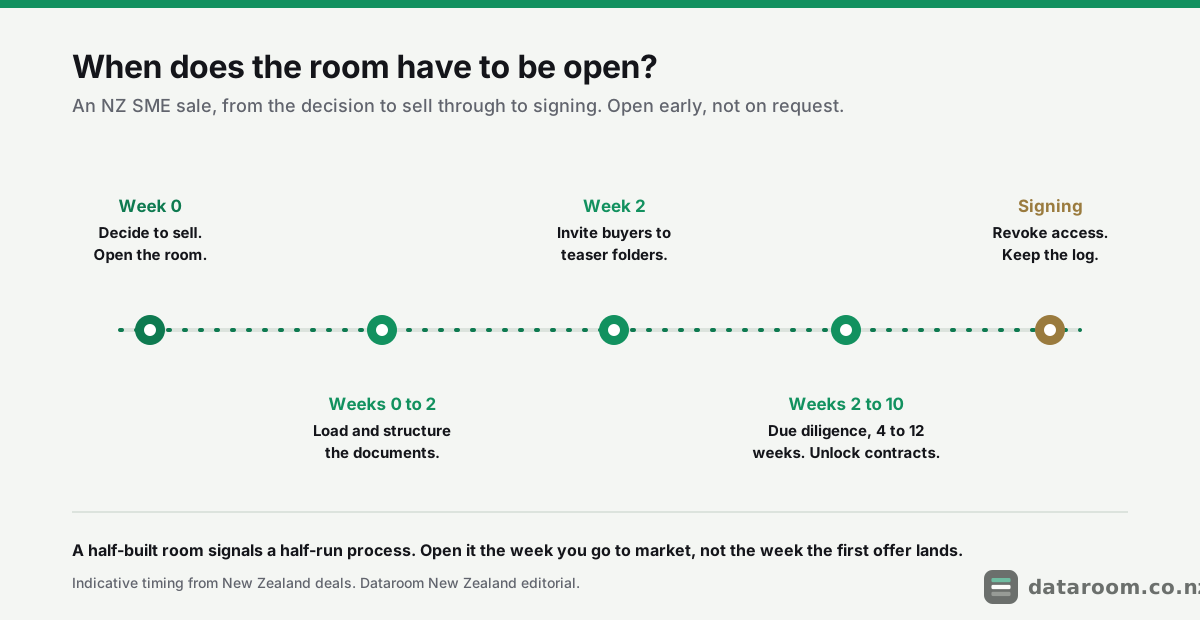
A half-built room signals a half-run process, and that is precisely the moment a bidder starts sharpening the discount.
The same clock governs a raise. Investors move fast when they are keen and cool off when they are kept waiting, so the founders who convert are the ones whose diligence pack is already sitting behind permissioned access before the term-sheet conversation opens. Our Dunedin team, ideally, has the room live the day the analyst emails. If you want the realistic picture, how long due diligence takes in New Zealand sets the expectation, and what documents go in a data room tells you what to load first so the room is genuinely ready on day one.
The founders who close fastest are not the ones with the most documents. They are the ones whose documents are already in one controlled, well-labelled place when the term sheet lands.
What does it cost, and when does the Privacy Act make it mandatory?
Cost rarely tips the decision, because the ranges are modest against any real transaction, but it helps to know the numbers before you commit. Entry-level rooms suited to a small NZ raise or sale start around NZD $99 to $150 a month; mid-market deals with several bidders and larger document sets sit around $600 to $2,000; large or enterprise M&A runs higher again, sometimes on legacy per-page pricing that can surprise you if you feed it a scanner full of historical paper.
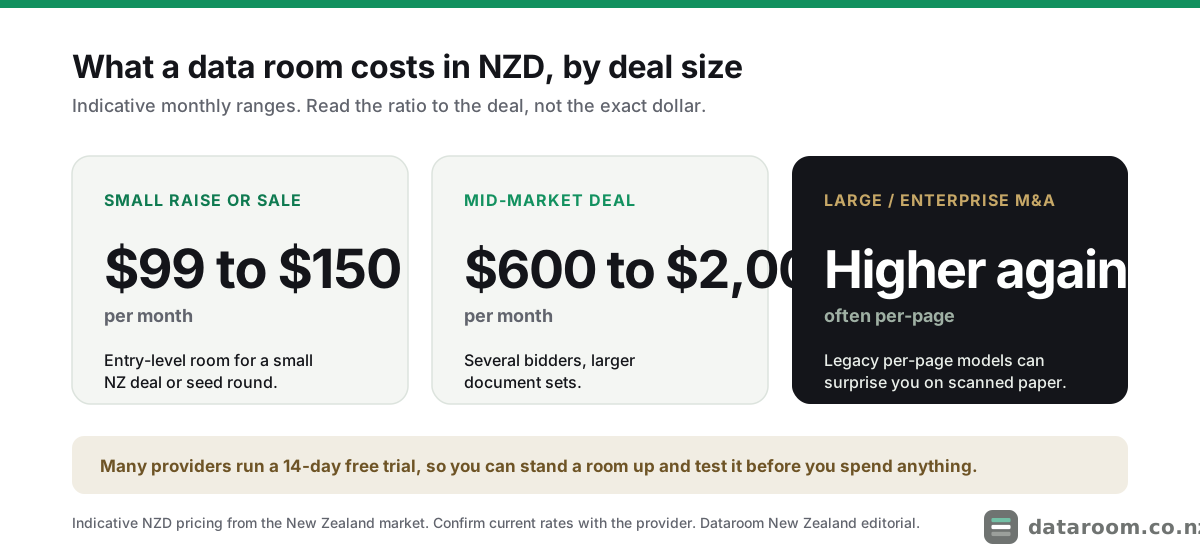
Several providers offer a 14-day free trial, so you can stand a room up and test it before spending anything. Our breakdown of VDR pricing in New Zealand explains the per-page, per-user and flat-rate models and where each one bites, and the guide to the cheapest rooms for small NZ deals covers the budget end honestly. For a sub-$5m deal, the spend is small enough that it should not be the reason you hesitate.
For a large share of NZ deals, though, a room is not merely sensible; it is how you discharge a legal duty. The moment your disclosure materials contain personal information, whether employee records, customer data, or health and financial details, the Privacy Act 2020 applies, and its information privacy principles require you to keep that information secure and use it only for a proper purpose. A room that enforces access by role and logs every view is a direct, demonstrable way to meet those obligations; an emailed spreadsheet is the textbook opposite.
There is a breach dimension sitting right behind the compliance one.
If sensitive documents leak you may be dealing with a notifiable privacy breach, and the national cyber agency CERT NZ publishes guidance on preventing exactly the uncontrolled exposure a room exists to stop. The duties that come with a company changing hands, such as director obligations under the Companies Act 1993, sit alongside all of this. None of it replaces advice from your own lawyer, but it does mean the “do I need one” question sometimes has a compliance answer rather than just a convenience one.
How do you decide, in four questions?
Everything above collapses into a short self-test you can run in ten minutes before you spend a cent. Clear the middle two steps and you should open a room; fail them and you can keep your money for now.
Work out if you need one in four steps
A quick self-test before you spend anything. If you clear steps two and three, set up a room.
- 1
Name the documents
List what you would be sharing. If any of it is confidential, commercial or personal information, note it. Public marketing material does not count toward the test.
- 2
Count the outsiders
Identify everyone outside your company who needs access. One trusted party for one day is borderline; several parties over several weeks is a clear yes.
- 3
Test for a record
Ask whether you would ever need to prove later who saw what, or revoke access cleanly. If yes, ordinary file sharing simply cannot do it.
- 4
Match the tool to the deal
If you cleared the tests, size the room to the deal and start a free trial. Our folder-structure template and setup guide take it from there.
Come out with a yes, and the next practical moves are how to set up a data room and the folder-structure template for NZ deals. Come out with a no, and keep this guide for the day your situation changes, because for most growing businesses it eventually does.
What will a data room actually cost you?
Indicative NZD pricing by deal size, with the pricing models explained.
Common questions about who needs a data room
Does a small business really need a virtual data room?
Often, yes. The trigger is the deal, not the company size. A small NZ business selling for $1m exposes the same confidential contracts, financials and customer data as a large one, so it faces the same need for controlled, logged access. What changes for small businesses is the budget, which is why entry-level rooms start around NZD $99 to $150 a month.
Can I just use Dropbox or Google Drive instead?
For low-stakes internal sharing, yes. For a confidential multi-party deal, they fall short on granular permissions, view-only controls, watermarking and a defensible audit trail. We compare the trade-offs directly in our data room vs Dropbox and vs Google Drive guides.
At what deal size does a data room become worth it?
There is no hard threshold, but as a rule of thumb the cost of a room is trivial against any transaction above roughly NZD $250k, and the risk of not having one rises with the value and the number of outside parties. Below that, and for single-party, single-week exchanges, plain storage can be enough.
Is a data room a legal requirement in New Zealand?
No single law mandates one, but the Privacy Act 2020 requires you to keep personal information secure and share it only for a proper purpose. When your deal documents contain personal or sensitive data, a permissioned, audited data room is the most direct way to meet that duty, which effectively makes it necessary for many transactions.
Who sets up the data room, me or the other side?
Usually the party disclosing the information: the seller in an M&A deal, the company in a capital raise, the syndicator in a property offer. Advisers often run it on their client's behalf. Whoever owns the documents should own the room, because they control access and hold the audit trail.
How quickly can I have a room open once I decide I need one?
Same day, in practice. Self-serve rooms let you sign up, create a folder structure and invite your first users within an afternoon, and many run a 14-day free trial so you can populate the room before paying. The slow part is preparing the documents, not the software, which is why we suggest opening the room the week you decide to go to market.