

Due diligence checklist for New Zealand deals
Different deals get scrutinised in different places, so before any prose the fastest orientation is to see where the pressure lands. Read the matrix, then read on for why.
| Workstream | Business sale (sub-$5M) | Startup raise | Property syndication | Mid-market M&A |
|---|---|---|---|---|
| Corporate & legal | ✓ | ✓ | ✓ | ✓ |
| Financial & tax | ✓ | ✓ | ✓ | ✓ |
| Commercial | ✓ | ✓ | ✗ | ✓ |
| People & employment | ✓ | ✗ | ✗ | ✓ |
| Technology & IP | ✗ | ✓ | ✗ | ✓ |
| Property & assets | ✓ | ✗ | ✓ | ✓ |
Most New Zealand deals do not fall over on price. They stall for weeks, or collapse outright, because due diligence turns up something the seller could have prepared for and simply did not.
A Bay of Plenty kiwifruit packhouse loses a fortnight because nobody can find the signed cool-store lease. A Christchurch software founder watches a raise cool while a lawyer hunts for proof the code belongs to the company rather than a former contractor. A Marlborough winery sale wobbles when a buyer notices the water-take resource consent expired eight months ago. In every one of those cases the checklist existed, the answer existed, and the delay was self-inflicted; the matrix above would have told each seller exactly where the buyer’s attention was going to land. This guide gives you the full checklist, the running order that makes it work, the real NZD costs, and the New Zealand-specific traps that a generic offshore template will quietly miss.
What is a due diligence checklist, and why does preparation decide the deal?
A due diligence checklist is the ordered set of documents and questions a buyer works through to verify a business before committing to buy it.
That single sentence hides three moving parts worth unpacking, because each one changes how you use the list. The first part is verification: due diligence is not about discovering whether a business is good, it is about confirming that what the seller has claimed is actually true, and pricing anything that is not. The second part is order, because the questions are not a flat pile; they cluster into predictable groups that professional buyers investigate in parallel, each led by a different specialist. The third part is ownership, because although the buyer’s advisers write the request list, it is the seller who assembles the answers, and the quality of that assembly quietly decides how the whole deal feels.
Preparation is the lever nobody outside the deal appreciates.
Read from the seller’s side, every row on the checklist is a task to complete before the buyer ever logs in; read from the buyer’s side, every row is a claim to test. A checklist that both parties recognise turns an adversarial process into a shared one, where the awkward finding surfaces early, in writing, rather than late and in an argument over the purchase price. The most disciplined sellers go one step further and run the checklist on themselves first, a practice known as vendor due diligence, so that nothing in the room is a surprise to the person who owns it. That habit is why two businesses with identical numbers can have wildly different sale experiences, one closing in six weeks and the other grinding through ten with a shrinking price.
The documents a buyer least expects to find on day one are the ones that build the most trust. A seller who has already answered the hard question looks like a seller with nothing to hide.
What are the six workstreams a buyer investigates?
Every item on a due diligence checklist belongs to exactly one of six workstreams, and buyers investigate all six in parallel, which is why your data room should give each its own top-level folder.
Getting this map right is the highest-leverage thing a seller does, because a room that mirrors the workstreams answers half the buyer’s questions before anyone types them. When a buyer asks for the shareholders’ agreement, it is already sitting in the corporate folder; when they want the debtors ledger, it is in financial; when their lawyer wants the make-good clause on a lease, it is in property. Nothing lands in an inbox with no place to go, and nobody wastes a billed hour asking for something you have already filed.
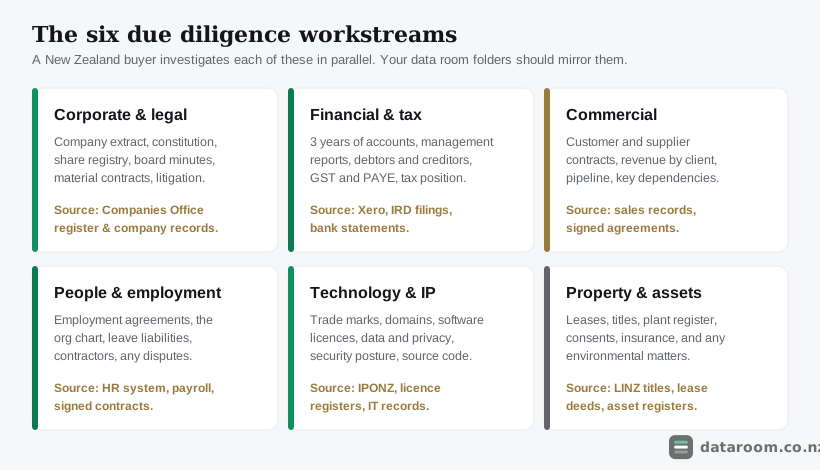
The first three workstreams tell the buyer whether the business is legally sound, financially real, and whether its revenue will survive the change of ownership.
Corporate and legal covers the bones of the company: the constitution, the share register, the shareholders’ agreement, board minutes, material contracts and any litigation, all of it verifying clean ownership and no hidden disputes. Financial and tax covers the numbers: three to five years of accounts, management reports, budgets, the debtors and creditors ledgers, and the GST and PAYE position, all of it testing whether the reported performance is genuine and sustainable rather than dressed for sale. Commercial is the one sellers under-prepare most often, because it examines revenue quality and concentration; a single customer at forty percent of turnover reads very differently to a cautious buyer than it does to the founder who won that account over a decade of dinners.
The remaining three workstreams tell the buyer what they are actually taking on once the deal closes and the founder’s goodwill walks out the door.
People and employment surfaces who transfers and at what cost: the employment agreements, the org chart, remuneration, accrued leave liabilities, contractor arrangements and any personal grievance in progress, each of which can quietly move the price. Technology and intellectual property confirms that the trade marks, domains, software licences and, above all, the source code are owned by the company and not by a founder or a former developer personally. Property and assets confirms that the leases, land titles, plant, resource consents and insurance exist, are owned and are unencumbered. Sellers who prepare these three with a buyer’s eyes rather than their own are the ones who avoid the late, price-chipping surprise that arrives in week eight rather than week one.
Compare data rooms for your due diligence
See indicative NZD pricing, security features and trials for every provider we track, side by side.
What does the core checklist actually contain?
The working checklist is best read as a table, because a table shows not just what a buyer requests but who holds each item and what they are really checking.
The list below is your master set. Treat it as a starting point and trim it to the deal in front of you, since not every row applies to every business. A Queenstown cafe sale will barely touch technology and IP, while a Wellington software company sale lives there. What matters is that you have considered each row and made a deliberate decision to include or exclude it, rather than discovering the gap at the exact moment a buyer’s adviser does.
| Workstream | Documents typically requested | Held by | What the buyer is checking |
|---|---|---|---|
| Corporate & legal | Company extract, constitution, share register, shareholders' agreement, board minutes, material contracts, litigation register | Company, lawyer, Companies Office | Clean ownership and no hidden liabilities or disputes |
| Financial & tax | Three to five years of accounts, management reports, budgets, debtors and creditors, GST and PAYE returns, tax position | Accountant, Xero, IRD filings | That the numbers are real, current and sustainable |
| Commercial | Customer and supplier contracts, revenue by client, pipeline, pricing, key dependencies | Business, sales records | Revenue quality and concentration risk |
| People & employment | Employment agreements, org chart, remuneration, leave liabilities, contractor terms, any disputes | HR, payroll, lawyer | Who transfers, at what cost, and any personal-grievance exposure |
| Technology & IP | Trade marks, domains, software licences, source-code ownership, data and privacy posture, security | Business, IPONZ, IT | That the IP is owned and the systems are sound |
| Property & assets | Leases, land titles, plant register, resource consents, insurance, environmental matters | Business, LINZ, lawyer | That assets exist, are owned and are unencumbered |
Two workstreams cause more late surprises than the other four combined, and both are surprises the seller could have defused.
Commercial due diligence exposes revenue concentration that the founder never framed as a risk, because to the founder that dominant customer is a success story rather than a dependency; a buyer sees a business that loses a third of its income if one relationship sours after settlement. People due diligence surfaces the leave liabilities, informal contractor arrangements and unresolved grievances that sit off the balance sheet until someone goes looking. Prepare both of these with a sceptical outsider’s eyes, and where the answer is uncomfortable, put the supporting document in the room before the question is asked. That single habit converts your two weakest workstreams into evidence of a seller who has nothing to hide, which is worth more at the negotiating table than an extra line of EBITDA.
The lead matrix at the top of this guide is the companion to this table.
It told you which workstreams run deep for four common New Zealand scenarios, so read the two together: the matrix decides how much of each row you polish, and the checklist tells you exactly what a polished row contains. A startup fundraising diligence set leans on IP, the cap table and the technology; a property syndication inverts that entirely toward titles, valuations, the trust deed and the product disclosure statement; and a full mid-market M&A deal runs all six at depth. If you want the item-level document lists per deal type, our guide to what documents go in a data room breaks each scenario down further.
Share sale or asset sale: how does the structure change the checklist?
Before you build a single folder there is a decision that quietly reshapes the entire checklist, and it is made in the sale and purchase agreement, not in the data room: is the buyer acquiring the shares in your company, or selected assets out of it?
In a share sale the buyer takes the whole legal entity, so its complete history and every liability travel across with it. That pushes corporate, tax and litigation diligence far deeper, because the buyer inherits the imputation credit account, the disputed assessment nobody resolved, and the personal grievance filed last spring. In an asset sale the buyer cherry-picks specific assets and contracts and leaves the shell behind, which shifts the whole emphasis onto title to each asset, whether key contracts can be assigned without a counterparty’s consent, and the GST treatment of the sale itself.
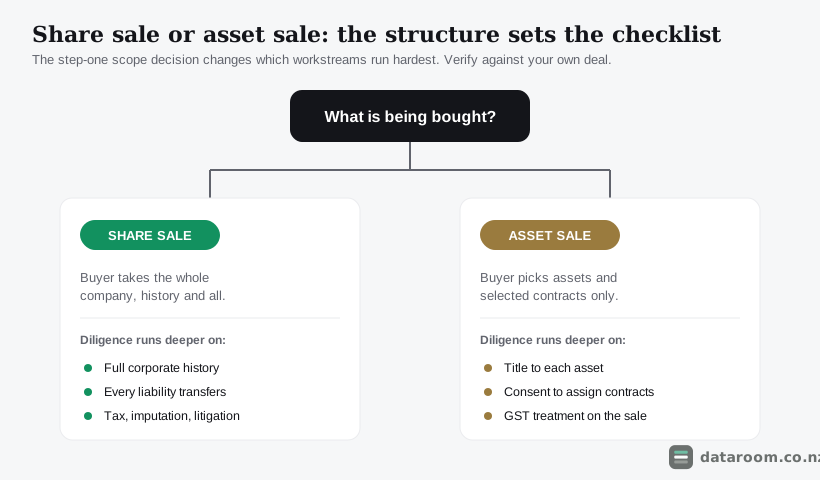
Neither structure is universally better; they simply move the risk to different parties, and the checklist follows the risk.
A buyer usually prefers an asset sale precisely because it leaves unknown liabilities behind, while a seller often prefers a share sale for a cleaner exit and, in some cases, a more favourable tax result. That tension is negotiated early, and once it settles it tells you where to spend your preparation hours. If it is a share sale, over-invest in a watertight corporate and tax file, because that is where the buyer will live. If it is an asset sale, front-load the work on assignment clauses in your material contracts, since a single non-assignable supply agreement can strand the value the buyer thought they were paying for. Our guide to selling a business in New Zealand covers how that structure choice threads through the whole agreement.
Which checklist items are unique to New Zealand?
A generic checklist copied from a US or UK template will miss the items that matter most here, because New Zealand has its own public registers, its own privacy regime, its own tax mechanics and its own foreign-investment rules, and buyers know exactly where to look.
Four pillars separate a local checklist from an offshore one, and a seller who prepares all four removes the most common reasons a well-advised buyer pauses.
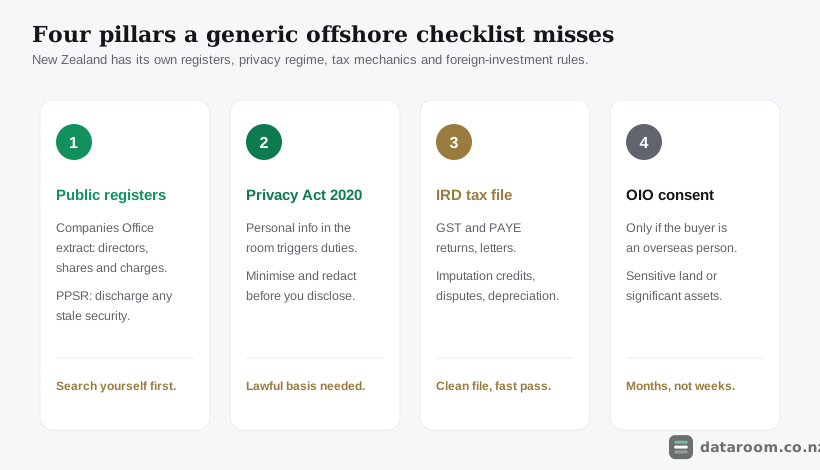
Start with the public record, because your buyer certainly will.
Anyone can pull your company’s extract from the Companies Office register, so the first move a seller makes is to search their own company and read it as an outsider. Confirm that the directors, the shareholding, the registered office and any registered charges are correct and current before a buyer flags a stale entry as a red flag; a director who resigned two years ago but still appears on the register invites exactly the wrong first question. Then check the Personal Property Securities Register for any security interest that should have been discharged, because a financing statement that a bank forgot to release after a loan was repaid will read as an undisclosed liability until you prove otherwise, and clearing it takes minutes now but can cost you leverage later.
Privacy is the item most sellers do not realise is a due diligence matter at all.
The moment you load employee files, customer lists or anything else containing personal information into a data room, you take on obligations under the Privacy Act 2020, and sharing that data with a prospective buyer is a disclosure that needs a lawful basis and reasonable security. The Office of the Privacy Commissioner sets out the privacy principles that govern how you collect, hold and disclose that information, and the practical discipline is to minimise and redact before you disclose rather than after. Our guide to Privacy Act 2020 obligations when sharing deal data walks through what that means in a live transaction, including which fields to strip from an employee schedule before a buyer’s adviser ever sees it.
Tax is the third pillar, and it is where a buyer’s accountant spends real time.
They will want the GST returns, the PAYE records and any correspondence with Inland Revenue, and they will check the tax position for anything that transfers with the business, from imputation credits to a disputed assessment to depreciation recovery on plant. A clean, current tax file shortens this workstream dramatically, while a gap invites the buyer to assume the worst and price for it. For a first-time seller, the government’s overview of buying or selling a business is a sensible orientation to what actually changes hands and what stays behind.
The fourth pillar only bites on some deals, but when it does it dominates the timeline.
If your buyer is an overseas person and the deal involves sensitive land, significant business assets or certain fishing quota, it may need consent under the Overseas Investment Act 2005 before it can complete. That consent is a process measured in months, not weeks, so a seller fielding offshore interest should flag it at the letter-of-intent stage rather than discovering it deep in diligence. It rarely changes the checklist itself, but it reshapes the conditions and the settlement date around it.
A flat-rate room for your due diligence
One monthly price, granular permissions, a full audit trail and a 14-day free trial to pilot with real documents.
How do you run the process end to end?
Due diligence is a process before it is a document list, so the surest way to keep a checklist from sprawling is to work a fixed sequence.
The seven steps below hold for either side of the table: the seller does most of the work in the first two steps, building and loading the room, while the buyer drives steps three through seven, testing what they find. Follow the order and every row of the checklist above slots naturally into place, because the structure is built before a single document is gathered rather than reverse-engineered from a pile of scanned PDFs the night before an offer expires.
Run the process in seven steps
A repeatable order for either side of the table. The seller does most of the work in steps one and two; the buyer drives steps three to seven.
- 1
Scope the deal and the workstreams
Agree what is being bought: shares or assets, which entities, which sites. A share sale drags the whole history and every liability across; an asset sale lets a buyer cherry-pick. That decision sets which of the six workstreams apply and how deep each one goes.
- 2
Build the data room and folder structure
Create a folder per workstream before you gather a single file. A clean structure means you upload each document once and the buyer can find it without asking, which is what keeps advisers billing analysis rather than admin.
- 3
Gather and load the documents
Pull the source records: the Companies Office extract, three to five years of accounts, signed contracts, employment agreements, leases and LINZ titles. Load each into the matching folder and name files so a stranger can navigate them.
- 4
Grant staged, permissioned access
Invite the buyer and their advisers with view or download rights set per folder. Hold the most sensitive material, such as customer pricing or the full employee schedule, behind a later stage or a signed NDA.
- 5
Run Q&A in a controlled channel
Route every buyer question through the data room's Q&A tool, not email. Assign each question to the right person, log the answer, and keep one audit trail that becomes part of the disclosure record.
- 6
Verify, and act on the findings
The buyer's advisers test the documents against reality. Findings feed the price, the warranties and any conditions. This is where a well-prepared room pays for itself in fewer chips and faster sign-off.
- 7
Close, then archive the room
Once the deal signs, export the full index and audit log as the disclosure record, then archive or close the room so access ends cleanly and no stray login lingers after settlement.
Those seven steps map onto four phases that a small New Zealand deal moves through, and seeing them on one line makes the shape of the timeline concrete.
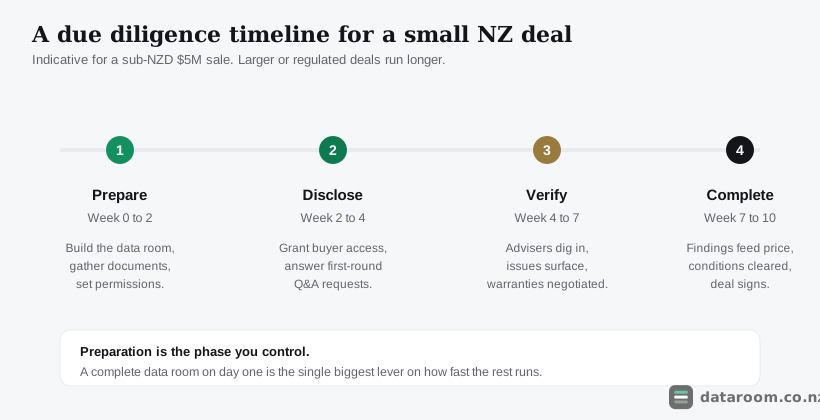
If you have not built the room yet, our step-by-step guide to setting up a virtual data room covers the mechanics, and the data room folder structure template gives you a ready-made skeleton for the six workstreams.
From the buyer’s side the same seven steps are a triage discipline: lead with the deal-breakers by confirming clean ownership and no undisclosed litigation first, because a failure there ends the process regardless of anything else, then test the numbers because the financial workstream sets the price, and only then work through commercial, people, IP and property. Logging every open item in the room’s Q&A tool rather than a sprawl of emails is its own skill, and managing data room Q&A without losing control covers how to keep it structured and auditable on both sides.
How long does due diligence take, and what does it cost?
For a straightforward New Zealand business sale under about $5 million, plan on six to ten weeks from the buyer getting data room access to a signed deal, with preparation adding another one to two weeks that you spend before the clock the buyer sees even starts.
Larger, regulated or multi-entity transactions run considerably longer, and our guide to how long does due diligence take in New Zealand gives realistic ranges by deal size. The costs of running that process sit in two buckets, the advisers who do the analytical work and the data room that houses the documents, and the striking thing is the proportion between them. The room is almost always the smallest line on the page, often a rounding error against the fees around it.
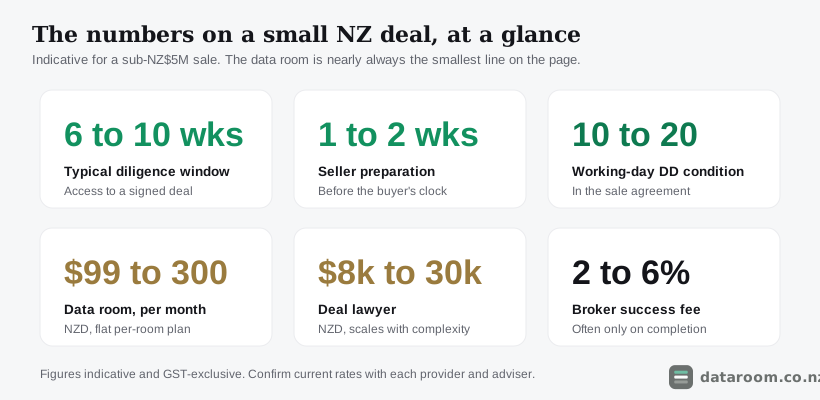
| Line item | Indicative NZD | Notes |
|---|---|---|
| Data room (small deal) | $99 to $300 / mo | Flat per-room plan; a 14-day free trial covers a pilot |
| Deal lawyer | $8,000 to $30,000+ | Scales with complexity, warranties and negotiation |
| Accountant / financial DD | $5,000 to $25,000+ | Buyer-side review or seller-side vendor DD |
| Corporate adviser / broker | Success fee, ~2 to 6% | Often only on completion, sometimes plus a retainer |
| Vendor due diligence report | $10,000 to $40,000+ | Optional; a seller-commissioned pack for larger deals |
| Warranty & indemnity insurance | ~1 to 2% of cover | Optional; more common on mid-market and up |
Read the proportions rather than the individual numbers.
The data room is frequently the cheapest line on the page, yet it is the single line that determines whether those expensive advisers spend their billed hours on analysis or on chasing missing files. Spending a few hundred dollars a month to save a lawyer a week of back-and-forth is not a close call, and the flat per-room plan with a 14-day free trial exists precisely so you can pilot the room with real documents before committing to anything. Two lines in that table are worth a closer look. A vendor due diligence report is a seller-commissioned pack that pre-empts the buyer’s own review, which can pay for itself on a competitive sale by keeping several bidders moving at once. Warranty and indemnity insurance, priced at roughly one to two percent of the cover, lets a seller cap their post-settlement exposure and is increasingly common once a deal clears the mid-market.
If you are weighing whether a room is justified at all for a very small deal, is a virtual data room worth it makes the case both ways, and the cheapest rooms for NZ small deals covers the bottom of the market in detail.
Where does the checklist sit in the sale and purchase agreement?
In most New Zealand deals the checklist is not a free-floating exercise; it is a written condition of the sale and purchase agreement, which changes how you should think about preparation.
The buyer signs a conditional offer that grants a defined due diligence period, commonly ten to twenty working days for a small business and longer for a complex one, during which they inspect the data room and can walk away if they are not satisfied. That clause sets the clock the whole checklist runs against, so getting it right matters as much as filling the folders. A seller who opens a half-built room burns the buyer’s paid-for time and invites either an extension request or a price chip, and because the condition is usually drafted so the buyer is satisfied at their sole discretion, almost any finding gives them a lawful exit.
The findings do far more than decide go or no-go; they flow into three distinct parts of the contract, and understanding that flow is what rewards an honest seller.
They shape the price, which a buyer will chip the moment diligence exposes a risk they did not price into their offer, sometimes via a straight reduction and sometimes via a retention or an earn-out that holds part of the money back. They shape the warranties, the promises the seller makes about the state of the business that the buyer then relies on and can sue over later. And they populate the disclosure schedule, where the seller formally lists the exceptions to those warranties. This is the mechanism that turns preparation into protection: a problem surfaced in the room becomes a disclosure that limits the seller’s later liability, while the identical problem discovered after signing becomes a live warranty claim. That asymmetry is precisely why a prepared seller volunteers the awkward lease or the concentrated customer rather than burying it.
What red flags stall or sink an NZ deal?
Some findings are worse than others, and the ones that most often send a New Zealand deal back to renegotiation or off the table entirely are, without exception, easier to defuse when the seller surfaces them first.
Ownership that is not clean sits at the top of the list: an undischarged security interest on the PPSR, a disputed shareholding, or intellectual property registered to a founder personally rather than to the company will all halt a deal until resolved, and each is far cheaper to fix before a buyer arrives than during a live negotiation. Revenue concentration is the next most common, where one or two customers carry most of the turnover on contracts that turn out to be short, informal or terminable at will; the same revenue reads as a strength or a fragility depending entirely on the paperwork underneath it, which is why a Nelson seafood exporter with three long, signed offtake agreements sells far more smoothly than one with the same revenue on a series of handshakes.
The remaining red flags cluster around liabilities and hygiene.
Undisclosed liabilities such as a personal grievance in progress, an unresolved tax position or a lease with an onerous make-good clause all erode trust the moment a buyer finds them unaided. Privacy and data gaps are increasingly deal-relevant, whether that is personal information shared without a lawful basis or a past breach the buyer discovers rather than being told about, and the government’s CERT NZ guidance is a reasonable baseline for the security practice that prevents exactly that kind of incident. And a messy room is itself a red flag, because missing documents, inconsistent versions and unanswered questions read as either disorganisation or concealment, and both cost the seller trust at exactly the wrong moment. None of these is automatically fatal; the deals that survive are the ones where the seller framed the issue honestly, in the room, before the buyer found it alone. The habits that most often go wrong are common enough that we catalogued them in ten data room mistakes that slow down NZ deals.
What do first-time sellers most often get wrong?
The pattern across every stalled deal in this guide is the same: the seller treated due diligence as something that happens to them rather than something they run, and the checklist was a request to answer instead of a plan to execute.
First-time sellers under-invest in the two soft workstreams, commercial and people, because those folders hold no tidy statutory document to file and instead require framing a concentrated customer or an informal contractor honestly. They discover the OIO question too late, deep in a negotiation with an offshore buyer, when flagging it at the letter-of-intent stage would have cost nothing. And they open the room half-built to save a week, not realising that the buyer’s clock has already started and every missing file is now being counted against them. Each of those is a preparation failure, not a document failure, which is the encouraging part: the fix is a fortnight of disciplined work before anyone else is watching, and it is the single highest-return fortnight in the whole transaction.
Due diligence checklist FAQ
What is a due diligence checklist?
It is the structured list of documents and questions a buyer works through before committing to a deal, sorted into workstreams: corporate and legal, financial and tax, commercial, people and employment, technology and IP, and property and assets. The seller prepares each item into a data room so the buyer can verify the business efficiently.
Who prepares the due diligence checklist, the buyer or the seller?
Both. The buyer's advisers issue a request list of what they want to see, and the seller assembles the documents into a data room to answer it. A well-prepared seller runs the checklist on themselves first, often as a vendor due diligence exercise, so there are no surprises once the buyer starts.
What is specific to due diligence in New Zealand?
Four things stand out: the public Companies Office register and the PPSR that any buyer can search, Privacy Act 2020 obligations the moment you share personal information, the IRD tax position including GST and PAYE, and OIO consent where the buyer is an overseas person. Land titles sit with LINZ and trade marks with IPONZ. A generic offshore checklist misses these.
What is the difference between a share sale and an asset sale for due diligence?
In a share sale the buyer takes the whole company, so its full history and every liability transfer, which makes corporate, tax and litigation diligence deeper. In an asset sale the buyer picks specific assets and contracts, so the focus shifts to title, consents and which agreements can be assigned. The scope decision in step one sets which workstreams run hardest.
How long does due diligence take in New Zealand?
For a straightforward business sale under about $5 million, roughly six to ten weeks from data room access to signing, plus one to two weeks of preparation beforehand. Larger, regulated or multi-entity deals take longer, and OIO consent can add months. See our timeline guide for ranges by deal size.
How much does a data room for due diligence cost?
For a small NZ deal, a flat-rate room typically runs from about NZD $99 to $300 a month, GST-exclusive, and most providers offer a free trial to pilot with real documents. That is usually the smallest cost in the deal, well below the legal and accounting fees. Confirm the current quote with the provider.