

How long does due diligence take in New Zealand?
Work this checklist before you read a single range
Do not start with the ranges. Start with the seven things you can control, because every one you can already tick is elapsed time you will not lose later, in week four, under pressure, when it costs the most.
- The data room is built and indexed before any buyer is invited.
- You have run a mock due diligence on your own business.
- Companies Office records, titles and leases are current and clean.
- Q&A has named owners and a promised turnaround time.
- You know whether OIO consent or Commerce Commission clearance applies.
- Your lawyer and accountant are briefed and can start on day one.
- The due diligence window in the sale agreement matches what the room can actually support.
Each line on that list is a lever, and each pays off in a specific, measurable way once a buyer starts reading. A room built in advance removes the dead fortnight between “access granted” and “review actually starts”, which on most deals is the single largest pool of avoidable delay. A mock review, where you walk your own business as if you were the acquirer, turns tomorrow’s stalled question into today’s quiet fix. Clean Companies Office and title records stop verification tripping over a missing consent that then takes a week to chase down. Structured Q&A with named owners shrinks a two-week query loop to two days, and knowing your consents early lets those separate regulatory clocks start running before, not after, the review has already finished.
Tick most of these and you sit at the fast end of every range in this guide. Leave them blank and the deal will find the time somewhere, because it always does, and it will find it in the most expensive place: the back half of an exclusivity period, when the buyer’s patience is thinnest and their leverage is highest. The rest of this guide unpacks each item in turn, puts real NZD figures around the cost of getting it wrong, and shows you where in a typical New Zealand deal the weeks actually hide.
How long does due diligence take, by deal size?
Deal size is the roughest possible guide to duration, and it is also where everyone instinctively starts, so it is worth starting there honestly. The table below gives indicative ranges for the common New Zealand scenarios we see, and you should read every figure as elapsed time from the data room opening to sign-off, with no regulatory hold-ups bolted on top. Treat the numbers as a first sighting shot rather than a promise, because the spread inside a single row is wide enough to swallow the difference between two adjacent rows.
| Deal type | Indicative value | Typical duration | Main driver of delay |
|---|---|---|---|
| Small business or franchise sale | Under $500k | 2 to 4 weeks | Missing leases, consents or clean accounts |
| SME trade sale | $500k to $5M | 3 to 8 weeks | Contract review and customer concentration |
| Startup seed or Series A raise | Round of $1M to $10M | 2 to 6 weeks | Cap table, IP assignment, financial model |
| Mid-market M&A | $5M to $50M | 6 to 12 weeks | Multiple workstreams and warranties |
| Property syndication or fund | Varies | 4 to 10 weeks | Valuations, trust deed and investor disclosure |
| Large or listed transaction | $50M+ | 3 to 6 months | Regulatory consents and board process |
Two things jump out of that table once you sit with it for a moment. The first is that the range inside any single row is wide precisely because readiness swamps size, so a tidy twenty-million-dollar sale can and often does outrun a chaotic two-million-dollar one; the price tag tells you almost nothing about the state of the folders behind it. The second is that the top rows are governed by process rather than reading speed, because boards, financiers and regulators each bolt on their own clock that no amount of diligence discipline can shorten. If you sit at the larger end of the table, our guides to M&A data rooms and an NZX listing cover the extra layers those institutional clocks add.
Ranges are abstract, and abstract numbers are hard to plan against, so it helps to calibrate against named deals with real shapes. A Bay of Plenty kiwifruit orchard selling for around three million dollars is asset-heavy but document-light: a title, a handful of licences, a spray diary, and three years of packhouse returns, which a prepared vendor clears in three to four weeks. A cloud SaaS business raising a six-million-dollar Series A is the mirror image, with few physical assets but a review where every question lands on the cap table, IP assignment, recurring-revenue quality and customer contracts; prepared, that runs two to five weeks, and the delay, when it comes, is almost always a founder who never formally assigned early contractor IP. A dental or veterinary practice selling for one and a half to four million dollars sits in between, where the value is in goodwill, patient relationships and clinician contracts, so the buyer digs into retention, restraint-of-trade clauses and any health-regulator obligations, and you should budget four to seven weeks. A fourth shape worth naming is the light-manufacturing exporter selling for eight to fifteen million dollars, where the review widens to inventory valuation, plant and equipment condition, foreign-currency exposure and a supplier base that may sit offshore, and where a single anchor customer representing a large slice of revenue can turn a clean sale into a warranty negotiation on its own; budget eight to twelve weeks and expect the customer-concentration question to be the one that runs longest. Same country, four very different clocks, and in each case readiness moved the number more than the price ever did.
What is due diligence actually measuring?
Due diligence is the buyer’s structured investigation of a target business, its finances, contracts, people, assets and legal risks, carried out before signing so the buyer can confirm what they are actually buying, and that single sentence is the whole idea. Everything else that surrounds it, the checklists, the room, the lawyers, the Q&A logs and the reporting, exists only to answer one question: is this business what the seller says it is, at the price on the table? The length of due diligence is simply how long both sides need to satisfy themselves on that question, and then how long they need to price or paper over anything the investigation turns up along the way.
Because scope is set by the shape of the deal rather than by its size, duration varies enormously from one transaction to the next. A Wellington café changing hands for a hundred and eighty thousand dollars needs a fortnight, while a forty-million-dollar manufacturer with three subsidiaries, an offshore buyer and a unionised workforce can comfortably take a full quarter. The number moves with how many genuine questions the business raises and how quickly those questions can be answered, and this is the part sellers consistently underestimate. A clean business answers quickly even at scale, giving crisp, sourced responses that close a thread on the first pass, whereas a messy one raises a fresh question with every folder it opens, however small the price tag on the deal, and each of those questions carries its own small delay that compounds across a review.
Deals rarely stall on the hard questions. They stall waiting for a document that should have been in the room on day one.
The five phases, and where each one hides time
Due diligence is not one long block of reading, it runs in five overlapping phases, and knowing them tells you exactly where your own deal will speed up or stall. Preparation happens before the buyer sees anything, as the seller and their adviser assemble the documents, usually into a virtual data room, and agree what gets disclosed; do this well and the deal flies later, skip it and you pay in week four with interest. Access and review is the longest phase, where the buyer’s team of lawyers and accountants works through the room against a due diligence checklist, and its length turns entirely on how complete the room is and how many reviewers are working it in parallel.
The remaining phases braid through the review rather than following it. Q&A runs alongside the reading, as reviewers raise questions, the seller answers, and follow-up documents get loaded, and a deal that runs this through a structured workflow rather than a tangle of email threads resolves queries in days instead of weeks. Verification then confirms those answers against third-party sources, meaning title searches, the Companies Office register, tax records and key-customer confirmations, and it typically begins before every folder has been read. Reporting and sign-off is where advisers write up findings and the parties adjust price, warranties or conditions before signing, and it is the phase most exposed to whatever nasty surprise the earlier phases surfaced late.
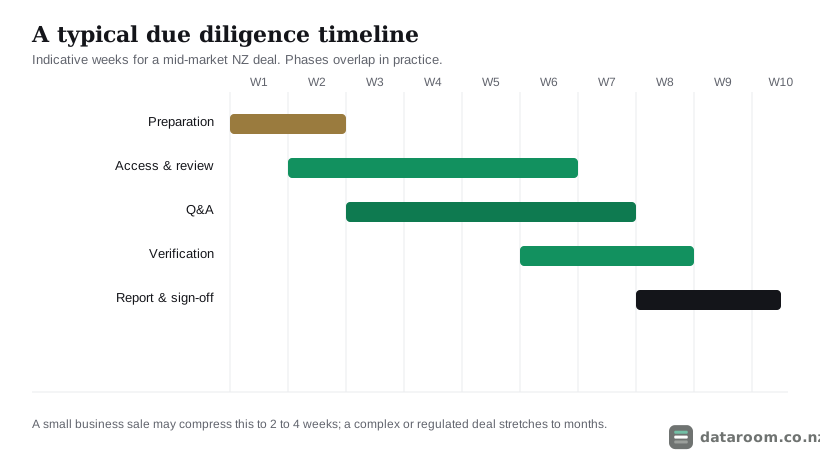
On a typical six-week SME trade sale the rhythm is easy to picture. Week one is access and orientation, weeks two and three carry the heaviest review and the bulk of the Q&A, week four is verification and the first draft findings, and weeks five and six are the negotiation of price, warranties and conditions off the back of whatever surfaced. The point of seeing the shape laid out is that the phases overlap on purpose, which is why a room with good access analytics earns its keep: the seller can watch what the buyer has opened and get ahead of the next question instead of waiting to be asked. Collapse the middle by having the room ready before access is granted, and the entire shape slides left, sometimes by a fortnight or more.
Compare data rooms built to move a deal quickly
See charging models, security and NZ-hours support for every provider we track, side by side.
What speeds a deal up, and what drags it out?
The gap between a two-week and a two-month due diligence is rarely luck, it is a short list of factors that either compress the timeline or stretch it, and you can score your own deal against them before you open the room. The matrix below sorts the common ones into the two columns, and it is worth being honest about where your deal actually sits rather than where you would like it to sit. If most of your answers land in the “no” column, budget for the top of every range above, or better, spend a day now fixing what you can, because a missing lease found today saves a stalled week of review later.
| Factor | Shortens the timeline? |
|---|---|
| Data room populated before buyers are invited | ✓ |
| Clear folder structure and document index | ✓ |
| Structured Q&A workflow with owners and due dates | ✓ |
| Clean, up-to-date company and title records | ✓ |
| A single, motivated buyer rather than an auction | ✓ |
| Documents assembled after the deal has started | ✗ |
| Missing consents, leases or board minutes | ✗ |
| Overseas Investment Office consent required | ✗ |
| Commerce Commission clearance required | ✗ |
| Unresolved litigation, tax or employment issues | ✗ |
One caution on the workstreams themselves, because the parts that overrun are rarely the ones people fear. Financial and legal review are laborious but predictable, and they almost never blow a timeline on their own; deals overrun on a single unresolved thread instead, typically an open Inland Revenue position, a Holidays Act remediation liability, or a key contract that turns out to be terminable on a change of control. Since the workstreams all run in parallel, the fix is never to work faster on the easy ones, it is to surface the hard one early, which is exactly what a mock review is designed to do. On the IT stream in particular, a target that already meets recognised security standards clears the cyber check faster, and our guide to VDR security for an NZ deal covers what a buyer expects to see there.
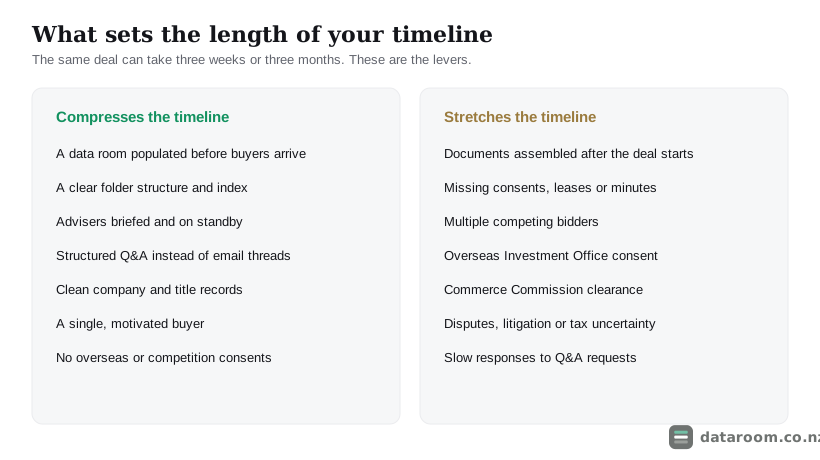
The room itself does more of this heavy lifting than any other single tool, because it sets the pace of the entire review. A deal run out of email attachments and a shared drive leaks time everywhere, to version confusion, to no record of who has seen what, and to questions asked, answered, then asked again a fortnight later. Three room features reliably reverse that: bulk upload and auto-indexing get documents in fast and findable so the review starts on time; structured Q&A keeps every question owned, tracked and answered once; and access analytics let the seller pre-empt the next request instead of reacting to it. A team that tries to save money with a consumer file-sharing tool usually spends the saving straight back in delay and rework, which is the pattern our comparison of a data room versus Dropbox walks through in detail.
Why do NZ deals run on their own clocks?
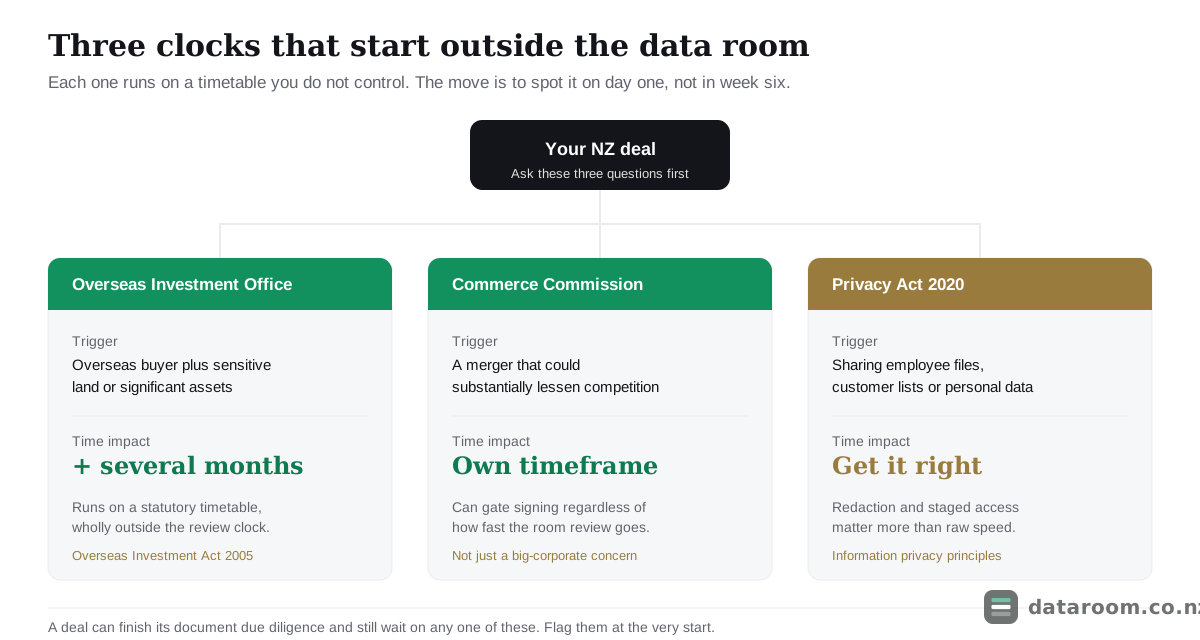
Some of the longest delays in a New Zealand deal have nothing to do with the documents and everything to do with regulators, and each of these runs on a timetable you simply do not control. The rule for all three is identical: identify it on day one, not in week six, so the separate clock starts as early as possible and runs alongside the review rather than after it. The first is Overseas Investment Office consent, which applies when the buyer is an overseas person and the target includes sensitive land or significant business assets, and it sits under the regime in the Overseas Investment Act 2005. It runs on its own statutory timetable, can add several months, and sits entirely outside the review clock, so a deal can finish its document due diligence and still be waiting on consent.
The second is Commerce Commission clearance, which the parties may seek where a merger could substantially lessen competition, and it has its own timeframe that can gate signing regardless of how fast the room review goes. This is not only a big-corporate concern, and that is the part people miss; a regional operator buying its nearest rival, say two civil-contracting firms in the same catchment, can trip the competition test even at modest deal values. The third is the Privacy Act 2020, because sharing employee files, customer lists or other personal information triggers obligations whose information privacy principles are set out by the Office of the Privacy Commissioner; here the goal is getting it right rather than getting it fast, and our Privacy Act 2020 guide explains what a seller must do before personal data goes into a room.
Land, title and people supply the rest of the New Zealand-specific delays. Deals involving land turn on LIM reports, resource consents, easements and the state of the title, and a single unconsented building work or an unresolved covenant can hold a deal open for weeks; our guide to property syndication data rooms covers the disclosure side of that. Employment matters, litigation, tax positions and shareholder disagreements are the classic time sinks, and none of them are really about the documents at all. They are about resolving genuine uncertainty between two parties, and that takes exactly as long as it takes, which is why the disciplined move is to get them onto the table in week one rather than letting them ambush the deal in week five.
How do you shorten your due diligence timeline?
You cannot control the buyer’s caution or the regulator’s calendar, but you can control your own readiness, and that is where nearly all of the avoidable weeks live. The five steps below are the ones that reliably compress a New Zealand timeline, and the order matters, because each one removes a category of delay that the next step would otherwise inherit. Work through them before you invite a single reviewer, not after, because every one of these is far cheaper to do calmly now than under deal pressure later. Done well, this preparation is worth more than any negotiating tactic, since a buyer who finds a clean, complete, well-run room reads it as a signal the business itself is well run, and that confidence shows up in the price as surely as it does in the calendar.
Five steps to a faster due diligence
Preparation is the only lever that reliably compresses the timeline. Pull it before the buyer arrives, not after.
- 1
Build the data room before you go to market
Assemble and upload the full document set in advance, indexed and structured, so the review can start the day access is granted rather than a fortnight later.
- 2
Run a mock due diligence on yourself
Work through a due diligence checklist as if you were the buyer. The gaps you find now are the questions that would otherwise stall the deal in week four.
- 3
Clean up your records first
Confirm the Companies Office register is current, titles are clear, leases are signed and board minutes are complete. Fixing a missing consent takes days now and weeks under deal pressure.
- 4
Set up structured Q&A with owners and deadlines
Decide who answers which category of question and commit to a turnaround, so queries resolve in days. Slow answers are the most common self-inflicted delay.
- 5
Brief your advisers and flag consents early
Get your lawyer and accountant on standby and identify any Overseas Investment Office or Commerce Commission steps at the outset, so those clocks start as early as possible.
Setting a room up for the first time is where sellers lose the most time to false starts, so it is worth borrowing a proven sequence rather than inventing your own. The order in how to set up a virtual data room and the folder structure template will spare you the most common ones, and both are built around the same idea that runs through this whole guide: the review can only move as fast as the room lets it. A room that is complete on the day access is granted, indexed so a reviewer can find anything in seconds, and wired for structured Q&A is not a nicety, it is the mechanism by which a six-week review becomes a three-week one, and it is the one part of the timeline that is entirely yours to build before the buyer ever logs in.
See pricing for a straightforward NZ deal room
A flat monthly plan and a 14-day free trial, so you can run a real pilot before the deal starts.
What does the clock cost, and what should you tell a buyer?
Time is not the only meter running during due diligence, and understanding the money helps you make the case for preparation to anyone who is tempted to skip it. The direct costs are advisory fees, which scale with duration, and the data room subscription for the period the room is open. Advisory fees are the big line by a wide margin: legal and accounting due diligence on a mid-market New Zealand deal can run well into five figures, and a broker or corporate adviser typically works to a success fee plus a monthly retainer, so every week the review drags the retainer keeps ticking while the success fee stays fixed, and that asymmetry is exactly why advisers, not just sellers, want a fast and clean process. It is also worth budgeting for the second-order costs that a slow review quietly generates, because they rarely appear on any quote. Management time is the obvious one, as the owner and finance lead who should be running the business end up answering queries instead, and on a founder-led company that distraction can dent the very trading performance the buyer is underwriting. Warranty and indemnity insurance, increasingly common on mid-market deals, adds a further short clock and its own premium, since the insurer runs an independent review before it will bind cover, and a thin or disorganised room slows that review just as it slows the buyer’s.
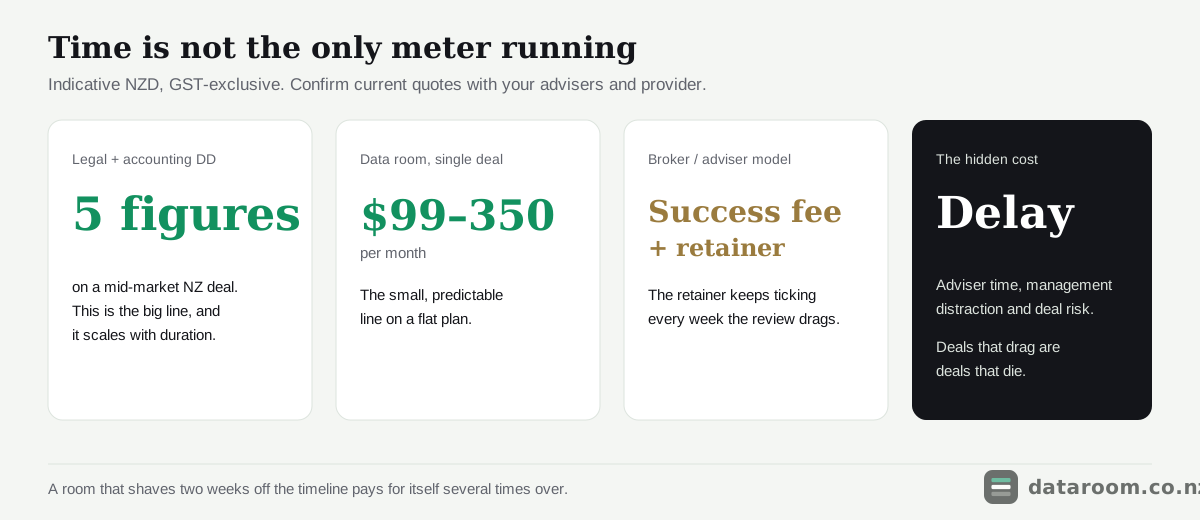
The room itself is the small, predictable line against all of that. A flat monthly plan for a single deal is typically indicative NZD $99 to $350 a month, GST-exclusive, and you should confirm the current quote with the provider, as our pricing guide sets out in full. The larger, hidden cost is delay itself, because every extra week a deal stays open is a week of adviser time, management distraction and deal risk, and deals that drag are deals that die. Viewed that way, a room that shaves two weeks off the timeline pays for itself several times over, which is the argument our is it worth it guide makes for small deals in particular.
All of which shapes what you should tell a buyer about timing, which is to set expectations early and in writing. A short due diligence period in the sale agreement concentrates minds, but it only works if the room is ready to support it, and promising a four-week window on an empty data room just guarantees an extension request in week three. The professional move is to open with a realistic timeframe drawn from the ranges above, backed by a room that actually makes it achievable. One last distinction worth holding: a capital raise is usually faster than a trade sale, because a seed or Series A runs on a tighter, more standardised document set that investors already know how to read, whereas a trade sale acquires the whole entity and puts every workstream and every warranty under a full look, sometimes with warranty and indemnity insurance adding its own short review clock on top. For a plain-English orientation on the sale itself the government’s guidance on selling a business is sensible, and our own selling a business in New Zealand guide covers the data room side end to end.
Due diligence timing FAQ
How long does due diligence take in New Zealand?
For a small business sale, typically two to six weeks once the data room is open. Mid-market M&A usually runs four to twelve weeks, and large or regulated deals take three to six months or more. The biggest variable is how ready the seller's documents are on day one; regulatory consents such as Overseas Investment Office approval sit outside that clock and can add months.
Why do some deals take so much longer than others?
Almost always because of readiness and complexity, not size. A seller who populates the data room and cleans up their records before going to market can halve the elapsed time. Deals stretch when documents are assembled on the fly, when consents or leases are missing, when several bidders compete, or when regulatory clearance is required.
Does a virtual data room actually make due diligence faster?
Yes, materially. Bulk upload and indexing let the review start on time, a structured Q&A workflow resolves questions in days instead of weeks, and access analytics let the seller anticipate the next request. A deal run out of email attachments leaks time to version confusion and repeated questions.
How long does Overseas Investment Office consent add?
It runs on its own statutory timetable and commonly adds several months for deals that need it, entirely separate from the document review. If an overseas buyer and sensitive assets are involved, flag it at the very start so the process begins as early as possible. The rules sit in the Overseas Investment Act 2005.
Can I speed up due diligence as a seller?
Yes, and it is the one lever fully in your control. Build the data room before you go to market, run a mock due diligence on yourself to find the gaps, confirm your Companies Office records and titles are current, and set up structured Q&A with owners and deadlines. Preparation is worth more weeks than any negotiating tactic.
How long should the due diligence period in the sale agreement be?
Match it to the deal type and, crucially, to how ready your room is. A tight four-week period concentrates minds but only works on a fully populated room; promising it on an empty data room just forces an extension. Use the indicative ranges above as your starting point and negotiate from there.