

Running data room Q&A without losing control
Data room Q&A is the controlled written channel inside your virtual data room where invited bidders ask questions about the disclosed documents and your side answers them, in the room and on the record.
Unpack that and the whole discipline falls out of three words.
Controlled. One route in, one approver before anything publishes.
Written. Typed into the room, so it can be searched, categorised and reconciled.
On the record. Timestamped and attributed, so nine months later you can prove what was asked, answered, and when.
Strip out any one and you no longer have Q&A. You have a comment box, or an inbox, and both lose deals.
What does the Q&A module actually do?
It runs the live conversation around static documents. That conversation, not the documents, is where control is won or lost.
A buyer’s lawyer reads a lease, spots a missing landlord consent, and asks. An accountant queries a one-off in the March accounts. A technical adviser wants the source of a revenue figure. Each question is small. Each is a chance to leak, to contradict an earlier answer, or to waive privilege by accident.
The module’s quiet work is the part email never does. It groups related questions, so you see that three bidders all circled the same clause. It shows status at a glance. It stops a question dropping through a crack because the owner was on leave.
Above all, it forces one path. Every question walks the same five stages, from a one-line clarification to a deal-critical query.
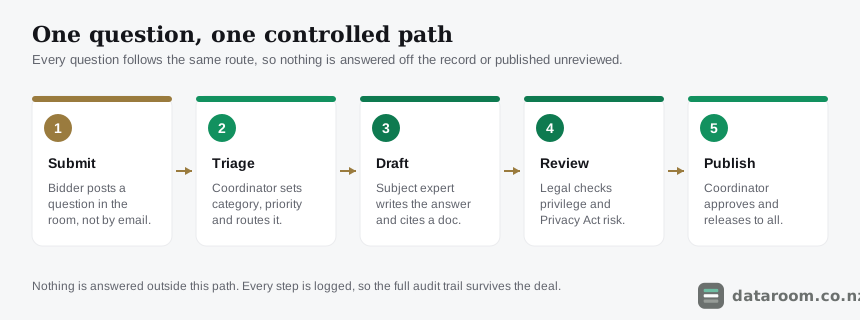
No arrow skips a stage. A question cannot jump from bidder to published answer, and it cannot loop back through a side channel. That single track is what keeps a Bay of Plenty kiwifruit syndication, with a hundred prospective investors, from becoming a hundred private conversations.
One channel that catches people out is the management meeting. Bidders on a mid-market sale expect a session with the vendor or the CFO, and questions get asked out loud across the table. Every one of those answers is disclosure too. The discipline is simple: whoever attends takes notes, and any substantive answer given verbally is written back into the room afterwards, so the record stays complete. The same goes for a site visit to a Waikato factory or a Central Otago vineyard. If it was answered off the record, it did not happen, and that cuts both ways.
Why does the thread decide the deal, not the documents?
Because the Q&A record is the disclosure record. That is the whole reason it matters.
Most New Zealand sales run on a warranty and disclosure model. The seller warrants a set of statements, and the buyer’s remedy for a broken warranty is a claim after completion. What the buyer was told in due diligence shapes that claim directly.
Disclose a problem clearly in a Q&A answer and the buyer usually cannot later say they were misled. Bury it in half-answers and off-record calls and the disclosure is contestable. A contestable disclosure is worth real money to the other side.
The thread also sets the tempo.
Bidders read your responsiveness as a signal for the whole transaction. A desk that turns questions around cleanly builds confidence. A thread that goes quiet for a week invites price chipping. In a competitive process, silence is never read as care. It is read as trouble.
Consider a Nelson aquaculture business on the market for about $8 million. Three trade buyers, marine farming consents that matter enormously, and a seller who answered the first few questions personally to be helpful. By week two the buyers held three slightly different versions of the consent position. The deal held, but the price did not, because inconsistency reads as risk.
The fastest way to lose a deal in Q&A is to be helpful. A director who answers a bidder directly at 11pm has just created a disclosure with no review, no log, and no consistency.
So the thread is not admin. It is the paper trail that decides who wears a problem that surfaces after the deal is done.
Who owns each part of the Q&A desk?
The single most common failure is that everyone owns Q&A, which means no one does.
Fix it by naming four roles before you invite a single bidder. On a small deal one person can wear two hats, but the roles stay distinct, and each has one thing it must never do.
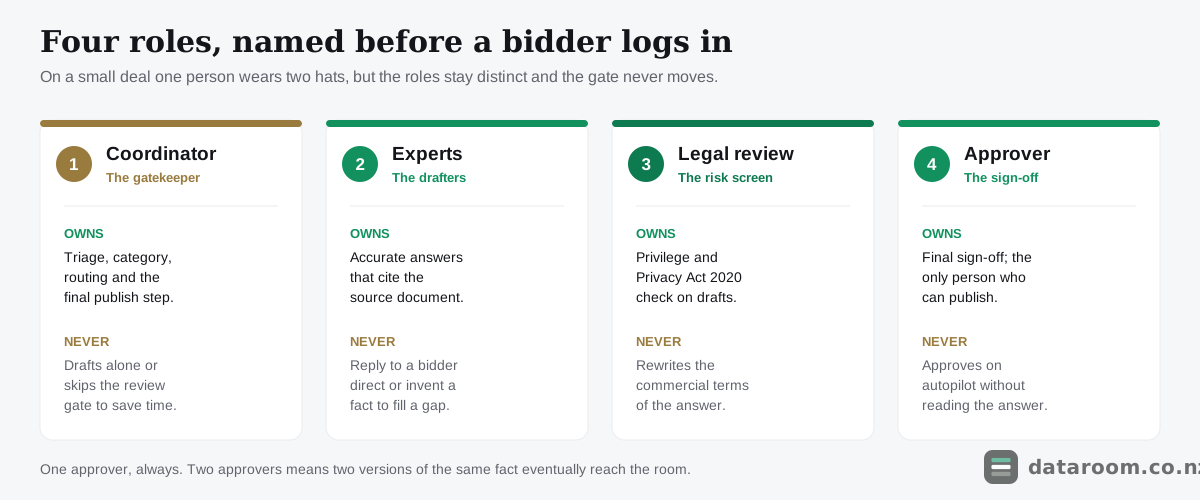
The coordinator is your gatekeeper, usually the corporate adviser or lead deal manager. Their real job is to say no. When a bidder emails a director directly, the rule is that the question does not exist until it is back in the room.
The experts are your drafters: the CFO, the HR lead, the operations manager, the external accountant. Each owns a category and cites the source document. An expert on a Christchurch civil contracting sale answers “the plant register is in folder 4.3, updated to 30 June”, not a value reconstructed from memory.
The legal reviewer screens drafts for privilege, Privacy Act exposure and warranty risk. Their lane is risk, not deal terms.
The approver gives final sign-off and is the only person who can publish. One approver, always. Two approvers means two people will eventually publish two versions of the same fact.
On a sub-$3 million sale this can collapse to two people: an adviser who coordinates and reviews for risk, and the owner who drafts and approves. That is fine, as long as one principle survives: a bidder never gets an answer that no one checked.
What response times should you actually commit to?
Speed is a control mechanism, not a courtesy.
When answers are predictably quick, bidders stop chasing, stop escalating, and stop reading a slow reply as a hidden problem. Set the service levels before the room opens, publish them in the guidance note, and treat them as a commitment.
| Priority | Typical question | Target response | Escalation if breached |
|---|---|---|---|
| Standard | Clarify a figure, locate a document | 2 business days | Coordinator reassigns the expert |
| High | Missing consent, material contract term | 1 business day | Flagged to the approver |
| Urgent | Deal-critical or condition-blocking | Same day, by agreement | Adviser calls a working session |
| Bulk / late-stage | Confirmatory diligence batch | 3 to 5 business days | Batch window scheduled in advance |
Two business days as a standard is realistic for most New Zealand mid-market transactions. It gives an expert time to check the source document rather than answer from memory. The exact number matters less than the fact that it exists and is met. An SLA you routinely miss is worse than none, because it trains bidders to mark everything urgent.
Write the SLA in business days, not calendar days, and say so in the guidance note. A question filed at 5pm on the Thursday before a long weekend should not be quietly counted as breached on the Tuesday. Watch the NZ calendar too: Christmas through late January is thin, regional anniversary days move by province, and a bidder’s overseas adviser may be working a timezone that turns your “same day” into their tomorrow. None of this is an excuse to go slow. It is a reason to agree the clock, in writing, before the first question lands.
The other planning input is volume, and volume tracks the calendar.
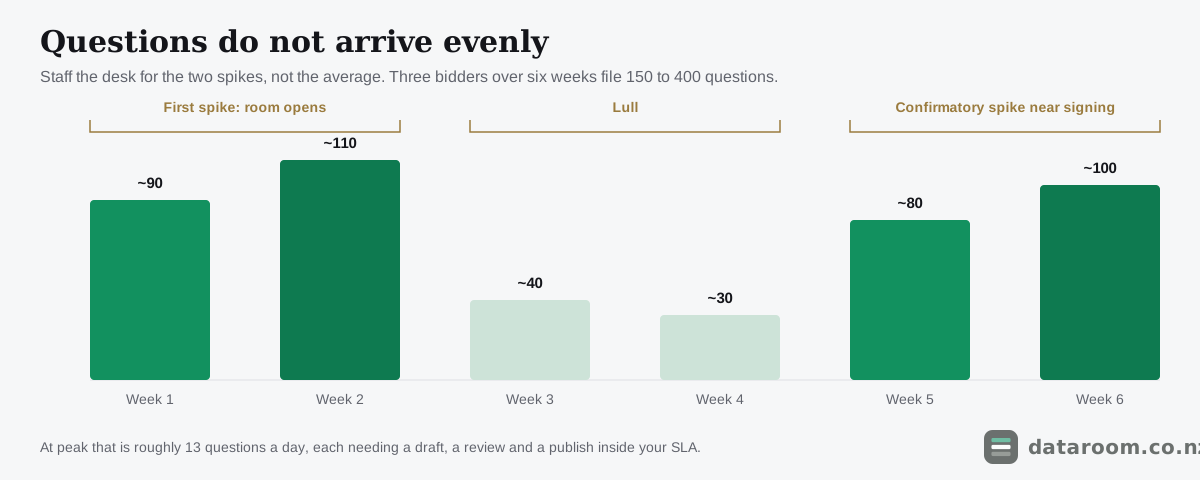
On a competitive mid-market sale, three bidders over six weeks commonly generate 150 to 400 questions. A single serious buyer on a bilateral deal might file 40 to 80.
Do the arithmetic before the room opens. Four hundred questions across six weeks is roughly 13 a day at peak, each needing a draft, a review and a publish. If your standard SLA is two business days, the desk must clear more than it receives, or the backlog compounds and every answer slips.
That is why the escalation column exists. When an expert is buried, the coordinator reassigns rather than letting the queue rot. Our guide to how long due diligence takes in New Zealand maps these phases, so you staff the desk when the questions actually arrive.
What can you never paste into an answer?
Three risks sit inside almost every Q&A thread. Each shares a feature: the damage is invisible when you hit publish and only shows up later, when it is expensive to undo. That is exactly why the review gate is not optional.
Confidential legal advice. Legal professional privilege in New Zealand sits under the Evidence Act 2006. Quote or summarise your lawyer’s confidential advice in a published answer and you may waive privilege over it, so a bidder or future litigant can demand the underlying advice. The fix is procedural: legal-flavoured questions route through the reviewer, and answers describe facts, not the advice about them. When in doubt, the answer is “the relevant documents are in folder 6”.
Personal information. Under the Privacy Act 2020 you need a proper basis to disclose personal information, and disclosure to a prospective buyer is not an automatic exemption. Redact identifiers. Disclose roles and ranges, not individuals: “the senior engineer is on a total package in the $140k to $160k band”, never a named employee’s exact salary. The Office of the Privacy Commissioner publishes guidance on sharing information in a business sale, and our walkthrough of your Privacy Act 2020 obligations in a deal covers the disclosure tests in full.
System and security detail. A stray answer that names a production system, an IP range or a credential is a security leak as much as a privacy one. General guidance from CERT NZ on protecting sensitive business information is a sensible reference for the review step.
There is a fourth trap that is not about law at all: over-answering. A one-line question does not need a three-paragraph essay volunteering information no one asked for. Answer the question, cite the document, stop. Every extra sentence is disclosure you did not have to make.
Which platforms give you real Q&A control?
Not every tool called a data room has real Q&A. Some offer only a comment thread on a file, which is the opposite of control: no routing, no roles, no review gate.
When you compare providers, this is the capability set that separates a document store from a deal room.
| Q&A capability | File share (Dropbox / Drive) | Lean deal room | Enterprise VDR |
|---|---|---|---|
| Dedicated Q&A module, not file comments | ✗ | ✓ | ✓ |
| Question categories and routing | ✗ | ✓ | ✓ |
| Roles: drafter, reviewer, approver | ✗ | ✓ | ✓ |
| Review gate before an answer publishes | ✗ | ✓ | ✓ |
| Priority levels and SLA tracking | ✗ | ✗ | ✓ |
| Bulk import and export of the Q&A log | ✗ | ✗ | ✓ |
| Full timestamped audit trail | ✗ | ✓ | ✓ |
| Per-bidder answer visibility control | ✗ | ✗ | ✓ |
The two “no” rows on the file-share column are the whole argument. As virtual data room vs Google Drive sets out, a consumer tool has no concept of a reviewed, routed, audited answer.
A lean deal room covers the essentials for a small transaction. SLA tracking and per-bidder visibility are where the enterprise tier earns its price, and whether you need them is a function of deal size, not prestige. A Wellington SaaS company running a Series B for a dozen funds rarely needs per-bidder visibility. A competitive trade auction with three rival buyers might.
Per-bidder visibility deserves a warning, because people misuse it. The temptation is to give a favoured buyer a fuller answer. On a contested deal that is how you create the inconsistency a losing bidder later points to. Use it only for genuinely bidder-specific facts. For anything touching a shared fact about the business, publish the same answer to everyone.
Check one detail the matrix cannot: does the export come out clean? Ask a prospective provider to show you a sample Q&A export before you sign. You want one file, every question, every answer, every timestamp, in an order a lawyer can read. Business.govt.nz has plain-English guidance on selling a business that is worth reading alongside the tooling decision.
Compare data rooms on Q&A workflow, not just storage
See which providers offer real question routing, roles and audit logs, side by side, with indicative NZD pricing.
How do you close Q&A out at completion?
Q&A does not just stop. It is disclosed.
The answered threads form part of what the buyer relied on. So at completion you export the entire log, timestamps and all, and keep it with the signed agreement. If a warranty claim ever surfaces, that export is your evidence of exactly what was asked and answered, and when.
Before you close the room, sweep for open threads. Anything still marked new or in review is a loose end that can undermine a disclosure position. Resolve or formally park each one.
Keep the export somewhere durable, not just in the platform. Rooms get decommissioned, subscriptions lapse, and a login can vanish a year after completion. The disclosure record needs to outlive the tool.
One last habit. When the deal closes, spend ten minutes reading the thread as a whole. It is the single best record of what worried buyers about your business, and on the next deal, the one where you are the buyer, it tells you which questions to ask first.
For the failures either side of the desk, our ten data room mistakes that slow down NZ deals piece is the companion read, and a clean due diligence checklist up front is what turns most questions into a folder reference rather than a fresh drafting job.
See pricing for a room with real Q&A built in
A flat monthly plan with question routing, roles and a full audit log, plus a 14-day free trial.
Data room Q&A FAQ
What is data room Q&A?
It is the structured module inside a virtual data room where invited parties submit written questions during due diligence and your side answers them under a controlled workflow. Each question is categorised, assigned an owner, reviewed and logged, so the whole exchange forms an auditable disclosure record rather than a scatter of emails.
Who should manage data room Q&A?
Appoint a coordinator or gatekeeper, usually your corporate adviser or lead deal manager, who triages and routes every question, plus subject-matter experts who draft answers, a legal reviewer, and one approver who alone publishes. On a small NZ deal one person can cover two roles, but the gatekeeper role should never be skipped.
How fast should you answer questions in a data room?
Set service levels by priority and publish them. Two business days is a realistic standard target for a New Zealand mid-market deal, with one business day for high-priority items and same-day by agreement for anything deal-critical. Meeting the target you set matters more than the exact number.
Can a Q&A answer waive legal privilege?
Yes. Legal professional privilege in New Zealand sits under the Evidence Act 2006, and if confidential legal advice is quoted or summarised in a published answer you may waive privilege over it. The other side can then seek the underlying advice. Route legal-flavoured questions through your reviewer and answer with facts and document references rather than a summary of counsel's advice.
Do Privacy Act 2020 rules apply to data room answers?
They do. An answer that discloses personal information about staff or customers must have a proper basis under the Privacy Act 2020, and disclosure to a prospective buyer is not automatically exempt. Redact identifiers, disclose roles or ranges instead of individuals, and check the Office of the Privacy Commissioner's guidance on business sales.
Should the same answer go to every bidder?
In a competitive process, share material answers with all bidders to keep disclosure fair and consistent, and decide that policy before the room opens. Enterprise platforms let you control per-bidder visibility for genuinely bidder-specific queries, but inconsistent answers on shared facts are a credibility risk you should avoid.