
Best Data Room for Technology, media & telecom in New Zealand (2026)
Compare the best virtual data rooms for technology, media and telecom deals in New Zealand (2026). ARR, source-code and IP diligence, indicative NZD pricing.
Best data rooms for Technology, media & telecom in New Zealand
Our shortlist for this use case, ranked after review. Independent, with indicative NZD pricing. Compare them all in the full table.
- 1
The modern data room. Live in minutes on a 14-day free trial.
Visit site SponsoredView profile - 2
Fast setup, granular permissions, 24/7 support.
- 3
Dropbox-owned document sharing with best-in-class view analytics, ideal for pitch decks and light diligence.
- 4

Built in Australasia; AI deal tools, strong local support.
Picture a Christchurch fleet-telematics company. Call it Fernway: forty staff, a product half the courier fleets in the South Island quietly run on, ARR just over the magic three million mark.
An ASX-listed strategic they had met at a logistics expo sent a warm email in autumn. By the following Friday the acquirer’s corp-dev lead had returned a diligence request list nine pages long.
Fernway had never once thought of itself as a stack of documents. Suddenly that is exactly what it was.
Every contractor who had touched the codebase. Every reseller agreement signed in a hurry. Every SIM-and-data reseller contract with the mobile carrier. Every line of an ARR bridge the accountant kept in a spreadsheet only she understood. All of it was about to be read by people paid to find the crack.
This guide is what a technology, media or telecom seller in New Zealand needs before that Tuesday email arrives, and where these deals quietly go wrong.
Why does a TMT buyer reprice your ARR before they meet you?
Software buyers do not pay for revenue. They pay for revenue they believe will still be there next year.
So the first thing a corp-dev team does inside your room is stress-test the quality of your recurring revenue. Every question they cannot answer from a document becomes a discount on the multiple.
They are rebuilding your ARR from first principles, not taking your deck on trust. The number in the pitch and the number the room can defend are treated very differently.
When those two numbers disagree, the buyer does not split the difference. They assume the lower one and widen the gap for the risk you made them carry.
The maths is unforgiving. On a business valued at a five-times ARR multiple, an ARR figure the room can only half-defend does not cost you half a turn. It costs you the multiple as well, because a buyer who cannot trust the top line discounts the confidence in everything below it.
A worked example. If Fernway argued NZD $3.2M of ARR but the room could only reconcile $2.9M invoice by invoice, that $300k gap is not a $300k adjustment.
At five times, it is a $1.5M swing in enterprise value. Add whatever extra caution the buyer prices in for having been made to find the gap themselves.
The rooms that hold their valuation are the ones where a stranger can reconstruct ARR without a single call.
What does an ARR bridge that survives diligence actually contain?
A buyer’s model walks from last year’s ARR to this year’s, step by step, and checks that your files can walk the same path. The figure below is the shape they expect.
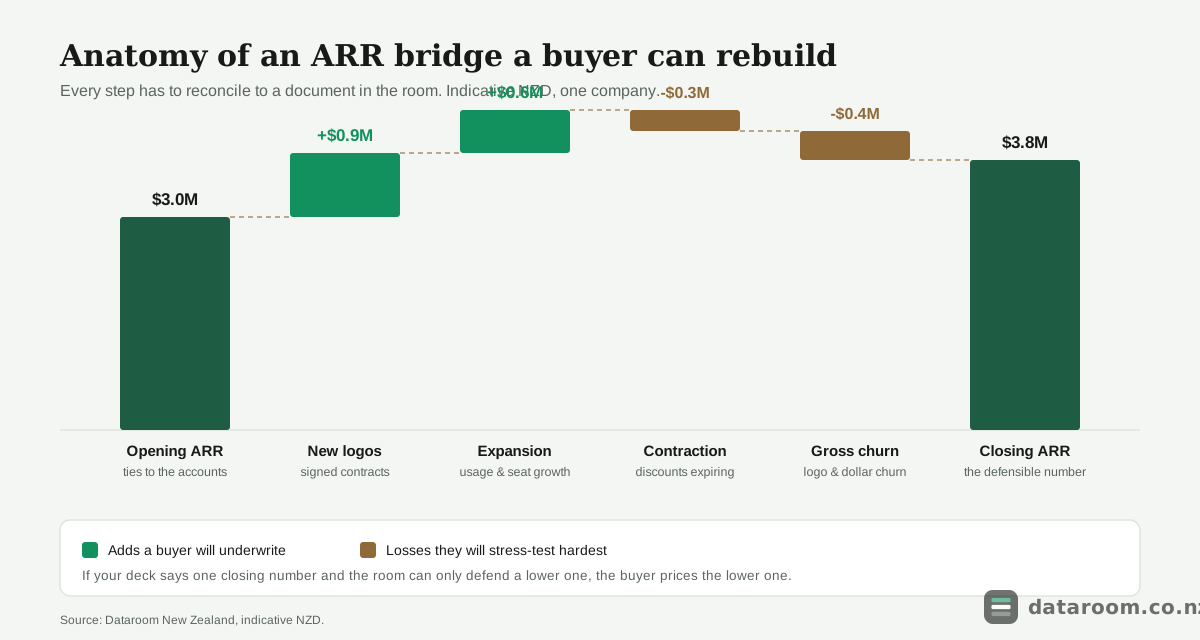
The monthly bridge
Give them a contracted ARR schedule that ties, invoice by invoice, to your accounting system and to the signed contracts sitting in the same room.
Then the movement, month by month for at least twenty-four months:
- New logos, each traceable to a signed contract.
- Expansion and contraction, split so seat growth is not hiding a price cut.
- Gross and net churn, logo and dollar, on a definition that does not change between tabs.
Surface the messy edges honestly. Annual prepaids versus monthly. Discounts that expire. The three customers who make up forty percent of the book.
The cohort file
When a specialist acquirer asks for raw cohort and usage data, they are not being tidy. They are running their own retention model against yours.
Give them a clean analytical layer, not a data dump. Monthly retention by signup vintage, expansion versus contraction, usage by feature or seat, and a definition of every metric so “active” means the same thing everywhere.
Two numbers in this file get stared at hardest:
- Net revenue retention. A figure comfortably above 100% tells a buyer the base grows even if you never sign another logo.
- Logo concentration. A book where three or four customers carry forty percent of ARR is one churn event from a hole.
Do not hide the concentration. Name it, show the contract terms behind each anchor customer, and let the room prove those relationships are sticky rather than lucky.
A room that offers structured, well-defined data reads as a company that treats data as an asset. That is exactly the impression a technology buyer is paying to confirm.
Can you actually prove you own the code you are selling?
Here is the question that ends more software deals than any pricing dispute: who owns the intellectual property?
In a New Zealand SaaS business the honest first answer is often “mostly us, and we think the rest.” And “we think” is not a state a buyer’s lawyer will underwrite.
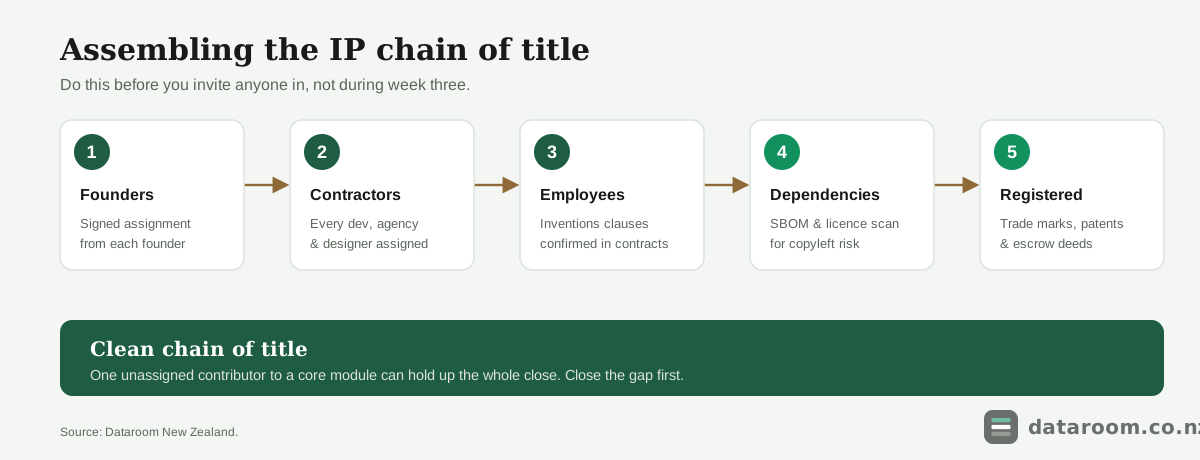
Contractors, and why New Zealand law is the trap
New Zealand law does not automatically vest a contractor’s work in the company the way it broadly does for employees.
So every developer, designer and agency who touched the product needs a signed IP assignment sitting in the room.
A single unassigned contributor to a core module can hold up a whole close. Track them down and get the assignment before diligence, not during it.
Open source and the SBOM
Buyers now expect a software bill of materials and a licence scan.
A copyleft licence buried deep in your stack can carry disclosure obligations the acquirer will not accept, and they will assume the worst until the scan proves otherwise.
Assemble the whole chain before you invite anyone in:
- Assignments from every founder and contractor.
- Confirmed employee invention clauses.
- The dependency manifest with its licences.
- Trade mark and patent filings.
- Any escrow deeds.
Our due diligence checklist for New Zealand walks the wider pack.
How does source-code escrow work, and who really needs it?
Source-code escrow is a three-way arrangement. You lodge a current copy of the code and build instructions with an independent agent, and a customer can only ever get it out if a defined release event happens, such as you going insolvent or stopping support.
Enterprise and government customers frequently hold these rights already. Those agreements, and any change-of-control clauses they trigger, belong in the room from day one rather than surfacing in week three.
In practice a New Zealand deal usually runs escrow through a specialist agent. The deed is not expensive relative to the transaction: budget low thousands of NZD a year for the arrangement, with deposit verification extra.
The cost that matters is not the fee. It is the deal time lost if a buyer learns, late, that a major customer can pull your source on a change of control and nobody had read the clause.
Keep the deed current. An escrow deposit that is two years and a dozen releases out of date reassures no one, and a buyer will treat a stale deposit as no escrow at all.
Not every deal needs escrow. The triggers below are the ones that mean a buyer, or an existing customer, will expect it.
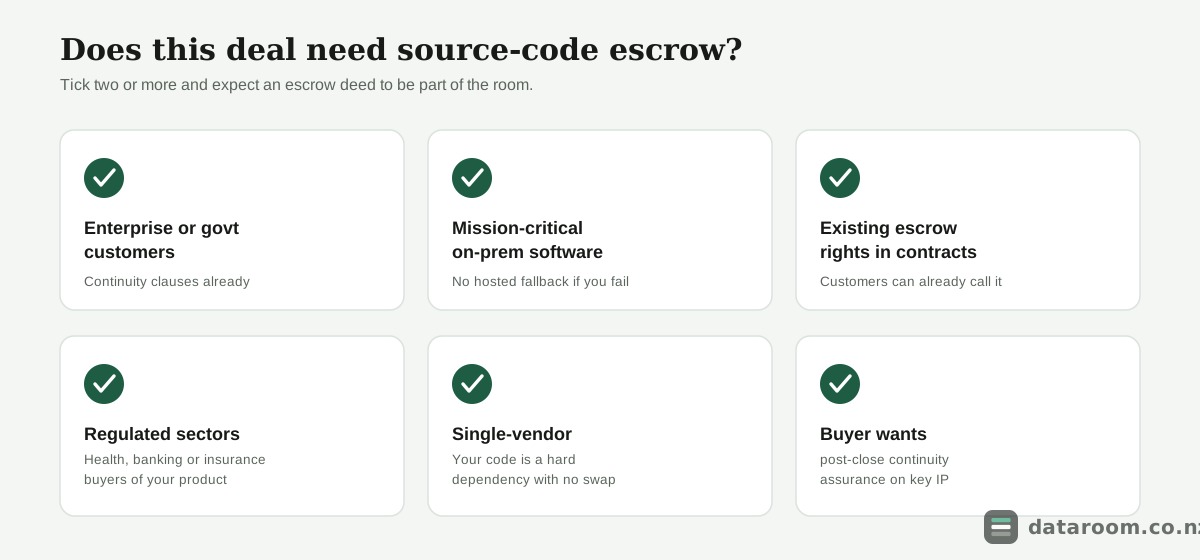
If two or more of those apply, put the escrow position in the room early. A buyer who discovers an unmanaged escrow right late reads it as a surprise, and surprises reprice deals.
In a technology deal the ownership file is the one that decides whether there is a deal at all. Everything else negotiates the price.
What is your data-processing posture under the Privacy Act 2020?
Every technology business is a data business. In a TMT deal the acquirer is buying your data posture along with your product.
Under the Privacy Act 2020 you stay accountable for the personal information you hold, including when it moves offshore to a cloud region or a sub-processor. A buyer’s counsel will test exactly that chain.
They will want:
- A current data-flow map showing where customer information lives and which regions process it.
- A sub-processor register with the contractual terms that let information cross a border.
- Your breach history and the notification calls you made under the Act’s mandatory reporting regime.
- Evidence that your own vendors, the data room included, meet a defensible security bar.
Offshore hosting is the question that catches New Zealand SaaS sellers most often. Running on a Sydney cloud region is entirely normal, but the Act still holds you accountable, so the room must show the contractual terms under which that information moves offshore.
Breach history is the other live wire. Under the Act you must notify the Commissioner and affected people of a privacy breach that has caused, or is likely to cause, serious harm. A buyer will ask what you have reported, and a clean, documented history reads far better than a suspiciously empty one.
This is why an open shared drive is a poor answer in a technology deal. You cannot produce an access log, you cannot gate the granular files, and you raise your own Privacy Act exposure by losing track of who saw what. A data room versus Dropbox comparison spells out the gap.
The Office of the Privacy Commissioner expects reasonable security safeguards over the personal information you hold, and CERT NZ sets out the baseline controls a buyer will expect you to meet. Access control and logging belong in that picture as everyday hygiene, not premium extras.
Which documents belong in each TMT workstream?
TMT deals are five diligence streams running at once. The fastest way to lose momentum is to make each specialist hunt across folders for their own lane.
Structure the room the way the buyer’s team is organised, and hand each specialist their workstream on arrival.
| Workstream | Core documents the buyer expects | Where NZ deals stall |
|---|---|---|
| Commercial & revenue | ARR schedule, signed contracts, churn and NRR series, pipeline, discount policy | ARR that will not reconcile; a handful of logos carrying the book |
| Technology & IP | Architecture map, source-code ownership, contractor assignments, dependency and licence scan, escrow deeds | Unassigned contractor code; copyleft licences in the core stack |
| Data & privacy | Data-flow map, sub-processor list, Privacy Act posture, breach history, security certifications | Personal information offshore with no documented basis |
| People | Key-employee agreements, restraints, ESOP and option grants, contractor register | Founder-critical knowledge with no handover plan |
| Media & telco assets | Content and rights licences, spectrum or infrastructure agreements, carriage and interconnect contracts | Rights that do not transfer on change of control |
The technology and data rows are where software deals are won or lost, so they earn the most preparation. The bottom row only applies if you hold media rights or telco assets, but when it applies it dominates. Our folder structure template shows how to lay this out cleanly.
What changes when the asset is media rights or telco spectrum?
Software companies sell code and contracts. Media and telecom businesses sell rights and regulated assets, and that shifts the whole centre of gravity of the room.
Here the question is rarely “do you own it.” It is almost always “does it transfer, and on what terms.”
Media rights
For media, value sits in content and distribution rights, and the room has to prove the chain: who granted each right, for which territories and windows, for how long, and whether a change of control lets the counterparty walk or reprice.
A catalogue that looks valuable can hollow out the moment a key licence turns out to be non-transferable. The scope of what a copyright licence actually covers is set by the Copyright Act 1994, and a buyer reads every grant against it.
Windows and exclusivity matter as much as ownership. A streaming right that is exclusive in New Zealand for two more years is a very different asset from one that lapses next quarter, or that a rights holder can claw back on sale.
Lay the rights out as a schedule, one line per grant:
- Counterparty and territory.
- Window and exclusivity.
- Renewal terms.
- The change-of-control position on that line.
Telco spectrum and infrastructure
For telecom, the assets are spectrum, network infrastructure, interconnect and carriage agreements, and layered regulatory approvals.
Spectrum management rights and licences are granted under the Radiocommunications Act 1989, and several may need consent to assign. A buyer needs every licence, lease, co-location and interconnection agreement, plus a clear read on which approvals survive the transaction and which must be re-applied for.
Spectrum is a registered, dated asset with a term, so treat it like one in the room. Show the register position, the expiry, any renewal or auction exposure, and whether the transfer needs the regulator’s sign-off before it binds.
There is a competition dimension too. A telco or infrastructure transaction of any size can attract Commerce Commission interest, and a buyer will want to see that the deal does not carry an approval risk you have not flagged. Surface it early rather than letting their counsel discover it.
The matrix below shows which proof signals are core to each sub-sector, so you can see where to spend your preparation.
| Proof the room must carry | SaaS | Media | Telco |
|---|---|---|---|
| ARR bridge tied to the accounts | ✓ | ✗ | ✓ |
| Contractor IP assignments & SBOM | ✓ | ✓ | ✗ |
| Rights transfer on change of control | ✗ | ✓ | ✓ |
| Regulatory approval to assign | ✗ | ✗ | ✓ |
| Privacy Act data-flow map | ✓ | ✓ | ✓ |
| Source-code escrow position | ✓ | ✗ | ✗ |
Stage the rights schedules and network agreements behind tight permissions. They are among the most commercially sensitive documents you will ever share, and they should never sit in a wide group.
How do you stage a room so your leverage survives?
The instinct is to open everything at once to look transparent. That is how sellers leak their most sensitive data to bidders who never make an offer.
Stage access so the most sensitive files open last, to the fewest people.
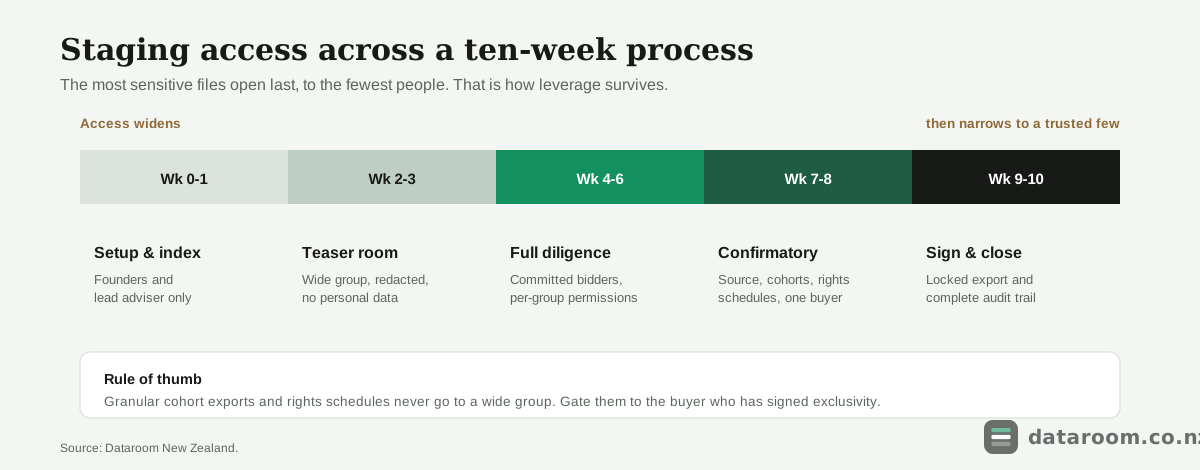
Stage the room in five moves
Open the safe material wide and early; hold the crown jewels for the buyer who has committed.
- 1
Index before you invite
Build the folder tree and load documents with only founders and your lead adviser inside. A room that looks half-built on day one costs you credibility you cannot get back.
- 2
Open a redacted teaser
Give a wide group the safe layer: overview, anonymised metrics, high-level contracts. Strip personal information and pricing that a competitor could use against you.
- 3
Gate full diligence per group
For committed bidders, open the workstream folders with per-group permissions so each specialist sees their lane and nothing else.
- 4
Hold confirmatory files for one buyer
Source code review, granular cohort exports and rights schedules go to the buyer in exclusivity, watermarked, and only then.
- 5
Export a clean record at close
Lock the room, export the full audit trail, and keep it. That evidentiary record is worth more the day a dispute surfaces than it ever felt during the deal.
What should a TMT data room cost in New Zealand?
Founders overestimate this, usually because they have heard enterprise M&A horror stories. A technology deal room does not need per-page pricing, and most vendors run a trial so you can stand up a real room before committing.
The figures below are indicative NZD to frame the conversation, not quotes.
| Deal shape | Indicative NZD/mo | What you are paying for |
|---|---|---|
| Early conversation, testing interest | 0 | A trial room, enough to share with a first acquirer |
| Small SaaS sale, single buyer | ~$200 to $500 | Watermarking, per-group permissions, a clean audit trail |
| Competitive process, several bidders | ~$500 to $1,200 | Structured Q&A, engagement analytics, tighter access control |
| Media or telco asset deal | ~$1,200+ | Deal-native tooling, heavy permissioning, support for regulated assets |
Get a written quote for your actual user count and storage, and read the storage cap and overage rate under the headline number. Most figures are quoted GST-exclusive, so add 15% for cash-flow planning.
The pricing page tracks current indicative NZD figures across providers, and the comparison table lets you line the shortlist up against the workstreams above.
Compare data rooms for a technology deal
See indicative NZD pricing, charging models and trials for every provider we track, in one table.
How is a TMT sale different from a straight startup raise?
A raise rewards speed and a headline story. A sale is exhaustive and adversarial.
In a raise, investors want to believe you. In a sale, specialists are paid to find the reason not to, across five parallel workstreams picking at ownership, data and rights at once.
That difference changes the room. A raise room can be lean and analytics-led. A sale room has to be defensible, staged and evidence-heavy, because every claim in it will be tested against a document.
If you are earlier in your journey, the startup fundraising guide covers the raise, and the mergers and acquisitions guide covers the full sale process from both sides.
TMT deal questions founders keep asking
An acquirer wants our raw event data before signing anything. Do we hand it over?
Not in full, and not early. Share a defined analytical layer, aggregated cohort and usage files with clear metric definitions, to a wide group, and gate the granular, personal-information-heavy exports behind per-group permissions for the committed buyer only. That protects your customers' privacy and your leverage at once.
One of our early developers was a contractor and we never got a signed assignment. How bad is that?
Common, and fixable, but fix it before diligence. In New Zealand a contractor's work does not automatically vest in the company, so an unassigned contributor to core code is a genuine hold-up. Track them down, get a signed assignment, and put it in the IP folder before you open the room.
Do we really need source-code escrow?
Only if the triggers apply: enterprise or government customers, mission-critical on-premise software, existing escrow rights in your contracts, regulated-sector buyers, or a hard single-vendor dependency. If two or more fit, expect an escrow deed and put your position in the room early so it is never a surprise.
Is a shared Google Drive really a problem for a software deal?
Yes, more than in other sectors. You lose the access log and granular permissions a technology buyer expects to see as part of your data posture, and you increase your own Privacy Act exposure. For the trade-offs, see virtual data room versus Google Drive.
What breaks a media or telco deal that would not break a SaaS one?
Transferability. Software ownership is mostly a question of assignment; media and telco value turns on whether a key right or licence survives a change of control, and whether a regulator or counterparty must consent to the assignment. Prove the transfer path in the room, not just the ownership.
Explore other use cases
A data room fits more than one kind of deal. See our other New Zealand guides.
Consumer & retail
How a virtual data room fits consumer & retail deals in New Zealand.
See the guideDue diligence
How a virtual data room fits due diligence deals in New Zealand.
See the guideFinancial institutions
How a virtual data room fits financial institutions deals in New Zealand.
See the guideHealthcare & life sciences
How a virtual data room fits healthcare & life sciences deals in New Zealand.
See the guideIndustrials
How a virtual data room fits industrials deals in New Zealand.
See the guideM&A
How a virtual data room fits m&a deals in New Zealand.
See the guideOil & gas
How a virtual data room fits oil & gas deals in New Zealand.
See the guideRenewable energy
How a virtual data room fits renewable energy deals in New Zealand.
See the guideReal estate
How a virtual data room fits real estate deals in New Zealand.
See the guideStartup fundraising
How a virtual data room fits startup fundraising deals in New Zealand.
See the guide