
Best Data Room for Renewable energy in New Zealand (2026)
Compare the best virtual data rooms for renewable energy projects in New Zealand (2026): solar, wind, hydro and geothermal, from consent to financial close.
Best data rooms for Renewable energy in New Zealand
Our shortlist for this use case, ranked after review. Independent, with indicative NZD pricing. Compare them all in the full table.
- 1
The modern data room. Live in minutes on a 14-day free trial.
Visit site SponsoredView profile - 2

Built in Australasia; AI deal tools, strong local support.
- 3

The original VDR, built for large, complex financial transactions.
- 4
Fast setup, granular permissions, 24/7 support.
What does getting a New Zealand renewable project to financial close cost and take?
Financial close is the moment every workstream has to line up in one reviewable place at once. The numbers behind it explain why a data room earns its keep. A grid-scale project is a multi-year, multi-million-dollar exercise long before a lender signs anything, and the spend differs sharply by technology.
The table below sets out indicative figures: capital cost per megawatt, the rough timeline to close, and where the paper risk sits. Read it as orientation rather than a quote, and treat the capex as installed-cost ranges a real feasibility study will sharpen. The figures reflect the current renewable build-out that MBIE tracks.
| Technology | Indicative capex (NZD/MW) | Development to close | Where the paper risk sits |
|---|---|---|---|
| Utility-scale solar | ~$1.2m to $1.6m | ~2 to 4 years | Consent conditions, land leases, grid connection |
| Onshore wind | ~$2.5m to $3.5m | ~4 to 7 years | Noise and landscape consents, appeals, turbine supply |
| Small hydro | ~$4m to $8m | ~4 to 8 years | Water-take and diversion consents, iwi interests |
| Geothermal | ~$4m to $6m | ~5 to 8 years | Resource consents, resource risk, iwi and land |
Two things fall out of those numbers.
- Development spend on a grid-scale project routinely passes NZD $4 million before a bank will lend, most of it sunk into consenting, land, grid studies and the model. Every dollar is documented somewhere a diligence team will read.
- The timelines are long enough that the evidence pack is never assembled in one sprint. It accretes over years, so a room that grew alongside the project is far cleaner than one thrown together before close.
When the lender’s technical, legal and insurance advisers finally sit down, they are not reviewing a project so much as a filing cabinet, and every gap in it is priced as risk. The rest of this guide covers how you hold that cabinet together and where New Zealand’s specifics decide whether the deal closes on time.
Which workstreams does one room have to hold at the same time?
What makes energy projects harder than a standard company sale is parallelism. In an M&A deal you broadly show one business; in project finance you show six or seven separate workstreams that all have to be current on the same day, each with its own advisers picking at it.
A missing variation to a consent condition stalls the legal opinion; an unsigned interconnection agreement stalls the technical adviser, and neither waits for the other. So the room has to be structured by workstream from day one, because a “Contracts” folder and a “Reports” folder are the wrong shape for how advisers actually work.
| Workstream | What the room must hold | Who reviews it |
|---|---|---|
| Consenting & environment | Resource consents and all conditions, notification decisions, the AEE, ecology and noise reports, compliance evidence | Lender's legal and environmental advisers, council |
| Land & property | Leases or purchase agreements, easements, LINZ title searches, encumbrances, OIO consent if relevant | Land counsel, lender's legal adviser |
| Iwi & community | Engagement records, cultural impact assessments, mana whenua correspondence, any benefit-sharing agreement | Legal adviser, ESG and reputational review |
| Grid & connection | Transpower or lines-company agreement, connection studies, EA registration, metering and dispatch setup | Technical adviser, lender |
| Offtake & revenue | The power purchase agreement, certificate arrangements, hedge or CfD terms, merchant revenue assumptions | Financial adviser, lender credit |
| Construction & technical | EPC contract, panel or turbine supply, O&M contract, independent engineer's report, warranties | Independent engineer, technical adviser |
| Finance & insurance | Financial model with sensitivities, tax structuring, insurance placement, the security package | Lender, model auditor, insurance adviser |
Each workstream has a different reviewer, which is why granular per-group permissions matter far more here than in a simple sale. Your grid engineer does not need the land leases, and your land counsel does not need the turbine warranties, so the room should land each adviser in their own workstream and nowhere else.
The diagram below shows the shape that follows: the bankable financial model at the centre, with the six workstreams orbiting it as spokes, because every one of them exists to make a single set of numbers defensible.
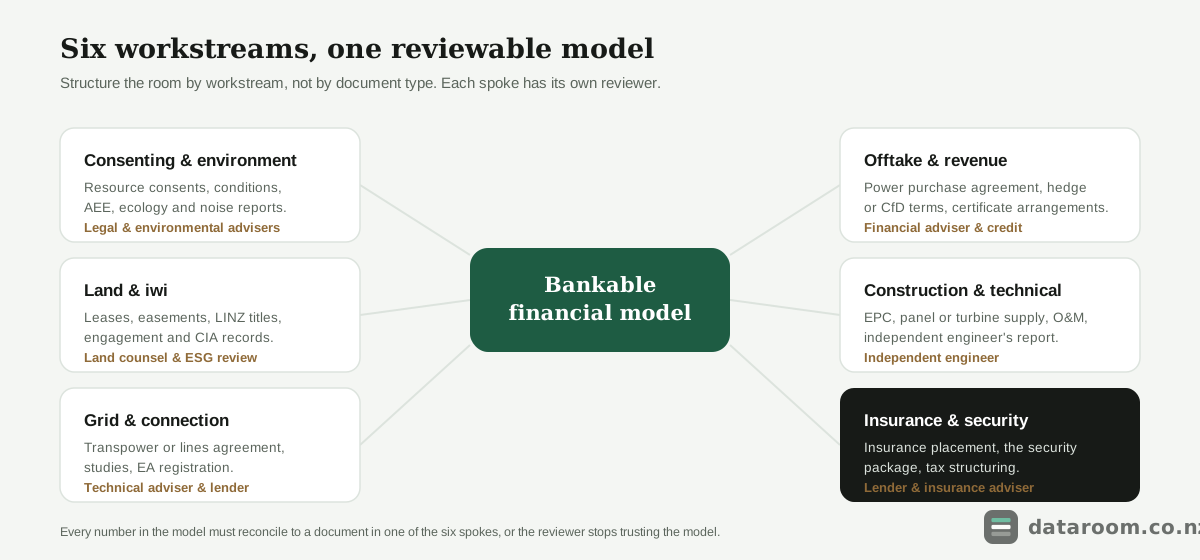
That central image is worth holding onto. The consenting folder proves the project is allowed to exist, the land folder proves it can sit where it sits, the grid folder proves it can deliver its output, and the offtake folder proves that output turns into cash.
If any of those numbers fails to reconcile with the model at the centre, the reviewer stops trusting the model. Once that trust goes, the whole financing slows while everyone re-checks everything.
How do resource consents under the RMA actually get diligenced?
Consenting is where New Zealand renewable deals most often lose time, because a resource consent is not a single yes. It is a grant with conditions, and those conditions carry obligations that run for the life of the project.
A lender does not just want to see the consent; they want every condition to have an owner, a compliance method, and evidence you are meeting it. The failure mode is treating the consent as a trophy and dropping the PDF in a folder. For each consent, the reviewer needs:
- the consent itself and the decision that granted it;
- the conditions broken out and tracked, each with a named owner;
- the compliance evidence against every condition;
- any section 127 variation and its own decision, sitting alongside the original rather than quietly replacing it.
If a condition required a management plan certified by council before works start, that certified plan has to be in the room too.
Notified, non-notified, or settled by consent order?
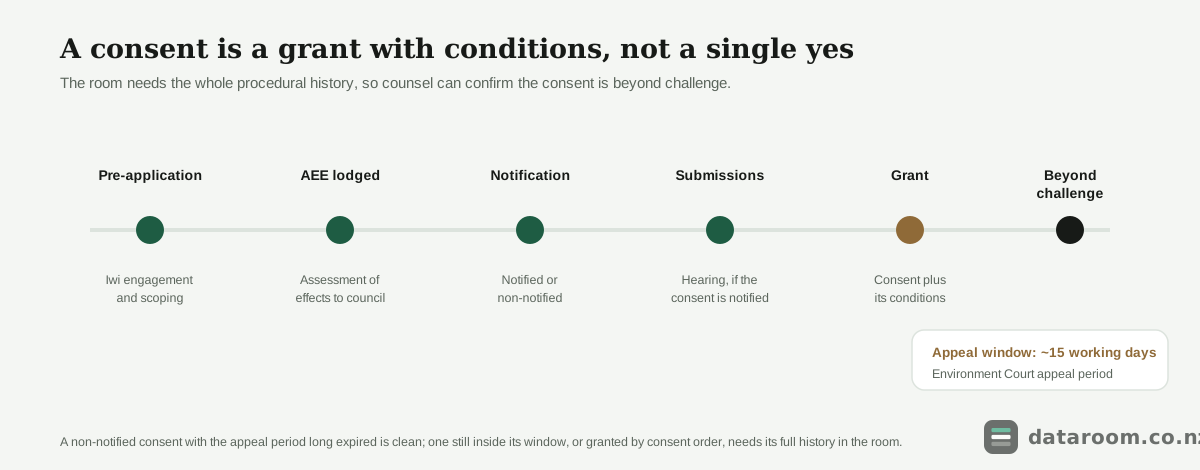
The procedural history of a consent changes its risk profile as much as its conditions do, so the room has to carry that history in full. Whether a consent was publicly notified, limited-notified or non-notified, and whether it was appealed to the Environment Court, all bear on how challengeable it is.
A non-notified consent with the appeal period long expired is clean. One still inside its window, or granted by an Environment Court consent order after mediation, needs its complete procedural record so counsel can confirm it is genuinely beyond challenge. The timeline below traces where that appeal clock sits.
Which regime does your consent sit under?
There is a reform wrinkle a reviewer will want resolved early, because the RMA is mid-transition and renewable projects have travelled several pathways in recent years. Some sit under standard council processing, some came through a fast-track or Ministerial-referral route, and some carry conditions shaped by national policy on renewable generation.
Keep the pathway documents and any referral decision in the room so the reviewer can see which regime your consent belongs to. Nationally significant and fast-track proposals are handled by the Environmental Protection Authority, whose record should sit alongside your council consents.
Why does the PPA sit at the centre of the financing?
Strip a renewable project back to what a lender is really lending against and you reach the revenue contract. Panels and turbines produce electricity; the power purchase agreement turns that electricity into bankable cash flow, and everything upstream exists to make the PPA deliverable.
What does a lender test in the PPA?
It is the most heavily read document in the room, and the one where a single clause can move the whole financing. Reviewers weigh several things at once:
- the term length against the debt tenor;
- the pricing structure, whether fixed, escalating or indexed;
- the volume commitment, and who wears shortfall or curtailment;
- the offtaker’s credit standing;
- the termination and change-in-law provisions.
A corporate PPA with a strong investment-grade offtaker supports more leverage than a shorter deal with a merchant tail. Where part of the revenue is merchant, sold into the spot market rather than contracted, the model’s price-curve assumptions get scrutinised hard. That contract underwrites both the debt and any equity story, so it anchors a capital-raising data room just as firmly as a project-finance one.
Nothing erodes lender confidence faster than a financial model that quotes a tariff the contract in the room does not contain.
Because the PPA drives the model, the two have to be kept tightly cross-referenced, and the version in the room must be the exact one the model was built on. If the PPA is still being negotiated at close, the reviewer needs the current execution draft plus a clear note of the open points, not a superseded draft that flatters the numbers.
Keep the supporting market forecasts in the room wherever a merchant assumption sits in the model, because an unsourced price curve is the fastest way to turn a confident financial adviser into a sceptical one. This is the discipline that most reliably keeps a financing on schedule: one PPA, one model, and a clean line between them any reviewer can trace in a minute.
What do the grid connection and Electricity Authority pieces add?
A renewable project that cannot connect and dispatch is a field of expensive equipment, so the grid workstream is where the project proves it can physically and legally deliver its output. It is reviewed by the technical adviser alongside the lender, and two things have to be evidenced: the connection itself, and the project’s standing in the electricity market.
What must the connection pack prove?
On connection, the room needs:
- the agreement with Transpower for a grid-connected asset, or the local lines company for a distribution-connected one;
- the connection studies showing the project will not destabilise the network;
- the agreed cost allocation for any network upgrades.
Upgrade obligations can carry material cost and timing risk, so a reviewer wants those pinned down rather than left as “under discussion”. The process below shows how those pieces sequence from first enquiry through to energisation.
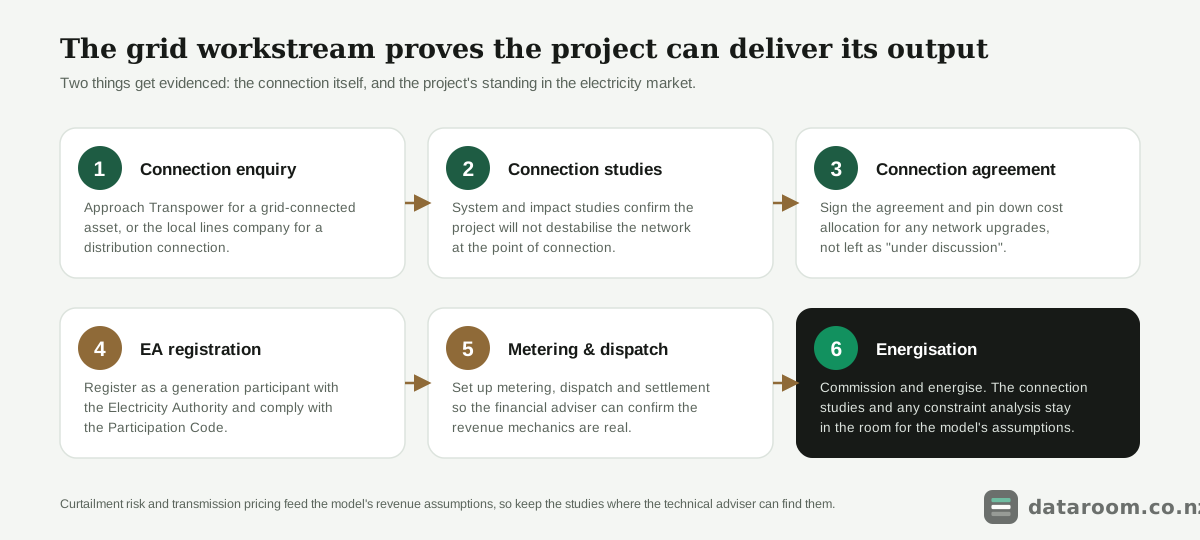
On market standing, generation participants register with the Electricity Authority and operate under the Electricity Industry Participation Code. So the room should carry the registration, the metering arrangements and the dispatch and settlement setup that let the financial adviser confirm the revenue mechanics are real.
New Zealand specifics bite here too. Curtailment risk, how often the project may be constrained off, and transmission pricing under the applicable methodology both feed the model’s output and revenue assumptions. If your project sits in a constrained part of the grid, expect the technical adviser to test those numbers hard, so keep the connection studies and any constraint analysis where they can be found without asking.
How should the land and iwi engagement record be presented?
Land looks simplest and turns out to be the fiddliest workstream in the room. A grid-scale project usually sits across multiple titles under leases or purchase agreements, with easements for access and cabling and sometimes an Overseas Investment Office consent if offshore capital is involved.
The lender’s legal adviser runs LINZ title searches against every parcel and checks three things: that the leases run long enough to cover the debt term and project life, that access and grid-corridor easements are properly granted and registered, and that no encumbrance sits ahead of the lender’s security.
A lease that expires before the loan is repaid, or an access route across land you do not control, is exactly the gap that gets priced or blocks the deal.
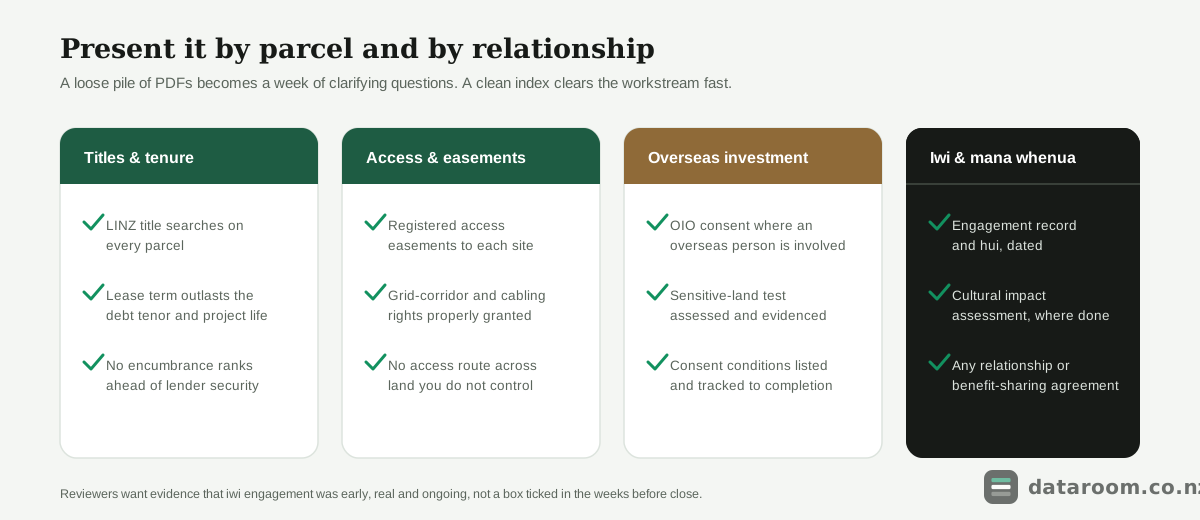
Iwi engagement sits alongside land and carries weight well beyond the legal checklist. Meaningful engagement with mana whenua is both a genuine RMA and Treaty consideration and, increasingly, a lender ESG requirement. So the room should hold the record honestly: correspondence, any cultural impact assessment, records of hui, and any relationship or benefit-sharing agreement reached.
Reviewers are not looking for a box ticked; they want evidence that engagement was early, real and ongoing, because a project that treated it as an afterthought carries reputational and sometimes legal risk a bank will not ignore.
Present both workstreams cleanly, by parcel and by relationship, with a short index tying each document to the title or party it concerns. Then the reviewer can see at a glance that every parcel has a secure interest and every relationship is documented. A loose pile of PDFs, by contrast, becomes a week of clarifying questions the moment the land counsel opens the folder.
What does the data room itself cost in NZD?
Against the total development spend on a grid-scale project, the data room is a rounding error, and getting it wrong costs far more than paying for it. Most vendors run a 14-day free trial, so you can stand a real room up and structure the workstreams before a single adviser is invited.
The figures below are indicative NZD to frame the conversation rather than quotes, and they are usually GST-exclusive. Confirm current pricing with the provider and size the plan against your real user, room and storage counts.
| Project stage | Indicative NZD/mo | Pricing model | What you are paying for |
|---|---|---|---|
| Early development, one small project | ~$200 to $450 | Flat monthly | A room to assemble consenting and land while you build the file |
| Financing a single grid-scale project | ~$600 to $1,200 | Flat or per-room | Granular permissions, Q&A and an audit trail across adviser teams |
| Portfolio or several projects in parallel | ~$1,200 to $2,500+ | Per-room or annual | Multiple rooms, engagement analytics and deal-native tooling |
| Large or contested financing | ~$2,500+ | Annual or enterprise | Dedicated support and structured Q&A for a wide syndicate |
Treat these as a starting point, because vendors change plans and run promotions, and the trap is signing a charging model that suits the vendor rather than the deal. A per-page or per-user meter can outrun a flat monthly rate quickly once a full consent history, connection studies and years of correspondence go in.
On a document-heavy financing a flat figure is usually the safer number to plan around, and the pricing page tracks current indicative figures across providers.
See flat monthly pricing for a project finance room
A predictable per-room rate and a 14-day free trial, with no per-page metering to model across a multi-year development.
Shared drive, standard room, or enterprise platform: which fits?
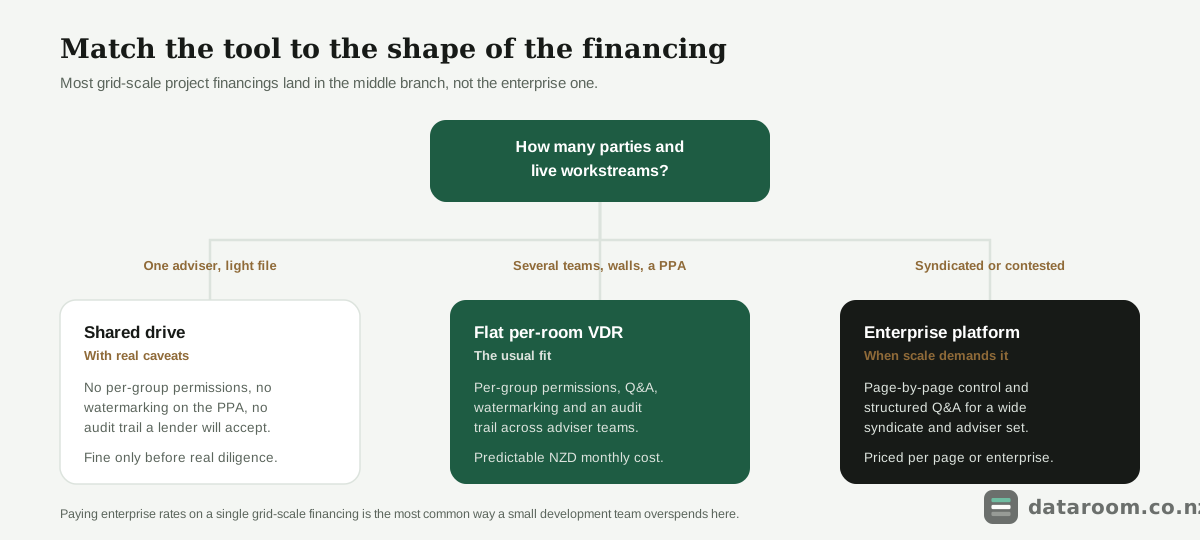
Not every renewable financing needs the same tool, and matching the tool to the shape of the deal saves both money and grief. The decision tree below runs the three realistic choices against the questions that separate them: how many parties and workstreams are live, whether there is a commercially sensitive PPA and set of studies to protect, and whether the financing is a single project or a syndicated affair.
Where a shared drive quietly fails
For a very early single project with one adviser reading a light file, a shared drive can technically hold the documents, and plenty of developers start there. What it cannot do is wall your grid engineer off from your land leases, watermark the PPA, gate a folder behind an NDA, or keep the audit trail a lender’s diligence will expect.
Those four gaps are invisible while the file is small and internal. They turn into real exposure the moment an external adviser is invited in, because a shared link has no memory of who opened what. For anything a lawyer or a lender will review, that is the whole reason to move to a room.
What the tiers give you at each price
The matrix below shows what tends to ship as standard at each tier, and it reads in both directions. Use it to check that a lean plan has not dropped something an adviser will demand on day one, such as per-group permissions or a real audit trail. Use it equally to check that an enterprise tier is not charging you for page-by-page metering a single grid-scale financing will never touch.
Most New Zealand project financings land in the middle column. The enterprise platform earns its per-page meter only when a portfolio or a bank-run syndicate genuinely needs page-level control.
| Capability | Shared drive | Flat per-room VDR | Enterprise platform |
|---|---|---|---|
| Per-workstream permission groups | ✗ | ✓ | ✓ |
| NDA-gated release of sensitive folders | ✗ | ✓ | ✓ |
| Dynamic watermarking on the PPA | ✗ | ✓ | ✓ |
| Full, exportable audit trail | ✗ | ✓ | ✓ |
| Structured Q&A with assignment | ✗ | ✓ | ✓ |
| Version control across a moving deal | ✗ | ✓ | ✓ |
| Per-page metering and redaction suite | ✗ | ✗ | ✓ |
| Dedicated onboarding and account manager | ✗ | ✗ | ✓ |
How do you build a project finance room in the right order?
Sequence matters as much as content. A room built in the wrong order either leaks early or stalls the deal while you retrofit permissions around documents advisers have already downloaded. The steps below put the structure and the walls in before any external party sees anything, so the first thing a lawyer tests, whether the walls hold, is also the first thing you have proven.
Build the room in six steps
Get the workstream structure and the permissions right before any adviser is invited in.
- 1
Lay out the tree by workstream
Mirror the workstream map: consenting, land and iwi, grid, offtake, construction and finance. Decide now which folders open at kickoff and which wait on request.
- 2
Set the permission groups first
Create a group per adviser team, land counsel, grid engineer, ESG reviewer, model auditor, and start each tighter than feels polite. It is easier to open a folder than to recall one.
- 3
Anchor the consent workstream
Load each consent, its decision, its conditions broken out with an owner and compliance evidence, and its full notification and appeal history so counsel can confirm it is beyond challenge.
- 4
Pin the PPA to the model
Put the exact PPA the model is built on in the room, cross-reference every shared number, and note any open points if it is still an execution draft.
- 5
Turn on watermarking and the audit trail
Watermark the PPA pricing and the financial model, and confirm the audit trail is exportable, since it evidences who saw what for both confidentiality and Privacy Act purposes.
- 6
Run a dry pass before you invite anyone
Log in as each adviser group and confirm it sees only its own workstream. Fix any cross-visibility now, because a leak is far cheaper to prevent than to explain.
Where do renewable project rooms usually go wrong?
The recurring problems are less about missing documents than about a room that cannot keep six live workstreams consistent at once. Five traps account for most of the slippage:
- Version drift between model and contracts. The model quotes a PPA tariff, connection cost or consent condition the current document no longer matches. Every number in both has to reconcile, or the reviewer stops trusting the model.
- Consent conditions with no compliance evidence. The consent is present but the conditions are untracked, so what should reassure instead reads as an open liability.
- A stale room during a moving process. Diligence runs for months while the PPA, EPC and connection agreements are finalised, so live versions have to be date-stamped and kept current.
- Flat permissions across specialist advisers. These invite both confusion and leaks, which is why access should be structured by workstream so each reviewer sees only their part.
- A missing audit trail on sensitive terms. You cannot say who saw the PPA pricing or the model, which matters for confidentiality and for your Privacy Act 2020 obligations over the personal information the room holds.
The first two faults come from treating the room as a filing exercise rather than a live reconciliation, and both are cheap to prevent and slow to fix once a reviewer has found them. Our guide to data room security in New Zealand covers the controls that hold across any deal.
Compare project-ready data rooms side by side
See indicative NZD pricing, charging models and trials for every provider we track, in one table.
When in a project should you actually stand the room up?
Earlier than most developers expect, and the reason is cumulative. The moment you are assembling consenting evidence, land agreements and the first connection studies, well before financing, you benefit from a structured room, because that material becomes the spine of the diligence pack later.
A project spends years accreting exactly the documents a lender will one day read. A room that grew alongside it is dramatically cleaner than one improvised in the weeks before close, when the team has the least attention to spare and the most to lose. Standing it up early also forces the disciplines that pay off at close: naming an owner for each consent condition, keeping one canonical PPA, and date-stamping live versions.
There is a longevity point on the other side of close too. A renewable room rarely goes dark the way a business-sale room does, because construction milestones, insurance renewals, refinancings and ongoing lender reporting keep drawing on the same evidence pack for years.
That makes the audit trail worth preserving long after drawdown, since a question about a consent condition or a PPA amendment can surface a decade later. Confirm how your provider prices a mostly quiet room and how exports work before you sign, because the years after close are where a headline rate and the real cost quietly diverge.
Questions renewable developers ask about project data rooms
At what point in a project do I need a proper data room?
Earlier than most developers expect. The moment you are assembling consenting evidence, land agreements and the first connection studies, before financing, a structured room pays off, because that material becomes the spine of the diligence pack later. By the time a lender engages, a room that grew alongside the project is far cleaner than one thrown together in the weeks before close.
How is a renewable project room different from a company sale room?
A company sale broadly shows one business. A renewable project room shows six or seven parallel workstreams, consent, land, iwi, grid, offtake, construction and finance, each reviewed by a different specialist adviser and each needing to be current on the same day. That parallelism is why workstream-based structure and per-group permissions matter more here than in a straight M&A process.
Who gets access, and should they all see the whole room?
No. Give each adviser their workstream and nothing more: the grid engineer to the connection folder, land counsel to the leases and titles, the ESG reviewer to the iwi record. Granular permissions keep the most commercially sensitive terms, above all the PPA pricing and the financial model, in front of only the people who need them, and the audit trail records who saw what.
What single document causes the most delay?
Consenting evidence, closely followed by the PPA. Consents stall deals when conditions are untracked and compliance evidence is missing; the PPA stalls them when the version in the room does not match the model the financing is built on. Getting both airtight before you invite reviewers removes the two most common sources of slippage.
How do consent conditions belong in the room?
Not as a single PDF. Load the consent, the decision that granted it, each condition broken out with an owner and a compliance method, and the evidence you are meeting it, plus any section 127 variation alongside the original. Keep the notification and appeal history too, so counsel can confirm the consent is beyond challenge under the RMA.
Does the Privacy Act 2020 apply to a project data room?
Yes. Your room holds personal information, staff details, landowner and iwi correspondence, adviser contacts, and you remain accountable for it. That is another reason a controlled room with an access log beats an open shared drive where you cannot say who accessed what. A controlled room is how you evidence the reasonable safeguards the Act expects.
Explore other use cases
A data room fits more than one kind of deal. See our other New Zealand guides.
Consumer & retail
How a virtual data room fits consumer & retail deals in New Zealand.
See the guideDue diligence
How a virtual data room fits due diligence deals in New Zealand.
See the guideFinancial institutions
How a virtual data room fits financial institutions deals in New Zealand.
See the guideHealthcare & life sciences
How a virtual data room fits healthcare & life sciences deals in New Zealand.
See the guideIndustrials
How a virtual data room fits industrials deals in New Zealand.
See the guideM&A
How a virtual data room fits m&a deals in New Zealand.
See the guideOil & gas
How a virtual data room fits oil & gas deals in New Zealand.
See the guideReal estate
How a virtual data room fits real estate deals in New Zealand.
See the guideStartup fundraising
How a virtual data room fits startup fundraising deals in New Zealand.
See the guideTechnology, media & telecom
How a virtual data room fits technology, media & telecom deals in New Zealand.
See the guide