

Ansarada vs iDeals: which suits an NZ deal?
Here is the money picture first, before a single sales pitch. The table below sets the indicative NZD starting points, and everything after it explains why the smallest number is rarely the cheapest deal.
| Provider | Indicative from (NZD/mo) | Typical charging model | Trial |
|---|---|---|---|
| Ansarada | ~$430 (on a 12-month term) | Per page or per room, quote-led | 14-day free trial |
| iDeals | ~$900 (indicative) | Per room or per user, quote-led | Demo & trial room |
| Lean flat-rate room (for context) | ~$99 to $300 | Flat per room | Free trial |
The gap in that first column is real, but it is not the story.
Ansarada often looks cheaper at the door because a short-term, per-room quote can start low. Flip to a per-page plan on a document-heavy sale, though, and that ranking can reverse before the second bidder even logs in. New to the concept entirely? Start with our plain-English guide to what a virtual data room is, then come back to weigh these two.
What separates Ansarada from iDeals?
Both platforms are enterprise-grade versions of the same idea: a secure, permissioned online repository where advisers share confidential documents and run due diligence with a full audit trail. On a feature checklist they look almost interchangeable, and that surface similarity is exactly why the choice trips buyers up.
The difference is not what they do. It is where each one’s centre of gravity sits.
Break it into three parts and it gets easier to hold in your head. Ansarada was founded in Sydney and grew up serving the Australasian market, while iDeals is a global operation built for cross-border deals. Ansarada can price per page or per room, whereas iDeals more often anchors on per-room or per-user packages. And on best-fit, Ansarada leans managed and domestic while iDeals leans distributed and international.
Everything else, from certifications to Q&A to watermarking, is broadly a match.
That is the honest headline most comparison pages bury. These are peers on the mechanics, so the decision has to be made on the axes where they actually differ.
What does each one actually cost on an NZ deal?
Neither provider publishes a simple price list, which is normal at this tier and makes an apples-to-apples read genuinely hard.
Your real number moves with four dials: the charging model, the user count, the document volume and the term length. Two of those, the model and the term, do most of the damage. It is the same trap we set out in our guide to virtual data room pricing in New Zealand: the model, not the sticker, sets the bill.
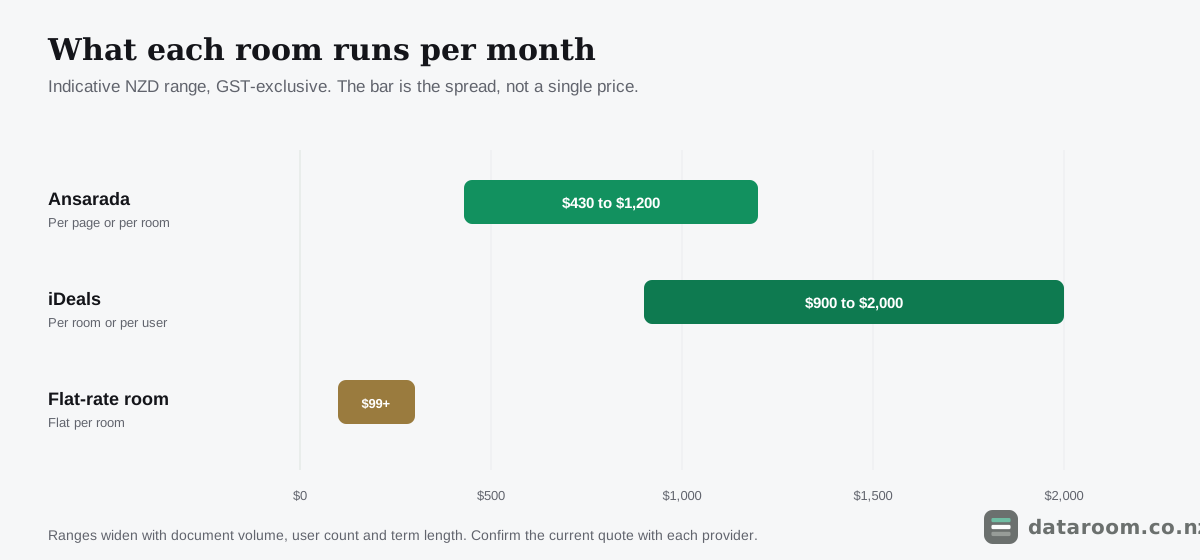
Read the bars as spreads, not prices. The bottom of each range is the demo-day headline; the top is what a busy, document-heavy deal actually lands at once overage and extra seats are counted.
The per-page question
Ansarada’s willingness to price per page is the single most consequential difference for a New Zealand seller. Per-page billing aligns cost to a curated, tightly managed document set, which is elegant for a large, controlled transaction where every page earns its place.
It becomes a liability the moment your deal runs on scanned paper.
Leases, resource consents, historical accounts, employment files: that is precisely what a sub-$5M NZ business sale generates, and it inflates a page count without adding a cent of value to the buyer. The rule is blunt. If you cannot predict your page count inside a wide margin, do not pay by the page.
The per-user question
iDeals more often anchors on per-room or per-user packages, which caps the page-count risk but shifts the exposure to headcount.
A busy diligence week invites a crowd: your team, both sets of advisers and several bidder groups, each wanting its own logins. On a per-user model, every one of those seats is a line item, so look for pooled or capped guest access before you sign.
One more thing that quietly moves the NZD figure is currency and GST. Both vendors typically quote in USD or GST-exclusive terms, so your landed cost is the headline converted at today’s rate, plus 15% GST where the supply is caught by New Zealand rules. A GST-registered business can usually claim that back, but it still moves cash across a deal that might run only nine weeks.
Compare every room side by side
See indicative NZD pricing, charging models and trials for Ansarada, iDeals and the leaner options, in one table.
Where do the two genuinely diverge?
Most of the checklist is a tie, so the matrix below strips out the noise and shows only where the platforms actually part ways or clearly match.
A tick means the capability is a standard, well-developed part of the offer. A cross means it is absent, an add-on, or not a core strength. Verify each row against the plan you are quoted, because tiers move between quotes.
| Capability | Ansarada | iDeals |
|---|---|---|
| ANZ-founded, local time-zone support | ✓ | ✗ |
| 24/7 global support desk | ✓ | ✓ |
| Published self-serve pricing | ✗ | ✗ |
| Per-page pricing option | ✓ | ✗ |
| Flat per-room / per-user options | ✓ | ✓ |
| ISO 27001 certified | ✓ | ✓ |
| SOC 2 reporting | ✓ | ✓ |
| Structured Q&A workflow | ✓ | ✓ |
| Built-in deal / readiness tools | ✓ | ✗ |
| Bulk upload and auto-indexing | ✓ | ✓ |
| Dynamic watermarking and redaction | ✓ | ✓ |
| Choice of hosting region | ✓ | ✓ |
| Free trial or trial room | ✓ | ✓ |
Three rows break the tie, and all three lean Ansarada: local time-zone support, built-in deal-readiness tooling, and a per-page pricing option. That last one is double-edged, not a pure win, as the cost section already showed.
Everything else is a match.
That is the real result of the exercise. On core data-room security and mechanics these two are peers, and the decision lives entirely in pricing, support model and the shape of your deal.
How does each hold up under the Privacy Act 2020?
Both clear the security bar we set in our guide to virtual data room security for a New Zealand deal. Each holds ISO 27001 and provides SOC 2 reporting, the two credentials that carry the most weight in NZ diligence.
A logo, though, is not the same as a current, in-scope report you can request and read.
Our explainer on ISO 27001, SOC 2 and VDR certifications unpacks what each actually proves, and the short version is that you should ask for the certificate and the SOC 2 report that cover the exact product and region hosting your room, not a company-wide claim. Ask when it was last audited, and by whom.
The row worth pressing hardest is hosting region.
Under the Privacy Act 2020, when you load personal information about employees, customers or shareholders into a room, you stay accountable for how it is handled, including when a provider stores it offshore. The Office of the Privacy Commissioner’s guidance on outsourcing personal information to the cloud is the sensible first stop, and it is worth reading before either demo. Ask each vendor which data-centre region hosts your room, and whether an Australian or Singapore region is available if you would rather keep data closer to home. CERT NZ’s guidance for business is a useful checklist for the wider vetting conversation.
What do Ansarada and iDeals look like side by side?
Before you sit through two sales pitches, it helps to fix the platforms in your head as pictures rather than paragraphs.
The two platforms, side by side
-
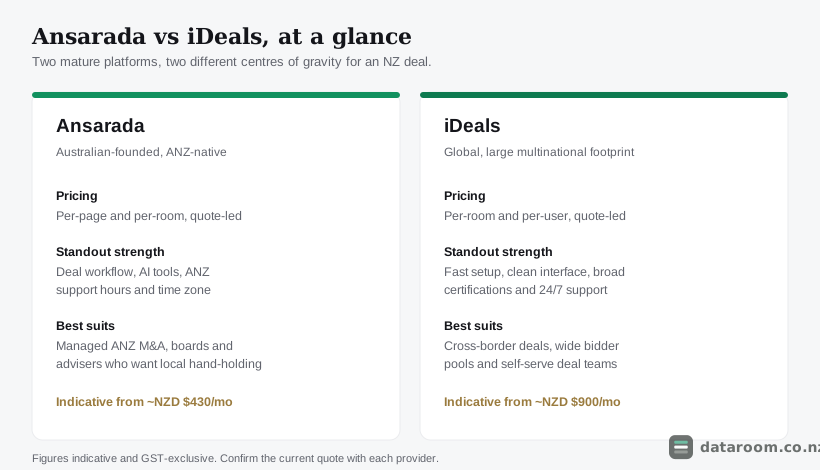
Same enterprise tier, different centre of gravity: Ansarada leans ANZ and managed, iDeals leans global and self-serve.
-
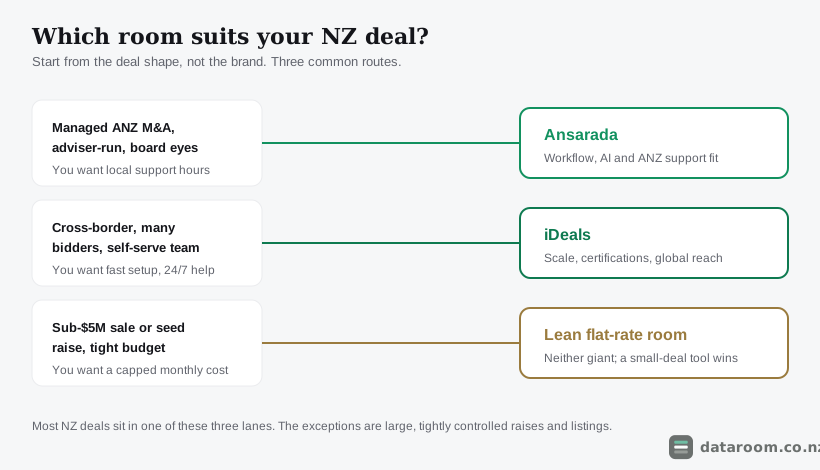
Route from your deal shape to the room. Small NZ deals often belong in neither enterprise lane.
Read the decision map first, because it routes on deal shape rather than brand loyalty.
A managed ANZ merger or acquisition points at Ansarada, whose deal-readiness tooling and local support fit the way domestic advisers actually run a process, and boards here recognise the name. A capital raise or cross-border sale that pulls in offshore institutional money points at iDeals instead, whose scale and 24/7 support suit a wider, more distributed bidder pool. When a room must feel native to a fund in New York and a family office in Auckland at the same time, the global operation earns its keep.
A startup fundraising round points at neither.
A seed or Series A room lives or dies on clean permissions and honest analytics, not per-page metering, and a flat plan under NZD $350 usually does the job with room to spare.
How do you choose between them for your deal?
You can settle this in an afternoon with an honest audit of the deal in front of you. Work the steps below, then bring the answers to both demos, so you compare quotes on the same footing rather than reacting to two different sales scripts.
Choose in six steps
Pin down the drivers of cost and fit first, then let the platform reveal itself rather than choosing on brand.
- 1
Map your bidder geography
List where every likely bidder and adviser sits on a world clock. Mostly ANZ points toward Ansarada's local support; genuinely global points toward the 24/7 iDeals model.
- 2
Estimate page count and users
Rough out total pages and the busiest-week login count. If pages are unpredictable, steer away from a per-page Ansarada plan; if users are, watch iDeals per-user tiers.
- 3
Set your true timeline
Decide how many months the room stays open, then check each minimum term. A nine-week deal should not sign a 12-month lock-in without a clear reason.
- 4
Confirm the security must-haves
Ask each vendor for the current ISO 27001 certificate and SOC 2 report in scope for your room, plus the hosting region, so you can meet your Privacy Act obligations.
- 5
Run a real trial with real documents
Use the free trial or trial room to load a genuine folder set and test permissions and Q&A. A demo shows the happy path; a trial shows the friction.
- 6
Get both quotes itemised in NZD plus GST
Request onboarding, overage and extra-user rates in writing, and compare the all-in landed cost, not the headline. Then sanity-check whether a leaner room would do.
If that audit keeps pointing below the enterprise tier, follow it. Our buyer’s guide to choosing a virtual data room and the ranked best virtual data rooms in New Zealand both cover the full field, so you are not choosing between two brands when a third fits better.
What are the honest trade-offs of each?
No platform is all upside, and pretending otherwise helps nobody who is about to sign a contract.
Ansarada: local fit, per-page risk
The strengths are local fit, deal-readiness features and per-room flexibility. Support overlaps your working day, and the workflow was built around the kind of managed ANZ process most domestic advisers run, which shows in the small details of how a room is set up and handed over.
When a bidder’s lawyer is stuck at 4pm on a Friday in Auckland and the room misbehaves, a support desk on your time zone is the difference between a fixed problem and a lost weekend.
The watch-outs are two. The per-page option can bite a document-heavy seller, and the feature set is rich enough that a small deal ends up paying for tooling it never opens.
iDeals: global reach, higher entry
The strengths are speed of setup, a clean interface reviewers like, and a deep global support and compliance footprint. On a cross-border deal with parties in Singapore, London and San Francisco, the follow-the-sun desk is a genuine advantage rather than a line on a brochure.
The watch-outs are a higher indicative entry point and a first-line contact that may rotate across regions rather than sit in one local ANZ team that knows the New Zealand context.
On a feature checklist these two are near-identical. The choice is really about the pricing model, the support hours and the shape of your deal, so start there and the answer falls out.
Both share the enterprise-tier trade-off: a sales process instead of a price, and a tendency to quote for scale you may not need. For a straightforward NZ deal that is not always worth solving, which is why the alternatives to the big-name rooms deserve a look before you commit.
How long does an NZ deal keep a room open?
Buyers tend to over-estimate this, and it costs them on the contract. Most New Zealand mid-market deals run their active data-room phase in roughly nine weeks, not the twelve months a headline term quietly assumes.
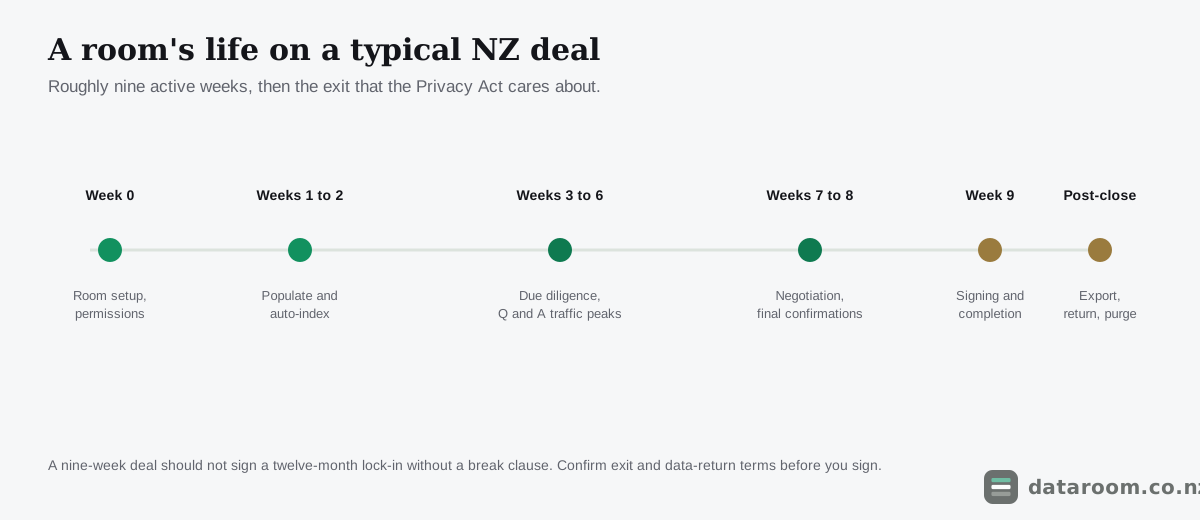
The shape above is typical, not a rule.
Setup and permissions land in week zero, the room is populated and auto-indexed across the first fortnight, and due diligence with its Q&A traffic peaks somewhere in weeks three to six. Negotiation and final confirmations fill weeks seven and eight, signing lands around week nine, and then comes the phase buyers forget: export, data return and purge. That closing phase is where the Privacy Act keeps you accountable long after the deal is done, so it belongs in the contract, not in an afterthought email.
What do the contract and lock-in terms cost you?
The row that surprises first-time buyers is not a feature. It is the contract underneath it.
Enterprise rooms are sold on a term, and the term shapes both the price and your freedom to walk. Ansarada and iDeals each offer short project-length engagements and longer annual commitments, and the headline monthly figure almost always assumes the longer one. A twelve-month term can shave the rate meaningfully, but a New Zealand deal that collapses at week six still owes the balance unless the contract says otherwise.
Read three clauses before you sign either.
- Minimum term and early death. What happens if the deal dies early? Is there a break option, or are you locked to the full year?
- Renewal mechanics. An auto-renew that rolls into a second annual term is a common way a nine-week deal becomes a nineteen-month invoice.
- Exit and data return. How you export the full room and audit trail at close, in what format, and whether the provider purges its copy afterward.
Both vendors will negotiate at this tier, so treat the first quote as an opening position rather than a menu. Ask for a term that matches your realistic timeline, a break clause tied to the deal completing or terminating, and overage rates capped in writing. The government’s plain guide to business contracts and agreements is a sensible refresher before you commit to a multi-year deal priced in USD and converted to NZD.
Which room fits which NZ deal shape?
It helps to map the abstract advice onto the transactions New Zealand businesses actually run. The table below is a rough guide, not a verdict, and any specific need can move you up or down a row.
| Deal shape | Indicative deal size | Room that tends to fit | Indicative NZD/mo |
|---|---|---|---|
| Seed or Series A raise | Under $5M | Lean flat-rate room | ~$99 to $350 |
| Owner-operated business sale | $2M to $10M | Flat-rate or entry Ansarada | ~$200 to $600 |
| Managed ANZ M&A, adviser-run | $10M to $50M | Ansarada | ~$430 to $1,200 |
| Cross-border sale, wide bidder pool | $20M+ | iDeals | ~$900 to $2,000 |
| Broad capital raise or NZX listing | $30M+ | Ansarada or iDeals | Quote-led |
Read the middle rows as the contested ground. A tidy $8M business sale can run happily on a flat-rate room, and only needs an enterprise platform if a demanding buyer or a complex structure forces the issue.
The named industries follow the same logic.
A SaaS or agritech seed round belongs in the lean lane, a professional-services or manufacturing business sale sits in the flat-to-entry band, and it is NZX listings, infrastructure and large primary-sector deals where the enterprise tier genuinely earns its fee. Match the room to the row, then pressure-test the quote.
When is neither Ansarada nor iDeals the right call?
Often, honestly, for the deals most New Zealand businesses actually do.
A sub-$5M business sale, an early-stage raise or a single-property syndication does not need an enterprise platform with a sales process attached. It needs granular permissions, an audit trail, a clean Q&A and a predictable monthly cost, and a flat-rate room delivers all four for a fraction of the price.
The enterprise tier earns its fee on large, controlled, multi-party transactions.
That means a mid-market M&A above roughly $10M, a broad capital raise, or an NZX listing where document control and scale genuinely matter. Below that line, the honest answer is that you are usually paying for capability your deal will never touch. If your situation looks small and domestic, start with the cheapest rooms for NZ small deals and only move up if a specific need pushes you there.
What else do NZ buyers ask before signing?
A few questions come up in almost every one of these decisions, so the answers below cover the ones that do not fit neatly into the sections above.
Ansarada vs iDeals FAQ
Is Ansarada or iDeals better for a New Zealand deal?
It depends on the deal shape. Ansarada, an Australian-founded platform with local time-zone support and deal-readiness tools, tends to suit a managed, adviser-run ANZ transaction. iDeals, a global platform with 24/7 support and broad certifications, tends to suit a cross-border deal with a wide bidder pool. On core security and mechanics they are close peers.
How much do Ansarada and iDeals cost in New Zealand?
Both are quote-led, so there is no simple list price. Indicatively, Ansarada can start around NZD $430 a month on a term and iDeals around NZD $900 a month, but the real figure turns on the pricing model, user count and document volume, and is usually quoted GST-exclusive. Confirm the current quote with each provider.
Does Ansarada or iDeals use per-page pricing?
Ansarada offers a per-page pricing option, which suits large, tightly controlled document sets but can punish a New Zealand seller whose scanned leases and accounts run to hundreds of pages. iDeals more commonly prices per room or per user. If you cannot predict your page count, avoid paying by the page.
Are both platforms secure enough for an NZ transaction?
Yes. Both hold ISO 27001 certification and provide SOC 2 reporting, along with granular permissions, watermarking, two-factor authentication and a full audit trail. For Privacy Act 2020 purposes, ask each vendor which region hosts your data and whether an Australian or nearby region is available. See our security guide for what to demand.
Do I need Ansarada or iDeals for a small NZ deal?
Usually not. A sub-$5M sale, a seed or Series A raise, or a single property syndication is well served by a lean flat-rate room under NZD $350 a month, which still provides permissions, an audit trail and Q&A. The enterprise tier earns its fee on large, controlled transactions above roughly $10M.
Which has better support for a New Zealand user?
For a domestic deal, Ansarada's ANZ-based support overlaps your working day and understands the local context, which reduces friction. For a cross-border deal, iDeals' 24/7 follow-the-sun model covers parties in multiple time zones. Map your bidder list against a world clock before you weight this.
See pricing for a straightforward NZ deal
A flat monthly plan with a 14-day free trial, and no per-page or per-seat metering to model.