
Best Data Room for Financial institutions in New Zealand (2026)
Data rooms for financial institutions in New Zealand (2026): loan-book sales, capital raises, KYC/AML and Privacy Act 2020 disclosure, plus NZD pricing.
Best data rooms for Financial institutions in New Zealand
Our shortlist for this use case, ranked after review. Independent, with indicative NZD pricing. Compare them all in the full table.
- 1
The modern data room. Live in minutes on a 14-day free trial.
Visit site SponsoredView profile - 2
Fast setup, granular permissions, 24/7 support.
- 3
Enterprise M&A standard; deep audit trails.
- 4

Built in Australasia; AI deal tools, strong local support.
A New Zealand loan-book or insurance-portfolio sale rarely turns on the headline discount rate the two sides argue about first. It turns on a handful of numbers buried three folders deep:
- the true arrears bucket on the tail of the book;
- the recovery assumptions behind the collective provision;
- the churn curve on the in-force policies;
- whether the customer files survive a Privacy Act review without a redaction scramble.
A buyer pricing a $60m residential book will move its bid by several percent on arrears data alone. It only trusts that data if it can see the loan-level tape, reconcile it to the audited accounts, and watch the servicing history untouched.
That reconciliation happens in the data room, or it does not happen at all. For a regulated seller the room is the control environment that decides whether diligence holds, and that is what makes it its own category, separate from a trade sale or a startup raise.
What numbers does a financial-institution data room actually turn on?
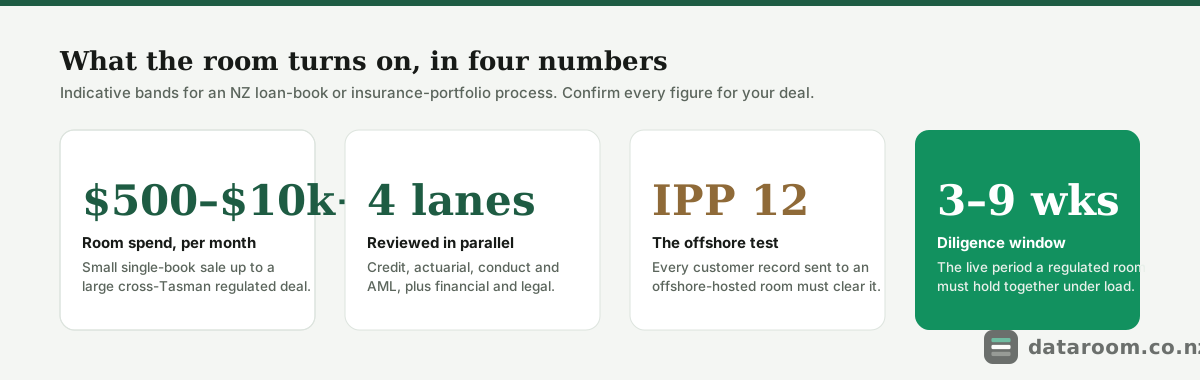
A regulated room is sized by the deal in front of you, not by the brand a bidder mentioned. So it helps to see the shape of the money and the clocks first.
The table below is a reckoner: the bands most NZ banking, insurance and fintech teams should budget against, and the lever underneath each. Read the third column rather than the second.
A $30m book with a competitor bidder and a messy AML history needs more room than a $200m raise between parties who already trust the numbers.
| What you are sizing | Indicative NZ figure | The lever underneath |
|---|---|---|
| Small single-book or portfolio sale (under ~$25m) | ~$500 to $1,500 / mo room | Per-workstream permissions, de-identified tape, full audit export |
| Mid-market bank or insurer deal (~$25m to $250m) | ~$1,500 to $4,000 / mo room | Parallel bidder access, clean-team lanes, routed Q&A |
| Large or cross-Tasman regulated deal (~$250m+) | ~$4,000 to $10,000+ / mo room | Very large data sets, heavy assurance, regulator-facing trail |
| Live diligence window | ~3 to 9 weeks | The period the room carries load; match the contract term to it |
| Regulator change-of-control sign-off | Months, on the regulator's clock | A clean room starts it earlier; it cannot shorten it |
| Arrears and provisioning quality | Can move a bid by several % of book value | Clean, reconciled data is the whole difference |
The reckoner makes one point before the guide begins: the expensive variable is almost never the monthly licence. It is the quality of the data you put behind it, and the discipline with which you stage it.
A room that costs a few thousand dollars can protect a nine-figure decision. A badly run one can quietly cost several points of value on a deal many multiples larger. That asymmetry is why the rest of this guide spends its length on the workflow, not the price list.
What really moves the price of an NZ loan book or insurance portfolio?
Price discovery in a bank or insurer transaction is a data problem before it is a negotiation. The buyer is buying a cash-flow stream with a risk tail, and every assumption about that tail is only as good as the file it can pull to test it.
Deliver the core data sets clean, reconciled and complete, and the buyer prices with confidence. Deliver them late, partial or unreconciled, and the buyer prices the uncertainty, which always favours the buyer.
The second driver, which sellers underrate, is reconciliation itself. A serious acquirer will tie:
- the loan tape back to the general ledger;
- the provision back to the audited financial statements;
- the customer count back to the regulatory returns.
If those numbers do not agree, the seller spends the next fortnight explaining variances instead of holding a price.
On the lending side
For a loan book, three data sets do most of the work:
- the loan-level tape, the spine the buyer models against;
- the arrears and hardship history, where the tail risk lives;
- the provisioning workpapers behind the collective provision.
The tape has to reconcile to the accounts line for line, or the whole valuation takes a haircut for doubt.
The arrears history is where a seller is most tempted to show a flattering snapshot rather than the real curve. A competent buyer spots the difference within a day.
A room that stages the financial workstream so reconciliations land in a logical order, with a clean trail of which version the buyer saw, is doing real commercial work, not just storing files.
On the insurance side
For an insurer, the centre of gravity moves to three sets:
- the in-force policy schedule;
- the claims and reserving triangles;
- the lapse and persistency data.
Here the buy-side reviewer is an actuary, testing whether your reserves will hold and whether the book will persist long enough to earn the price.
Reserving triangles are dense and easy to misread out of context. The room needs to carry the supporting methodology alongside the numbers, and keep a record of which version each party worked from.
This is the disclosure discipline that carries an ordinary merger or acquisition, applied to data that is heavier, more regulated and far less forgiving of gaps.
Which documents belong to which workstream, and how do you stage them?
The mistake that slows a financial-institution room is dumping everything into one folder tree and hoping the index carries it.
A regulated book has distinct workstreams that different specialists review in parallel. The actuary, the credit analyst, the compliance reviewer and the technology team should each work their own lane without tripping over each other.
Build the room to this shape before you invite anyone, and you set permissions once per workstream, then open lanes progressively as a bidder earns access. It also makes the eventual due diligence far faster to run.
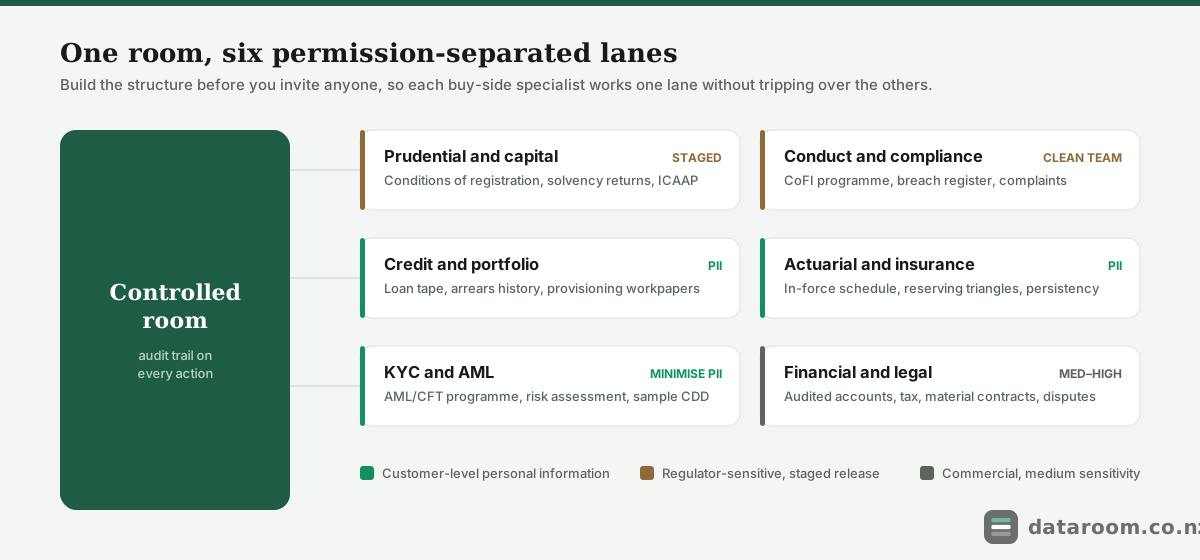
The matrix below is the staging plan behind that anatomy. It shows which lanes belong in the day-one room, which wait for a shortlist, which sit behind a clean-team wall, and which carry customer-level personal information.
The pattern is consistent across NZ banking and insurance deals. Financial, tax and technology material can open early to help a bidder decide whether to keep going.
The credit, actuarial and, above all, conduct and AML lanes open later, narrower and with more control, because they carry regulated sensitivity or personal information or both.
| Workstream | Day-one room | Shortlist stage | Clean team only | Customer PII |
|---|---|---|---|---|
| Financial and tax | ✓ | ✓ | ✗ | ✗ |
| Technology and operations | ✓ | ✓ | ✗ | ✗ |
| Prudential and capital | ✗ | ✓ | ✗ | ✗ |
| Credit and portfolio (tape) | ✗ | ✓ | ✗ | ✓ |
| Actuarial and insurance | ✗ | ✓ | ✗ | ✓ |
| Conduct and compliance | ✗ | ✗ | ✓ | ✗ |
| KYC / AML | ✗ | ✗ | ✓ | ✓ |
| Legal and HR | ✗ | ✓ | ✗ | ✓ |
Where do RBNZ and FMA expectations land inside the room?
New Zealand runs a twin-track regime, and both tracks reach into the room.
The Reserve Bank of New Zealand sits on the prudential side: capital adequacy, liquidity, the conditions of registration for a registered bank or the solvency standard for a licensed insurer, and the correspondence documenting how the institution met them.
The Financial Markets Authority sits on the conduct side: the CoFI licensing regime, fair-dealing obligations, and how the institution treats its customers.
A buyer of a regulated book wants to see both, because it is inheriting both. It needs comfort that the target is in good standing prudentially and that there is no conduct time bomb in the customer base.
Practically, your room carries material most trade sales never touch:
- capital and solvency returns;
- prudential correspondence;
- internal audit and compliance reports;
- breach registers;
- any live or recent regulator engagement.
How do you stage the most sensitive files?
This is some of the most sensitive material in the process. It can shape not just price but whether the buyer proceeds at all, and a change of control usually needs the regulator squared away before completion.
The correct handling is tight staging. Prudential and conduct correspondence sits behind its own permission set, released to shortlisted parties and their advisers rather than dropped into the general room on day one.
A breach register in particular is treated the way you would treat the crown jewels, because to a regulator that is exactly what it is.
Staging is not concealment: a serious buyer will and should see this material before completion. The point is to disclose it in a controlled order, to the right people, with a defensible record of who saw what and when.
In a financial-institution deal the room is not where you store the risk. It is where you prove you can be trusted with it.
How does the Privacy Act 2020 change the way you disclose customer files?
This is the difference that catches sellers out. In a financial-institution deal, a large share of what the buyer wants to see is personal information:
- loan files;
- policy records;
- claims histories;
- customer due-diligence documents.
Under the Privacy Act 2020 you remain the accountable agency for every piece of that information for as long as it is in the room, including where the room is hosted and who can reach it.
Disclosing it to a prospective buyer is a use. Once it moves offshore or to the acquirer it is a disclosure. Both have to be defensible.
Information Privacy Principle 12 sets conditions on sending personal information overseas, which matters because most virtual data rooms host outside New Zealand. The Office of the Privacy Commissioner is the primary source your counsel will work from.
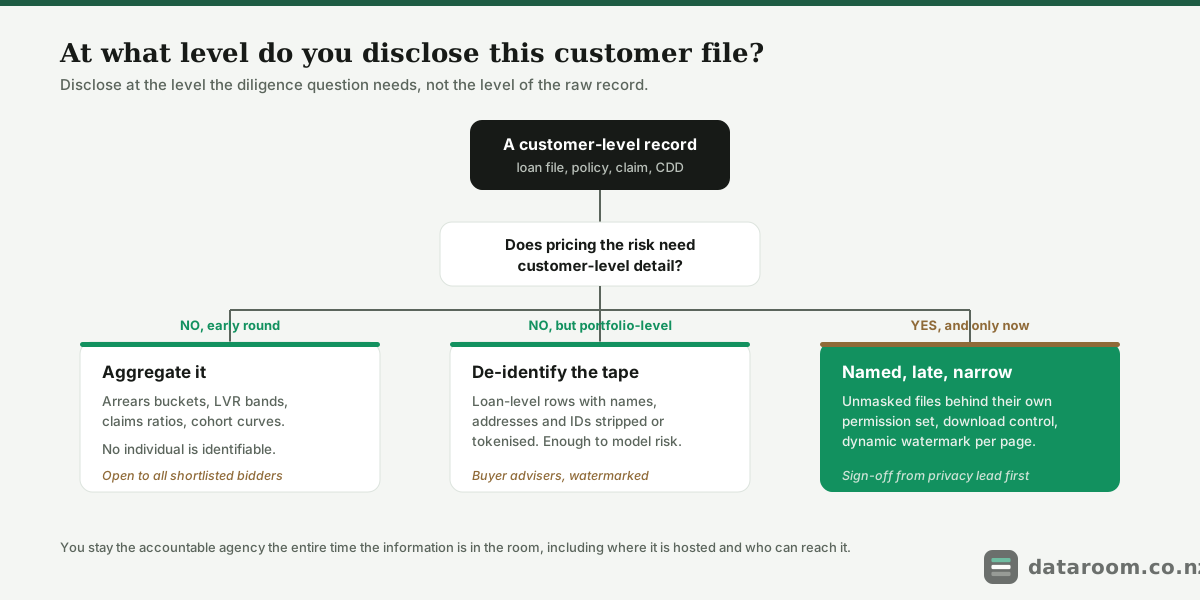
Disclose at the level the question needs
The workable answer is to disclose at the level the diligence question actually needs, not at the level of the raw file. Early rounds should see the loan tape and the claims data de-identified or aggregated: enough to price the risk, not enough to identify a customer.
The decision tree below is the test to run on every customer-level record before it goes anywhere. It keeps the vast majority of personal information out of the room entirely, which is the cheapest privacy protection there is.
The late, named stage
Named, unmasked customer files, where they are needed at all, belong to a late, narrow stage behind their own permission set. Ideally the buyer’s advisers review them rather than its commercial staff, with dynamic watermarking and download control on every page.
Confirm the hosting location and certifications in writing. Have your privacy lead and counsel sign off the offshore-disclosure position before a single customer record is uploaded.
The room does not discharge your obligation. But the right permission and watermarking controls are what make the disclosure defensible when someone later asks how a customer’s file was handled. Our guide to running a data room under the Privacy Act 2020 covers the mechanics.
What does a capital raise or Tier 2 issuance add to the picture?
Not every financial-institution room is a portfolio sale. A registered bank or licensed insurer raising regulatory capital, issuing a Tier 2 subordinated note, or bringing in a cornerstone investor runs a room with a different centre of gravity.
Here the audience is investors, their analysts and, on a regulated capital instrument, the rating agencies and the arranging bank. What they want is the capital story:
- the ICAAP;
- the capital and solvency headroom;
- the stress-testing and model documentation behind the risk-weighted asset calculation.
Customer-level sensitivity is lower than in a book sale, but the model and risk documentation is far more central. The whole thesis rests on the quality of the institution’s risk measurement, not on any single customer.
The room for a raise therefore leans on version control and a clean audit trail more than on granular masking.
When an analyst builds a capital model off your numbers, you need to know precisely which version of the ICAAP or stress test they worked from.
You also need every investor to have seen the same disclosure at the same time, to keep the process fair and, on a regulated offer, defensible.
Will a change of control need RBNZ or FMA sign-off before you can complete?
For a registered bank, a licensed insurer or a licensed conduct entity, a change of control or licence transfer generally needs the regulator satisfied before completion. That runs on its own timetable.
A data room does not shorten that clock. Be honest about it up front, because a seller who assumes the deal timetable is the only timetable will be surprised.
What a clean, complete, well-staged disclosure set does is let your advisers open the regulatory engagement earlier and answer questions faster. That removes delay around the approval, even though it cannot compress the approval itself. The two tracks run in parallel, and the room keeps them from colliding.
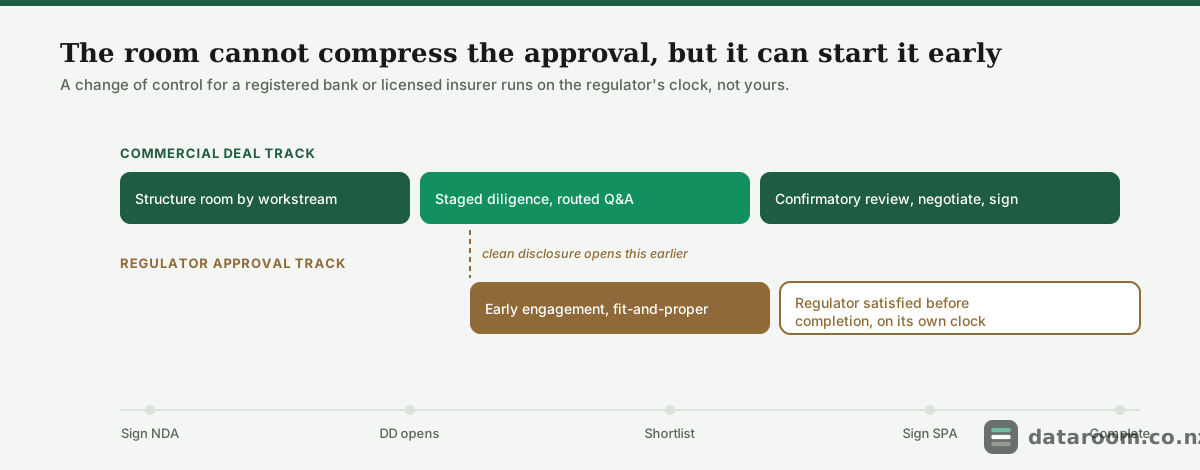
The practical consequence is that you build the regulatory story into the room from the start, rather than assembling it in a panic near signing. Stage and ready three things in particular:
- fit-and-proper material on the incoming owners;
- the capital and funding plan for the combined entity;
- the answers to the questions a regulator predictably asks about a change of control.
When your advisers open the engagement, the supporting evidence is already sitting behind a clean permission set. Handled that way, the approval stops holding up completion and becomes a track that finishes close behind the commercial one.
What should you check before regulated data goes near the room?
Once you know your workstreams and your side of the Privacy Act line, the provider itself needs a short, hard-nosed check. In a regulated deal the two failure modes are a security gap your compliance function cannot sign off, and a data event that becomes a notifiable breach.
The card grid below sets out six checks your risk and compliance functions should sign off in writing. None are exotic: they are what a regulator or a disputing party would expect you to have confirmed before exposing a customer’s information.
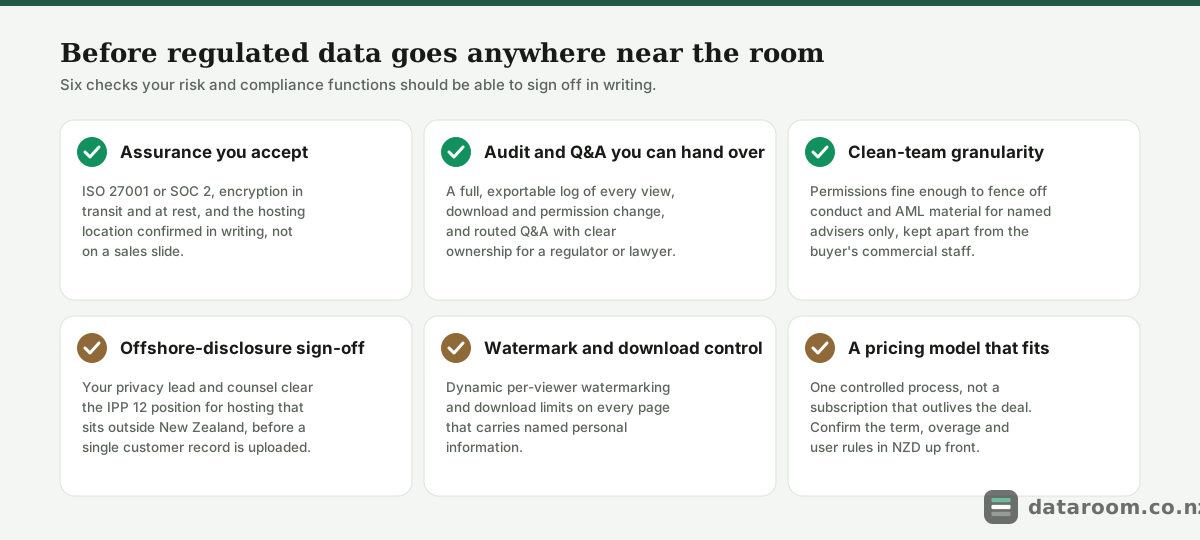
Our note on what those certifications actually mean is worth reading before you take a sales deck at face value. The fuller treatment of controls sits in our guide to data room security in New Zealand.
Work the check as a short sequence rather than a vibe, so nothing important is left to assumption.
Run the check as four steps
Do this before a single customer record or breach register goes into the room, while you still have leverage as a prospect.
- 1
Confirm assurance and hosting in writing
Get ISO 27001 or SOC 2, encryption in transit and at rest, and the hosting location stated in the contract, not on a slide. This is what your risk team signs against.
- 2
Test the audit and Q&A you could hand a regulator
Confirm a full, exportable log of every view, download and permission change, plus routed Q&A with clear ownership, so the record survives later scrutiny.
- 3
Check permission granularity for clean teams
Make sure controls are fine enough to fence conduct and AML material off for named advisers only, kept apart from the buyer's commercial staff.
- 4
Get the offshore-disclosure sign-off
Have your privacy lead and counsel clear the IPP 12 position for offshore hosting before any customer-level data is uploaded, and record the decision.
What does the room cost, and what pushes it up a band?
The reckoner near the top gave the headline bands. The more useful question is what tips a given deal from one band into the next, because that is where the budget actually moves.
A small book sale between trusting parties can run on a lean room. A similarly sized deal with a competitor in the process, a customer-level data set and a patchy AML history needs the assurance, staging and clean-team controls of something a band up.
The table below sets out the drivers that do that lifting, so you can size honestly rather than defaulting to the most expensive tier out of caution or the cheapest out of thrift.
| What raises the band | Typical trigger | Effect on spend |
|---|---|---|
| A competitor among the bidders | Clean-team walls and tighter staging become essential | Toward the mid or large band |
| A messy AML or breach history | More staged lanes, heavier routed Q&A load | Up roughly one band |
| Customer-level files genuinely in scope | Watermarking, download control, careful PII handling | A higher-assurance tier |
| Cross-Tasman parties | ANZ support hours, larger user counts, big data sets | The large-deal band |
| A long or open-ended timeline | The room is needed well beyond the live deal | Term risk; model both ends |
Read that table as a diagnostic rather than a menu. If none of the drivers apply, a lean flat-rate room is not a corner cut; it is the right size.
A 14-day free trial is enough to stand up a contained single-book process, structure it by workstream, and test the controls before you commit. If several drivers apply at once, do not fight the band: the cost of a weak evidentiary record on a regulated deal dwarfs the monthly saving.
The pricing overview has provider-by-provider notes. The comparison table lets you read the security and permission features through the lens of a regulated seller.
Size the room to your deal, not the brochure
Indicative NZD bands, charging models and what each tier includes, in one place.
Where does the room stop and your own systems start?
It is worth being clear about the split, because a room is often oversold as compliance in a box, and it is nothing of the sort.
A data room is where you disclose your AML/CFT programme, risk assessment and sample customer due diligence to a buyer. It does not perform customer due diligence or run transaction monitoring, which stay with your own systems and your own AML/CFT obligations.
Treating the room as if it discharged those duties is exactly the kind of gap a supervisor notices. The mental model to hold: the room is an evidence and disclosure layer sitting on top of your controls, not a replacement for them.
There is a second split that sellers miss. Because a virtual data room is usually an offshore-hosted service handling personal information, the provider itself is a material outsourcing decision under your own policies. It should go through the same diligence you apply to any vendor touching customer data.
Confirm the controls and the hosting in writing, record the decision, and keep the provider’s certifications on file. Access control and logging belong as hygiene rather than premium features, and that is exactly what a regulated room is built to deliver.
Are you a fintech rather than a bank? Do you still need this?
Usually yes, and sometimes more of it, which surprises founders who assume this level of room is only for incumbents.
A fintech raising capital or selling a lending book often holds a dense, valuable customer data set with the same Privacy Act 2020 exposure as an established lender, but with less compliance muscle and less experience of what a serious counterparty will ask for.
The controlled permissions, watermarking and audit trail of a purpose-built room are what let a lean team disclose safely without over-exposing customers. They also make the team look like a credible counterparty rather than a startup improvising with shared drives.
The one economy to avoid is the false one: running a regulated disclosure through a consumer file-sharing tool to save a little money.
An option that lacks a real audit trail and granular permissions becomes expensive the instant a dispute or a Privacy Act obligation surfaces, because you cannot prove who saw what. On a regulated book that is not hypothetical but predictable.
A free trial lets a fintech stand up a secure space, structure it by workstream and test the controls before committing to a full process. That is the right way to learn the discipline on a small deal, before the stakes climb.
Compare data rooms through a regulated seller's lens
Read the security, permission and audit features side by side for every provider we track.
Questions NZ banking, insurance and fintech teams keep asking
Can we put unmasked customer loan or policy files straight into the room?
Not early, and often not at all in raw form. Under the Privacy Act 2020 you stay accountable for that personal information the whole time it is in the room.
The safe pattern is to disclose de-identified or aggregated data in the early rounds, and reserve named, unmasked files for a late, narrow stage behind their own permission set, with watermarking and download control on every page. Get your privacy lead and counsel to sign off the position, including offshore hosting, before you upload anything customer-level.
How do we share breach registers and regulator correspondence without spooking the deal?
Stage them. Prudential and conduct correspondence, breach registers and internal audit findings are among the most sensitive documents in the process, and can move both price and appetite.
They belong behind their own permission set, released to shortlisted parties and their advisers rather than the general room. The point is not to hide anything, since a serious buyer will and should see it before completion; it is to disclose it in a controlled order, with a defensible record of who saw what and when.
Does a data room satisfy our AML/CFT and outsourcing obligations?
No, and the split matters. A room is where you disclose your AML/CFT programme, risk assessment and sample customer due diligence to a buyer. It does not perform customer due diligence or run transaction monitoring, which stay with your own systems.
Because a virtual data room is usually an offshore-hosted service handling personal information, treat the provider itself as a material outsourcing decision under your own policies, and confirm its controls and hosting in writing before regulated data goes near it.
Will a change of control need RBNZ or FMA sign-off before we can complete?
For a registered bank, a licensed insurer or a licensed conduct entity, a change of control or licence transfer generally requires the regulator to be satisfied before completion, and that runs on its own timetable. A data room does not shorten that clock.
What a clean, complete and well-staged disclosure set does is let your advisers open the regulatory engagement earlier and answer questions faster, which removes delay around the approval even though it cannot compress the approval itself.
We are a fintech, not a bank. Do we still need this level of room?
Usually yes, and sometimes more of it. A fintech raising capital or selling a lending book is often holding a dense, valuable customer data set with the same Privacy Act 2020 exposure as an incumbent, but with less compliance muscle to manage the disclosure.
The controlled permissions, watermarking and audit trail of a purpose-built room are what let a lean team disclose safely without over-exposing customers, and a free trial lets you stand up a secure space and test the controls before you commit.
How much should the room itself cost for a regulated NZ deal?
Indicatively, from about NZD $500 to $1,500 a month for a small single-book or portfolio sale, roughly $1,500 to $4,000 a month for a mid-market bank or insurer transaction, and $4,000 to $10,000 or more for a large or cross-Tasman regulated deal.
The band moves with whether there is a competitor bidder, customer-level data, a messy AML history or cross-Tasman parties, more than with the logo. Confirm the number for your specific deal and match the contract term to the diligence window.
Explore other use cases
A data room fits more than one kind of deal. See our other New Zealand guides.
Consumer & retail
How a virtual data room fits consumer & retail deals in New Zealand.
See the guideDue diligence
How a virtual data room fits due diligence deals in New Zealand.
See the guideHealthcare & life sciences
How a virtual data room fits healthcare & life sciences deals in New Zealand.
See the guideIndustrials
How a virtual data room fits industrials deals in New Zealand.
See the guideM&A
How a virtual data room fits m&a deals in New Zealand.
See the guideOil & gas
How a virtual data room fits oil & gas deals in New Zealand.
See the guideRenewable energy
How a virtual data room fits renewable energy deals in New Zealand.
See the guideReal estate
How a virtual data room fits real estate deals in New Zealand.
See the guideStartup fundraising
How a virtual data room fits startup fundraising deals in New Zealand.
See the guideTechnology, media & telecom
How a virtual data room fits technology, media & telecom deals in New Zealand.
See the guide