

What documents go in a data room? A checklist by deal type
Most guides open with the folder names. Start instead with the two numbers a New Zealand seller actually needs on day one: how much material a deal like yours requires, and how long it takes to pull together. Get either wrong and the room opens half-empty on the morning a bidder first logs in, which is the worst possible first impression to give someone deciding whether to trust your price.
So before any folder is named, here is the shape of the job.
| Deal type | Typical folders | Document volume | Prep lead time | Indicative room spend (NZD/mo) |
|---|---|---|---|---|
| Startup seed / Series A raise | 6 to 8 | 50 to 200 files | 1 to 2 weeks | $99 to $350 flat |
| Small business sale (sub-$5M) | 8 to 10 | 200 to 800 pages | 2 to 4 weeks | $99 to $300 flat |
| Property syndication offer | 5 to 7 | Trust deed, valuations, PDS | 2 to 4 weeks | $250 to $700 |
| Mid-market M&A ($10M to $50M) | 10 to 12 | Full diligence set, 1,000+ pages | 4 to 8 weeks | $700 to $2,200 |
| NZX listing / large raise | 12+ | Extensive, controlled | 8 weeks+ | Quote-based, $2,000+ |
That table is the whole article in miniature. The rest of this guide names what goes in the folders, then tunes the emphasis to your transaction.
If the term itself is still new, our plain-English guide to what a virtual data room is covers the basics first. This piece assumes you already know you need a room and want to know exactly what to put inside, in what volume, and in what order.
How much material does a data room actually need, by deal type?
The size of the job is set by the deal, not the ambition. A seed raise and a trade sale both draw on the same ten folders, yet they need wildly different depth, page count and lead time. Three figures in the table above deserve a second, slower look before you commit to anything.
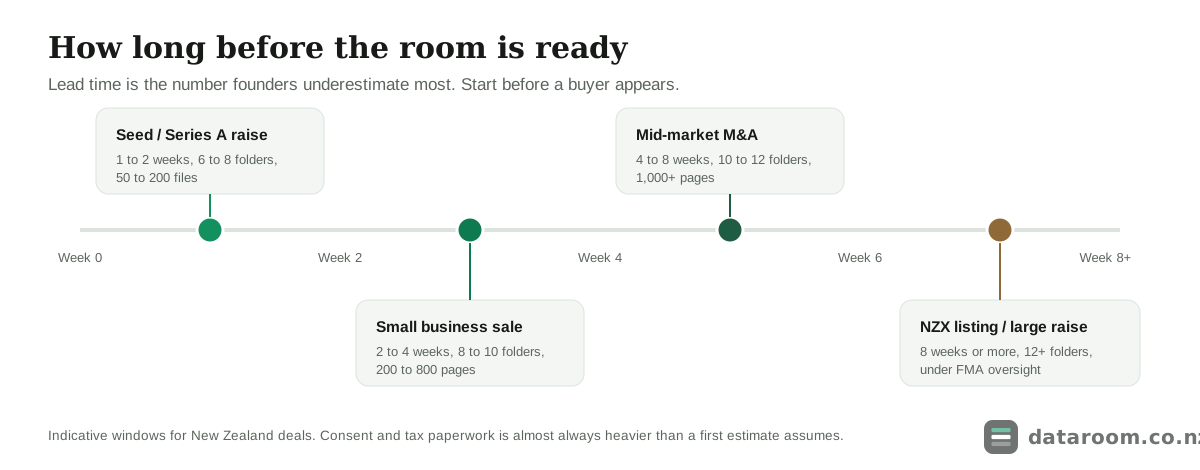
Lead time beats everything. Preparation almost always runs longer than founders expect, because the awkward documents live in inboxes and lawyers’ drawers rather than the accounting system. Start assembling before a buyer appears, not after one asks for access.
Volume drives cost, not deal value. A document-heavy small business sale can cost as much to host as a leaner mid-market raise, because most New Zealand providers price on storage, pages or user seats rather than the size of the cheque changing hands. If budget is tight, our roundup of the cheapest virtual data rooms for NZ small deals is the sensible place to start, and it explains where the flat-fee plans stop being flat.
Folder count also creeps up with formality. An NZX listing carries twelve-plus folders under Financial Markets Authority oversight; a seed raise runs comfortably on six.
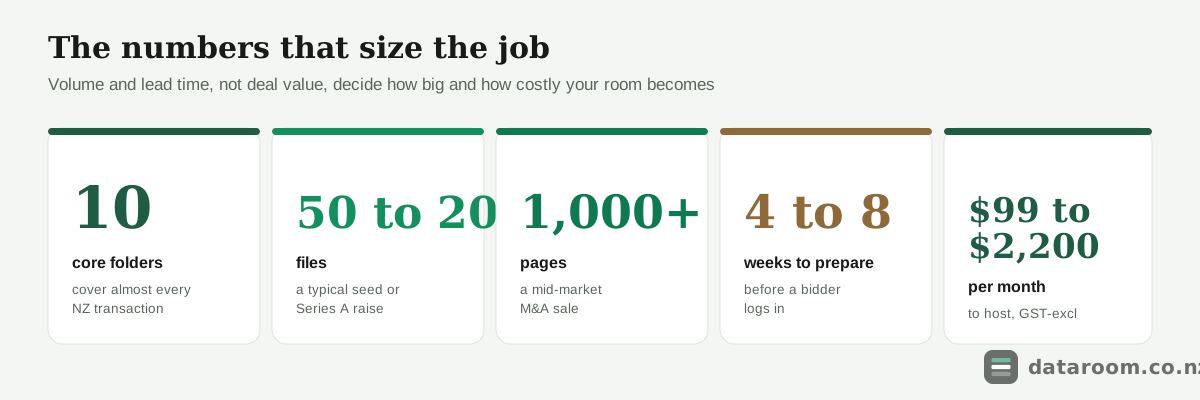
Take a concrete case. A Nelson aquaculture operator selling a 60 percent stake to an offshore investor for around $8 million sits squarely in the mid-market band. That means ten to twelve folders, well past 1,000 pages once marine farm consents, biosecurity records, five years of accounts and supply contracts are loaded, and a four to eight week prep window that the owner underestimated by a full month. The consent paperwork alone ran to several hundred pages, none of which lived anywhere near the ledger.
The lesson repeats across industries and deal sizes. The document set is never smaller than you hope, and the regulatory paperwork is always heavier than you remember. Treat this guide as the companion to our data room folder structure template and the fuller due diligence checklist for New Zealand deals, which give you the skeleton and the buyer-side questions respectively.
Compare data rooms for your deal type
See charging models, security and trials for every provider we track, side by side.
Which ten folders belong in a New Zealand data room?
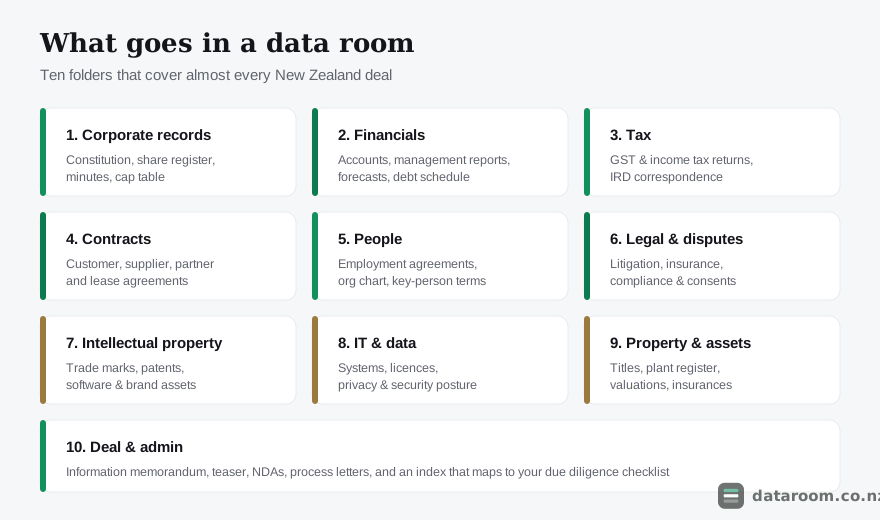
Here is the master list at a glance. Tick most of these and your room is close to ready.
- Corporate records. Constitution, certificate of incorporation, current share register, directors’ and shareholders’ resolutions, minute book, shareholders’ agreement, cap table.
- Financial statements. Three years of annual accounts, current-year management accounts, budget and forecast, aged debtors and creditors, bank facility and debt schedule.
- Tax. GST returns, income tax returns and assessments, PAYE records, any IRD correspondence or rulings, transfer-pricing notes if relevant.
- Contracts. Top customer and supplier agreements, distribution and partner deals, leases, loan and security documents, insurance policies.
- People. Employment agreements for key staff, the org chart, contractor agreements, restraint and confidentiality terms, any collective agreement, KiwiSaver and payroll summary.
- Legal and disputes. Current or threatened litigation, regulatory correspondence, resource and other consents, warranties given, compliance registers.
- Intellectual property. Trade marks, patents and designs, domain names, software ownership and assignment, brand and design assets.
- IT and data. System inventory, key software licences, data processing and privacy arrangements, security posture, incident history.
- Property and assets. Titles or lease schedules, plant and equipment register, asset valuations, motor vehicles, insurances over assets.
- Deal and admin. Information memorandum, teaser, non-disclosure agreements, process letters, and an index that maps every folder to your checklist.
That list looks long, and for a full trade sale it is. Most deals need a subset.
The skill is knowing which folders carry the weight for your particular transaction, which the deal-type matrix further down settles. The figure below is the same ten folders laid out as a grid, so you can keep it beside you as you build.
One quiet point about the tenth folder. The index is not optional busywork; it is the document a reviewer opens first and the one that signals whether the rest of the room is organised or improvised. A clean index maps every checklist line to a folder and a file, so a bidder never has to email you asking where the leases are. Rooms without one generate a stream of clarifying questions that slow the deal and, worse, make the seller look unprepared at exactly the moment confidence matters.
What proves the company is what it says? Corporate records and financials
These two folders are the foundation. Reviewers open them first, because everything else hangs off who owns the company, who can bind it, and whether it is worth buying at all.
Corporate records prove the company exists and is properly held. Include:
- The constitution and certificate of incorporation.
- A current, reconciled share register.
- The minute book, plus directors’ and shareholders’ resolutions.
- The shareholders’ agreement, if one exists.
- The capitalisation table on a fully diluted basis, including options, warrants and convertible notes.
A buyer will cross-check the register against the Companies Register as a matter of routine. Make your filed particulars and your internal records agree before anyone looks, because a mismatch reads as sloppy governance and invites deeper digging everywhere else in the room. For a company that has raised before, an out-of-date cap table is the classic reason a process quietly stalls: the numbers on the model no longer tie to the register, and every party starts second-guessing what else is stale.
Governance records matter for a reason beyond tidiness. Under the Companies Act 1993, a New Zealand company must keep a share register, minutes of shareholder and board meetings, and records of major decisions, and a diligence reviewer treats gaps in that trail as a live risk rather than a paperwork quirk. If a share issue or a director appointment was never properly minuted, the buyer’s lawyer will want it regularised before completion, and that can add days to a timeline that is already tight. The fix is almost always cheap if done early and expensive if done under deadline pressure with a bidder watching.
Financials prove the company is worth buying. Load:
- Three years of annual accounts, ideally with the accountant’s compilation or audit report.
- Current-year management accounts, so the picture is not stale.
- A budget and a forward forecast.
- An aged debtors and creditors report.
- A schedule of all debt and bank facilities, with terms.
A buyer’s accountant is hunting for normalised earnings, so anything that helps them travel from statutory accounts to a clean EBITDA figure speeds the deal. Where the numbers move around, a short reconciliation note attached to the accounts saves an entire round of written questions. Our guide on how a virtual data room works explains the access reporting that tells you when a bidder keeps returning to the debtors ledger, a signal worth acting on before it hardens into a price chip.
Where does the value and the risk actually live? Contracts and people
For most operating businesses, value sits in the contracts and the team. These two folders get the closest reading, for opposite reasons: one carries the upside, the other carries the surprises.
Contracts are read for revenue durability and hidden risk. Prioritise:
- Your largest customer and supplier agreements.
- Any exclusive or long-term distribution deals.
- All property leases.
- Every loan and security document.
- Current insurance policies with sums insured.
The clauses that decide price are the change-of-control and assignment provisions, because a contract that terminates or needs third-party consent when the company changes hands directly reduces what a buyer will pay for it. Load the executed counterpart of each agreement, with all schedules and variations attached; a signed contract with a missing annexure is only half a document, and reviewers will ask for the rest within the hour.
Do not upload a folder of unsigned drafts and hope nobody notices.
Revenue concentration is the quiet risk this folder exposes. If a single customer accounts for a third of turnover, a buyer will want the contract, its remaining term and its termination rights in full, because that one relationship carries a disproportionate share of the price. A short cover note that maps your top five customers to their agreements, renewal dates and any change-of-control clause turns a nervous line of questioning into a settled one. The same discipline applies to your key supply agreements, where a sole-source input on a short contract can worry a buyer as much as a concentrated customer does.
People files get real attention in services and technology businesses, where the team is the asset rather than the machinery. Include:
- Current employment agreements for key staff.
- An organisation chart.
- Contractor and consultancy agreements.
- Restraint of trade and confidentiality terms.
- KiwiSaver arrangements, accrued leave and any personal grievance history.
If key employees sit on generous or unusual terms, flag it early rather than letting a buyer discover it late in diligence, where a surprise reads as concealment. This is also the folder most likely to hold personal information, which brings the Privacy Act squarely into play; there is a dedicated section on that below, because getting it wrong is one of the few mistakes here that carries a legal tail rather than just a commercial one.
What changes by deal type: share sale, raise, syndication or listing?
The ten folders are constant. The emphasis changes completely. A trade sale needs the entire set in depth; a seed raise cares far more about the cap table, the model and the IP than about a plant register that a buyer of the whole company would comb through line by line. The matrix shows where each deal type concentrates its documents.
| Document category | Trade sale / M&A | Startup raise | Property syndication | NZX listing |
|---|---|---|---|---|
| Corporate records & cap table | ✓ | ✓ | ✓ | ✓ |
| Full financial statements | ✓ | ✓ | ✓ | ✓ |
| Customer & supplier contracts | ✓ | ✗ | ✗ | ✓ |
| Employment & people files | ✓ | ✗ | ✗ | ✓ |
| Tax filings & IRD correspondence | ✓ | ✗ | ✓ | ✓ |
| Intellectual property & assignments | ✓ | ✓ | ✗ | ✓ |
| Property titles & asset register | ✓ | ✗ | ✓ | ✗ |
| Product disclosure / offer document | ✗ | ✗ | ✓ | ✓ |
Read the pattern closely.
An M&A sale is the only deal type that demands every folder in full, because the buyer is inheriting the entire legal entity and everything attached to it. A startup raise is narrower and sharper: investors want the model, the cap table and clean IP ownership, and will happily forgive a thin property folder. A property syndication or a public offer pivots around the disclosure document and the underlying asset, both under Financial Markets Authority oversight, which raises the bar on what must be shown and how it must be presented.
One more distinction is easy to miss, and it changes which folders lead the room.
A share sale and an asset sale draw on the same folders but weight them very differently. A share sale hands the buyer the whole company, so corporate records, tax history and contingent liabilities get forensic attention, since the buyer inherits every one of them. An asset sale cherry-picks what transfers, so the schedule of included and excluded assets, and the consents needed to assign each contract, move straight to the front. Confirm which structure you are running before you decide how deep each folder goes, because building a share-sale room for an asset deal wastes weeks on paperwork nobody will read.
Lead time shifts by deal type too, and the timeline below sets the expectations that catch first-time sellers out.
A data room is not a filing cabinet you empty into the cloud. It is a curated case for why the business is worth the price, told through the documents a buyer trusts more than your pitch.
Which folders do sellers underestimate? Tax, legal, IP and assets
Four folders quietly carry outsized risk. Sellers skimp on them because the material lives in inboxes and lawyers’ files rather than the accounting system, and reviewers notice the gap immediately.
Tax follows the company, so give it the care you give the financials. Load recent income tax returns and assessments, GST returns, PAYE and employer filings, any correspondence, audit or ruling from Inland Revenue, and transfer-pricing documentation if the business has cross-border dealings. A buyer wants comfort that no latent liability sits behind the accounts, and clean tax records are the fastest way to give it. If you are unsure what your filings should show, the plain-English overviews at business.govt.nz are a sensible first stop before you loop in an adviser.
Legal and disputes exists to prove the absence of surprises, so completeness beats volume here. Disclose:
- Current, threatened or recent litigation.
- Regulatory correspondence and any warranties or indemnities given.
- Consents and licences: for many NZ businesses that means resource consents, building consents or industry authorisations.
- A compliance register, even a simple one.
Silence is not a strategy. A dispute a buyer finds through their own public searches is far more damaging than one you disclosed and framed on your own terms. Our guide to the ten data room mistakes that slow down NZ deals puts under-disclosure near the top of the list for exactly this reason.
Intellectual property, IT and data is the modern diligence frontier, and often the single most valuable folder for a brand or technology business. Include registered trade marks, patents and designs, and domain names; the assignments that prove the company, not a founder or contractor, owns the code and creative work; a systems inventory and key software licences; and your data processing arrangements and security posture, including any past incident. Founder-built software with no written assignment is a common and entirely fixable gap, so fix it before the room opens rather than during diligence when it becomes a bargaining lever. If you have suffered a notifiable breach, a buyer will want to see how it was handled, and CERT NZ publishes the guidance most New Zealand businesses are measured against.
Property and physical assets is the fourth trap, and for asset-heavy businesses in manufacturing, transport, agriculture and property it can be the largest folder by page count. It is also the one that quietly inflates a per-page bill, because scanned titles and equipment schedules balloon fast.
Two details separate a clean assets folder from a messy one.
- Ownership must be unambiguous. Where plant sits under a hire-purchase or a registered security interest, show the underlying agreement, not just the asset line in the accounts, so a buyer knows exactly what they are getting.
- Valuations should be current. A three-year-old valuation on a Canterbury dairy conversion or a Tauranga transport fleet invites a fresh one at the buyer’s expense, and their number is rarely the one you would have chosen.
If you are on a per-page room, this folder is where the meter runs fastest. Our pricing guide explains when that charging model bites and when a flat plan works out cheaper.
Which documents does everyone forget?
Some gaps recur so often they are almost a checklist of their own. The table below names the usual suspects, where each one tends to hide, and why a reviewer flags it the moment it is missing.
| Forgotten document | Where it usually hides | Why reviewers flag it |
|---|---|---|
| Signed contract counterparts | A Word draft in someone's email, not the executed PDF | A draft is not binding; missing signature pages read as unfinished |
| Current share register | A spreadsheet that predates the last raise | Must reconcile to the Companies Register and the cap table |
| IRD correspondence | The accountant's or director's inbox | Proves the tax position is settled, not just filed |
| Consents and licences | A physical folder or the council's records | Buyers assume they exist; a gap can halt a settlement |
| IP assignments | Never written down for founder-built code | Without them the company may not own its core asset |
| Insurance schedules | A broker summary rather than the full policy | Sums insured and exclusions decide the real coverage |
None of these are exotic documents. They are the papers that live in someone’s inbox or a filing cabinet rather than the accounting system, which is exactly why they slip through the net.
The fix is dull but reliable: work the left-hand column as a pre-flight check the day before you invite anyone. Confirm every signed counterpart is the executed version with all schedules attached, that the share register ties to both the register and the cap table, and that each consent your business relies on is actually in the folder rather than assumed to exist. Ten minutes here saves a week of back-and-forth once bidders are live and impatient.
Do the Privacy Act and confidentiality change what you upload?
Yes, and this is the part sellers most often overlook. A data room is a disclosure of confidential and often personal information, and putting it behind a login does not remove your obligations under the Privacy Act 2020.
Two questions decide what happens to each document, and the decision tree below walks them in order.
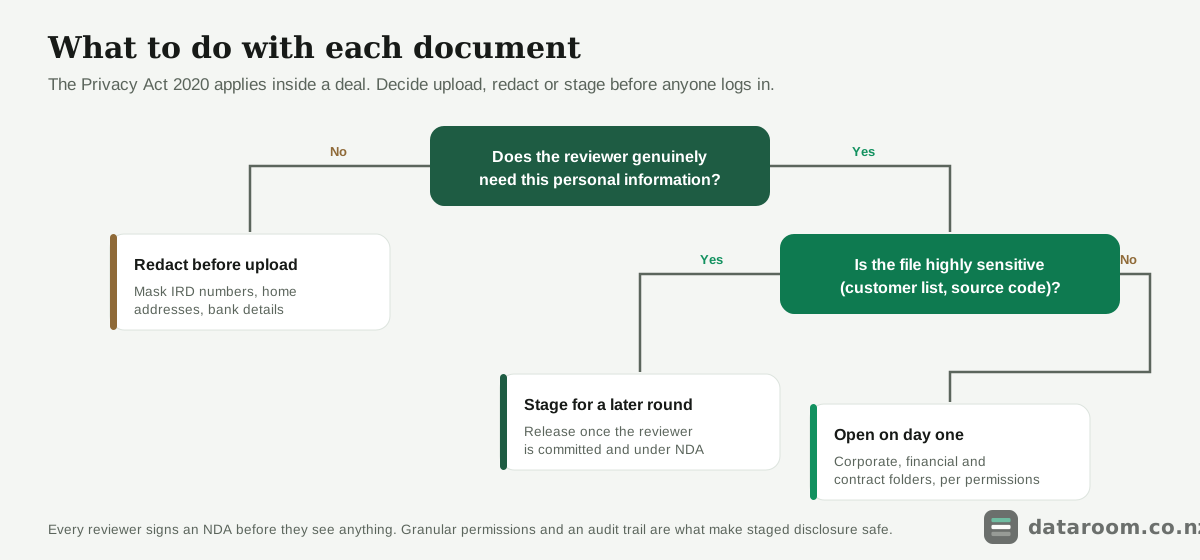
The first question is whether the reviewer genuinely needs the personal information at all. Often they need to see that a contract exists and what its commercial terms are, not the home address or IRD number of the counterparty. Redaction here is a compliance step, not just tidiness. The Office of the Privacy Commissioner sets out the principles that govern how you collect, hold and disclose personal information, and a live deal does not suspend a single one of them.
The second question is whether the reviewer is under a non-disclosure agreement yet, and how sensitive the material is. Every reviewer should be under an NDA before they see anything at all. The most sensitive material, customer lists, source code, precise financial detail, is then staged for later diligence rounds rather than exposed at first look, so a tyre-kicker never gets your crown jewels.
That staging is why granular permissions and a full audit trail matter, and why a proper room beats a shared folder for anything above the smallest deal. Our deeper guide, sharing data in a deal: your Privacy Act 2020 obligations, works through the practical steps in detail. If you are still weighing the tool itself, virtual data room vs Dropbox and vs Google Drive make the case for why a consumer file-share falls short once personal information and staged access enter the picture.
A straightforward room for an NZ deal
A flat monthly plan, a 14-day free trial, and permissions built for staged disclosure.
How do you prepare documents before uploading?
Populating the room well is a short, deliberate process. Rush it and sensitive files land in the wrong folder, or personal data goes out un-redacted, and both are far harder to unwind once a reviewer has already seen them. Work through these six steps in order, before you invite a single reviewer.
Prepare your document set in six steps
Do the preparation before you invite a single reviewer, so the room opens clean and stays controlled.
- 1
Build the checklist from the deal type
Start from the ten folders, then use the deal-type matrix to decide which carry weight for your transaction. That becomes your master index.
- 2
Collect and name consistently
Gather the executed version of every document and rename files to a clear convention, so a reviewer and your own analytics can find anything in seconds.
- 3
Redact personal information
Remove or mask personal data that reviewers do not need, such as employee ID numbers and bank details, before upload. The Privacy Act 2020 still applies inside a deal.
- 4
Set the folder structure
Mirror your checklist in the folder tree so nothing is orphaned. Our folder structure template gives a ready-made skeleton for NZ deals.
- 5
Apply permissions before inviting anyone
Decide who sees which folders, and stage the most sensitive material for later rounds rather than exposing everything on day one.
- 6
Test with a dry run
Log in as a guest, walk the room as a bidder would, and confirm permissions, watermarks and the index all behave before real reviewers arrive.
For the mechanics of that setup, from choosing a provider to inviting users, follow our step-by-step guide to setting up a data room. It picks up precisely where this checklist leaves off, and it is worth reading before you commit to a provider, since the folder work above is far easier when the tool supports staged permissions natively.
Data room documents FAQ
What are the essential documents for a data room?
At a minimum: current corporate records including a reconciled share register and cap table, three years of financial statements plus current management accounts, your key contracts and leases in signed form, tax filings, employment agreements for key staff, and any litigation or compliance disclosures. Those cover the questions almost every reviewer asks first.
What documents does a startup need in a data room to raise money?
Investors focus on the cap table, the financial model and historic accounts, customer or traction evidence, and clean intellectual property ownership with written assignments. A seed or Series A room is narrower than an M&A room, usually 50 to 200 files; see our guide to data rooms for NZ startup fundraising for the full set.
Do I need to redact personal information before uploading?
Usually yes. The Privacy Act 2020 applies inside a deal, so mask personal data that reviewers do not need, such as employee identifiers and bank details. The Office of the Privacy Commissioner sets out the principles, and our Privacy Act guide covers the practical steps.
How many documents should be in a data room?
It depends on the deal. A startup raise might run to 50 to 200 files, a small business sale to several hundred pages, and a mid-market M&A process to well over a thousand. Volume, not deal value, is what drives your room cost, so plan the folder set before you pick a plan.
What is the difference between a share sale and an asset sale data room?
A share sale transfers the whole company, so corporate records, tax history and contingent liabilities get forensic attention. An asset sale transfers only chosen items, so the schedule of included and excluded assets and the consents to assign each contract move to the front. Same ten folders, different depth in each.
What is the single most forgotten document?
Signed contract counterparts. Sellers upload the last draft rather than the executed version with all schedules attached, and reviewers immediately ask for the rest. A close second is a share register that has not been reconciled to the Companies Register and the cap table.
Should I upload everything at once?
No. Stage disclosure: open with corporate, financial and contract folders, and hold the most sensitive material, such as customer lists and source code, for later diligence rounds once a reviewer is committed and under an NDA. Granular permissions and an audit trail are what make staged disclosure safe.