
Best Data Room for Startup Fundraising in New Zealand (2026)
Compare the best virtual data rooms for startup fundraising in New Zealand (2026). Founder-friendly picks with indicative NZD pricing.
Best data rooms for Startup fundraising in New Zealand
Our shortlist for this use case, ranked after review. Independent, with indicative NZD pricing. Compare them all in the full table.
- 1
The modern data room. Live in minutes on a 14-day free trial.
Visit site SponsoredView profile - 2

Built in Australasia; AI deal tools, strong local support.
- 3
Flat-rate value for advisors and mid-market deals.
- 4
Document-security-first data rooms with strong DRM, watermarking and post-download control.
What investors expect in your room
- 1Pitch deck & one-pager
- 2Cap table & option pool
- 3Financial model & historicals
- 4Key customer & supplier contracts
- 5IP assignments & trademarks
- 6Constitution & shareholders' agreement
- 7Recent board minutes
Here is the truth most founders learn a round too late: investors do not open your data room to be impressed. They open it to find a reason to pass.
A partner at Movac, an angel from AngelHQ, a syndicate lead running your deal past their investment committee: they are all hunting the one loose thread that turns a maybe into a no.
That thread is usually small. A cap table that does not reconcile. A missing IP assignment from a contractor who left in year one. Three versions of the model with three different revenue numbers.
Your deck sells the upside; your room defends the downside. The founders who raise fastest are not the ones with the prettiest folder tree. They are the ones who quietly removed every easy excuse to walk away.
This guide stays practical: what to put in the room at each stage, how to keep your cap table clean, how SAFEs and ASAs convert, and the New Zealand specifics that trip founders up. A raise is not a design exercise. It is a race against an investor’s attention.
Does a tidy data room actually win you the round?
No single document wins a round. But an untidy room can lose one before you finish the second meeting.
Sit behind a fund analyst for an hour and the pattern is obvious. They are not reading every page; they are triaging. In the first ten minutes they check three things:
- Does the ownership story hold together?
- Does the money story hold together?
- Is anything obviously going to blow up in legal diligence later?
So the fastest way to stall a raise is not a weak metric. It is an inconsistency.
If your deck says 40 percent month-on-month growth and the model says 22 percent, you have handed them a reason to distrust everything else. If the cap table shows a shareholder nobody mentioned, the questions multiply.
A room that is internally consistent, current and easy to navigate signals that the rest of the business is run the same way. That signal is worth more than any single file inside it.
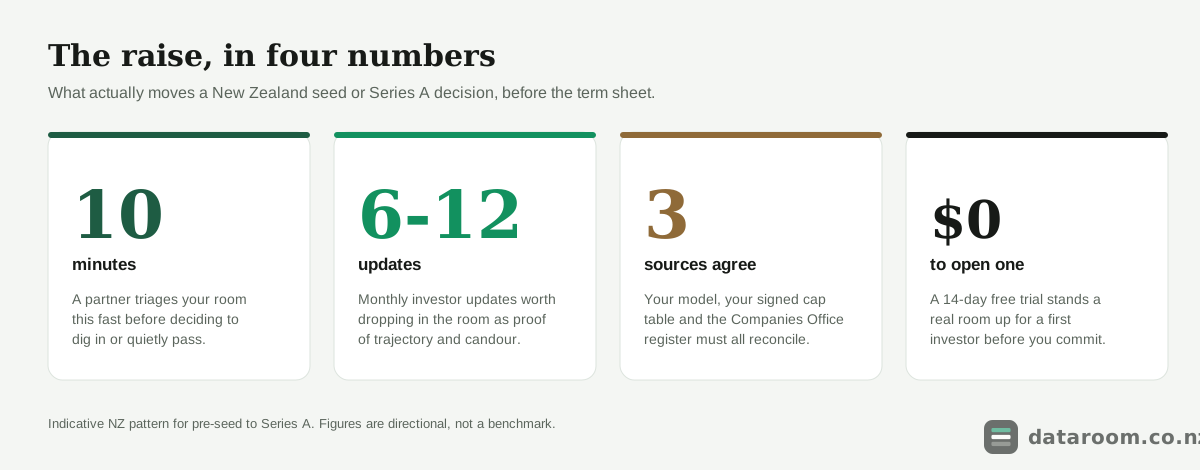
Before you invite a single investor, do the harshest read of your own room you can manage. Open it as a stranger, and check that:
- every number that appears twice matches
- every folder is findable without a phone call
- every document is the version you would defend under questioning
That one hour of self-review is the highest-return work in the whole raise.
What belongs in the room at pre-seed, seed and Series A?
The mistake founders make is treating the room as one fixed thing. What belongs in it scales with the round.
Over-stuffing a pre-seed room is as unhelpful as under-preparing a Series A one. A pre-seed angel does not want a 60-tab model. A Series A committee will not accept its absence.
Build the room to match the stage you are actually raising. Each stage keeps everything below it and adds the next layer.
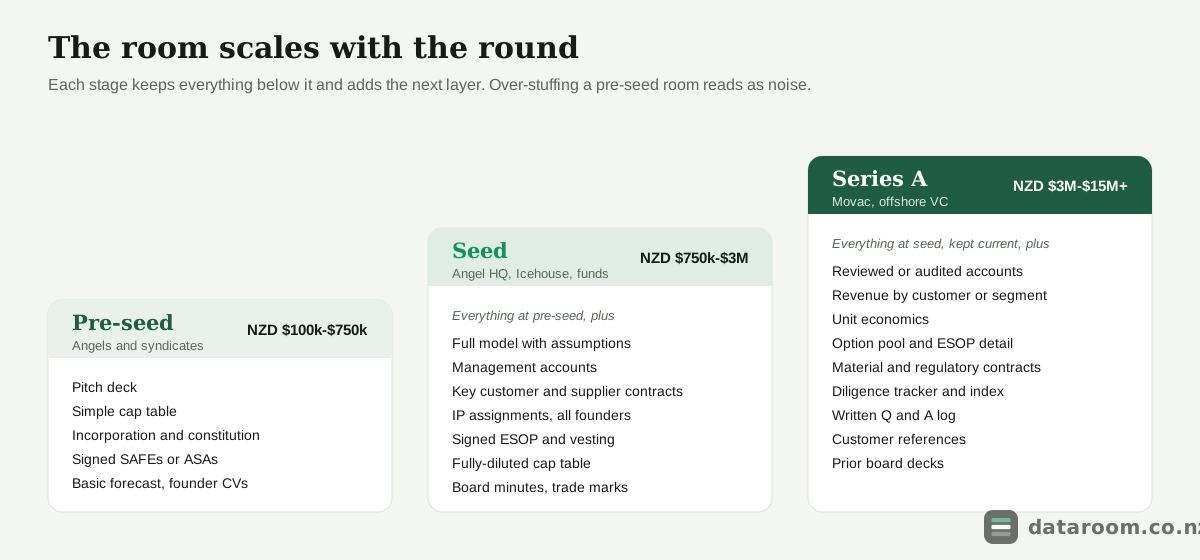
The table below maps what most New Zealand investors expect at each level.
| Round stage | Must-have documents | Nice-to-have (strengthens the story) |
|---|---|---|
| Pre-seed | Pitch deck, simple cap table, founder CVs, incorporation record and constitution, any signed SAFEs or ASAs, a basic forecast | Product roadmap, early traction or waitlist data, founder vesting terms, a short market memo |
| Seed | The above plus a proper model with assumptions, management accounts, key customer and supplier contracts, IP assignments from all founders and contractors, employment agreements for key hires | Cohort or retention data, pipeline detail, a fully-diluted cap table, board minutes, trade mark filings |
| Series A | All of it kept current, reviewed or audited accounts where available, revenue by customer or segment, unit economics, option pool and ESOP documentation, material and regulatory contracts | Diligence tracker, customer reference list, security and privacy posture, a written Q and A log, prior board decks |
Two things stand out.
The must-have column at each stage becomes the baseline of the next, so you are always building on the last round rather than starting over.
And a clean cap table and full IP assignments appear early and never leave. They are the two areas where a gap is both common and fatal in legal diligence. Our due diligence guide covers the wider pack an investor’s lawyers will work through.
How clean is your cap table, really?
If one document decides your raise, it is this one.
A cap table is a promise about who owns the company. Investors treat any wobble in it as a wobble in the founder.
The failure modes are predictable:
- a spreadsheet that does not reconcile to the share register
- SAFEs whose conversion nobody has modelled
- an option pool that exists in conversation but not in signed documents
- a former co-founder whose exit was never properly papered
The fix is a three-way reconciliation, done before the raise, not during it.
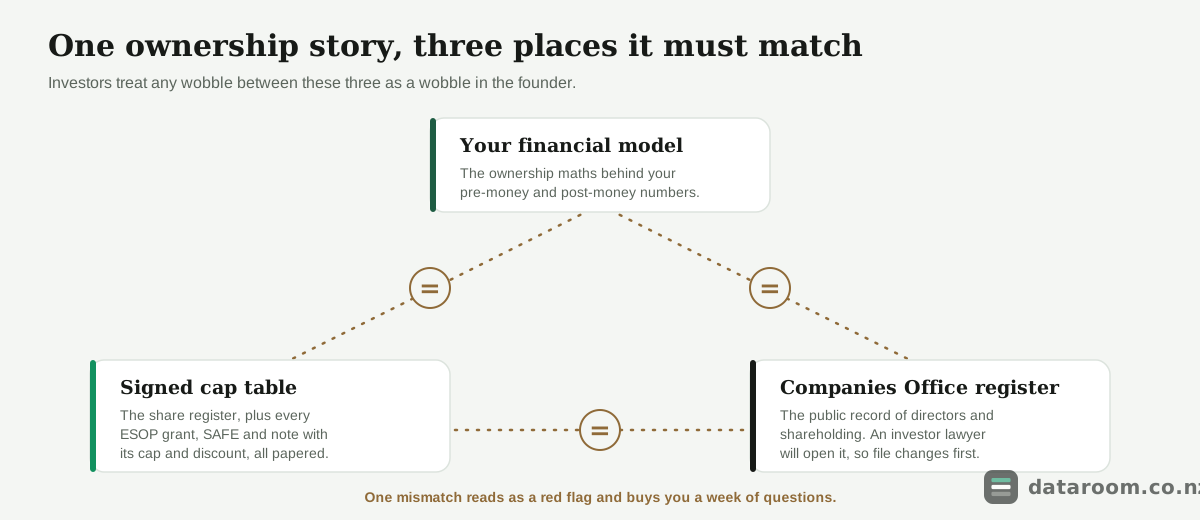
Work through it in order:
- Reconcile your working cap table against the shareholding on the Companies Office register; an investor’s lawyer will, and a mismatch invites a week of questions.
- Model your SAFEs and ASAs on both a priced round and a cap conversion, so the fully-diluted picture holds at the valuation on the table.
- Get every option grant into a signed ESOP with board approval, not a founder’s memory.
- Check that the pre-money and post-money numbers you quote actually produce the ownership percentages in the file.
One authoritative, fully-diluted cap table, with the underlying SAFEs, notes and option documents behind it, builds more confidence than almost anything else you put in front of an investor.
Your model, your signed cap table and the public register are three views of one promise. Investors trust the founder whose three views agree, and doubt the one whose views do not.
SAFE or ASA, and how does it actually convert?
Most New Zealand pre-seed and seed rounds do not sell priced equity. They use a SAFE or an Advance Subscription Agreement, and founders lose real ownership by not understanding how those convert.
Both instruments do the same core thing: an investor gives you money now, in exchange for shares later, at a price set by your next priced round. The difference is mechanical.
- A SAFE is a standing agreement that converts to shares when a priced round triggers it. It can sit open indefinitely.
- An ASA (Advance Subscription Agreement) is usually written with a long-stop date by which it must convert, which some New Zealand investors and accountants prefer for its cleaner treatment.
Both carry the two terms that decide dilution: a valuation cap (the highest price at which they convert, protecting the early backer) and a discount (a percentage off the next round’s price). On conversion, the investor gets the better of the two.
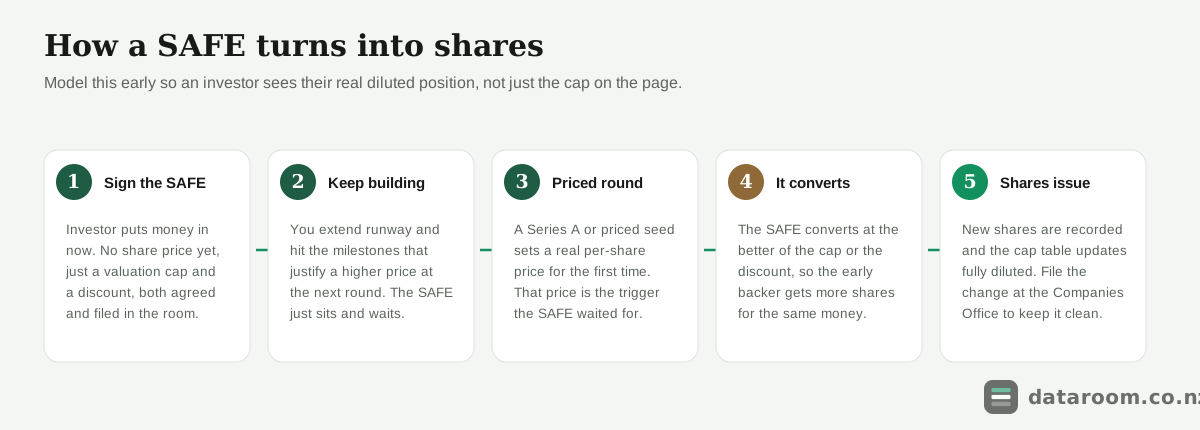
Here is the trap. Founders quote a headline valuation to a new lead without stacking the earlier SAFEs on top.
Then the fully-diluted cap table lands, the new investor sees their real post-conversion percentage, and it is smaller than the pitch implied. Now you are renegotiating from behind.
The matrix below lines up the three early-stage routes so you can see what each one costs you in speed, certainty and dilution clarity.
| What matters | SAFE | ASA | Priced round |
|---|---|---|---|
| Sets a share price now | ✗ | ✗ | ✓ |
| Fast and low legal cost | ✓ | ✓ | ✗ |
| Common at NZ pre-seed and seed | ✓ | ✓ | ✗ |
| Has a hard conversion deadline | ✗ | ✓ | ✓ |
| Dilution is obvious upfront | ✗ | ✗ | ✓ |
| Needs a full shareholders' agreement | ✗ | ✗ | ✓ |
Whichever you use, keep every signed instrument in the room with its cap and discount stated plainly, and keep a live model of how the stack converts at your next round.
An investor who can see their real diluted position trusts the founder who showed it to them. Our capital raising guide walks through the same mechanics across a full round.
Are your investor updates a raise asset or an afterthought?
Most founders think the raise starts when they send the deck. The best raises start months earlier, in the monthly investor update.
If you have sent tight updates to angels and prospective leads, growth numbers, key wins, the ask, a clear runway line, you have been running diligence in slow motion the whole time.
By the time you open the room, a warm investor already trusts the numbers, because they have watched them accrue.
So treat your past updates as a raise asset and drop the last six to twelve into the room. They show three things at once:
- trajectory
- honesty about what went wrong
- that you communicate like someone worth having on a cap table
An investor who has watched you report a bad month plainly, then fix it, trusts your good months far more than a founder who only surfaces at raise time with a polished story.
Not sending updates yet? Start now, even mid-raise. Two or three real ones during a process still beat none, and they give you a reason to re-engage a fund that went quiet.
What is different about raising in New Zealand?
The mechanics of a raise are global. The paperwork and the norms here are local, and getting them right marks you as someone who knows the market.
- SAFEs and ASAs are the standard early instrument. Keep every signed one in the room with its cap and discount, and model the conversion so investors see their real diluted position, not just the headline.
- The Companies Office register is public, and investors will check it. Your directors, shareholding and constitution sit on the public companies register. Make sure what is filed matches what is in your room, and file any overdue changes before you invite anyone in.
- Disclosure rules bite. Most early rounds rely on the wholesale or eligible-investor exclusions rather than a full product disclosure statement, but the boundaries matter. If you approach retail investors or raise through a licensed equity crowdfunding platform, the rules change. The Financial Markets Authority sets these expectations, so keep the relevant exclusion certificates or platform paperwork in the room for counsel.
- The Privacy Act 2020 applies inside the room. It holds personal information: staff records, customer contracts, founder details. You stay accountable for it, which is another reason a controlled room with an access log beats an open Drive folder. business.govt.nz sets out the reasonable safeguards expected of a New Zealand company.
None of this is exotic. But each item is a place where an offshore-template approach quietly signals that a founder skipped the local homework.
What should a fundraising room actually cost in NZD?
Founders routinely overestimate this.
A fundraising room does not need the per-page pricing that enterprise M&A deals attract. Most vendors run a trial, so you can stand a real room up at no cost before you commit.
The figures below are indicative NZD to frame the conversation, not quotes. Confirm current pricing with the provider.
| Where you are | Indicative NZD/mo | Pricing model | What you are paying for |
|---|---|---|---|
| Pre-seed, testing the waters | $0 | Free trial | A 14-day free trial opens a real room to share with a first investor |
| Seed round | ~$150 to $400 | Flat monthly | Generous user allowance and watermarking; watch storage and overage caps |
| Series A | ~$400 to $900 | Flat monthly or per-room | Structured Q and A and engagement analytics start to earn their cost |
| Competitive or larger round | ~$900+ | Per-room or annual | Deal-native tooling and dedicated support for a wider investor set |
Vendors change plans and run promotions, so treat these as a starting point and always get a written quote for your actual user count and storage.
GST of 15 percent usually sits on top. Many international vendors quote in USD, so the landed NZD figure moves with the exchange rate.
If cost is the deciding factor, our comparison table ranks the shortlisted rooms side by side, and the best data rooms for startups guide weighs the founder-specific trade-offs.
See current pricing for a founder-sized room
A flat monthly plan, a 14-day free trial, and no per-page metering to model against your raise.
How do you stage access across a live raise?
Opening the whole room to every investor at once is the reflex mistake. It leaks your most sensitive material to people who are still just browsing, and it throws away the engagement signal that tells you who is serious.
Stage it instead. Run each investor at the level their commitment has actually earned, and let permissions do the gatekeeping.
Stage access in five moves
Open the room in tiers so browsers see the headline pack and committed leads unlock the detail.
- 1
Publish a headline pack
For first conversations, expose only the deck, high-level metrics and a cap table summary. Enough to earn a second meeting, not enough to give the business away.
- 2
Group your investors
Set permission groups by stage: early browsers, active diligence, committed lead. Move an investor up a group as they lean in, so access tracks real intent.
- 3
Unlock the detail for a committed lead
Once a lead is in diligence, open the deeper folders: the full model, contracts, IP assignments and the fully-diluted cap table with the SAFE stack behind it.
- 4
Turn on watermarking and logging
Apply dynamic watermarks to sensitive files and keep the access log on, so you always know who opened what. That log is also your Privacy Act evidence.
- 5
Read the engagement signal
Watch who spent nine minutes on the cap table and who never opened the model. Chase the warm ones and stop spending your scarce attention on the cold ones.
That staged approach needs per-group and per-file permissions, which a shared Drive folder cannot give you.
It keeps you in control while you run several investors at different levels of commitment. The engagement analytics turn a passive document store into a live read on your own raise.
Founder questions, answered
Startup fundraising data room FAQ
When in the raise do I actually need a data room?
Once an investor moves past the pitch into diligence, which for a serious lead can be as early as the first proper meeting. A first angel cheque may be fine with a tidy folder, but the moment more than one investor is reviewing in parallel, or a lead's lawyers get involved, a purpose-built room pays for itself in saved time and preserved momentum.
Should I open the whole room to every investor at once?
No, stage it. Early conversations see the headline pack: deck, high-level metrics and a cap table summary. A committed lead unlocks the deeper folders: detailed model, contracts, IP assignments. Per-group and per-file permissions make that possible and keep you in control while you run several investors at different levels of commitment.
SAFE or ASA for a New Zealand seed round?
Both are common here and both convert to shares at your next priced round on a cap and a discount. The main difference is that an ASA usually carries a long-stop date by which it must convert, which some NZ investors and accountants prefer. Whichever you use, keep the signed instrument in the room and model how the stack converts. Take the specific terms to counsel.
What is the single most common mistake founders make with the room?
An inconsistent cap table. The numbers in the model, the ownership in the cap table and the shareholding on the Companies Office register all need to agree. When they do not, an investor stops trusting the whole room, and you spend the raise answering questions instead of closing. See our due diligence guide for the wider checklist.
Can I just use a shared Google Drive folder?
Some seed rounds do, but you give up granular permissions, watermarking, engagement analytics and a defensible access log, and you take on more Privacy Act exposure because you cannot reliably say who saw what. For sensitive files across multiple investors, a purpose-built room lowers leak risk and reads as materially more professional.
How does a fundraising room differ from one for a later sale?
The emphasis shifts. Fundraising rewards speed, low friction and engagement signals; a later acquisition leans harder on exhaustive diligence and Q and A volume. If an exit is on the horizon, our mergers and acquisitions guide covers what changes.
Explore other use cases
A data room fits more than one kind of deal. See our other New Zealand guides.
Consumer & retail
How a virtual data room fits consumer & retail deals in New Zealand.
See the guideDue diligence
How a virtual data room fits due diligence deals in New Zealand.
See the guideFinancial institutions
How a virtual data room fits financial institutions deals in New Zealand.
See the guideHealthcare & life sciences
How a virtual data room fits healthcare & life sciences deals in New Zealand.
See the guideIndustrials
How a virtual data room fits industrials deals in New Zealand.
See the guideM&A
How a virtual data room fits m&a deals in New Zealand.
See the guideOil & gas
How a virtual data room fits oil & gas deals in New Zealand.
See the guideRenewable energy
How a virtual data room fits renewable energy deals in New Zealand.
See the guideReal estate
How a virtual data room fits real estate deals in New Zealand.
See the guideTechnology, media & telecom
How a virtual data room fits technology, media & telecom deals in New Zealand.
See the guide