

Virtual data rooms for capital raising in New Zealand
Picture a Tauranga post-harvest agritech, eighteen months of revenue behind it, raising a NZD $4 million Series A to push its sensor kit into Australian packhouses. The founders have a strong deck and two warm term sheets. Then the lead investor’s analyst asks for the cap table, the customer contracts and three years of accounts, and the whole thing lands in the founders’ laps as a single question: where do we send all this, safely, without losing the thread of who saw what?
That question is the raise, in miniature.
An investor’s first real impression of your company is not the pitch. It is the moment they click into the space where the evidence lives. A logically ordered, permissioned room says the founders run a tight ship and will be accountable to outside capital. A folder of unnamed PDFs, or a promise to “send everything over email”, quietly says the opposite, and it says it before anyone has judged the business itself. This guide walks the whole arc: what a raise involves under New Zealand law, what a room costs in NZD, what to load, how to stage access, and how to be ready before the first meeting rather than scrambling after a term sheet lands.
So, do you actually need a data room to raise capital here?
For a genuine handshake round, three people who already trust you and a term sheet on the back of a napkin, you can survive without one. Barely.
For anything else, the case is quick to make.
Even a modest angel raise means sharing a cap table, financials and contracts with several parties who all talk to each other. The moment you invite three angels plus their accountant and a lawyer, a shared Google Drive folder loses the plot on who holds what. A consumer file tool has no real permission granularity, no proper audit trail, and no clean way to pull access back the instant a conversation ends.
If the raise later raises a Privacy Act 2020 question, or an investor disputes what they were actually shown, a Drive link cannot tell you who opened which file on which day.
A data room can.
So the real question is rarely “do I need one”. It is “how much room do I need, and how much should I spend”. That depends on the shape of the raise, which is where NZ law quietly sets the rules.
What does a capital raise look like from the room’s side?
From the room’s point of view, a raise is not one event. It is four phases, and the room does a different job in each.
You prepare before anyone is watching. You reach out and open a teaser to a widening pool. You survive diligence, where the questions get sharp. Then you close, sign and archive. The founders who treat the room as a due-diligence afterthought only switch it on at phase three, and by then the messy setup is already visible to the people deciding whether to wire the money.
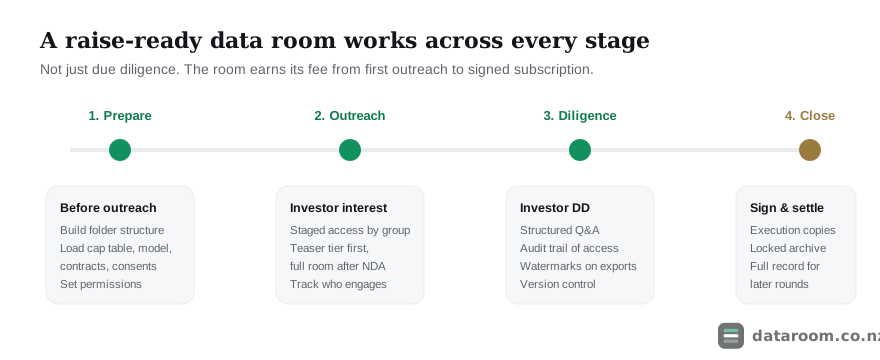
The point of the timeline is simple: the room earns its fee from first outreach to signed subscription, not just during the diligence crunch. Getting the early phases right is what makes the crunch short.
“Capital raising” is also a wider category than most founders assume. It covers an angel or seed equity round, a Series A or later venture round, a growth-equity private placement, convertible notes or SAFEs, and debt raising, and it stretches up to a regulated retail offer and an eventual NZX listing. The common thread is that you are inviting outsiders to put money in, and they will want to look under the bonnet first.
Where your raise sits on that spectrum decides two things: how much disclosure the law demands, and how much room infrastructure you actually need.
Are you making a wholesale, eligible or retail offer?
This single distinction, who you are allowed to offer to, shapes what you load and who you let in. It is worth getting right before you open the room to a single person.
Wholesale and eligible-investor offers
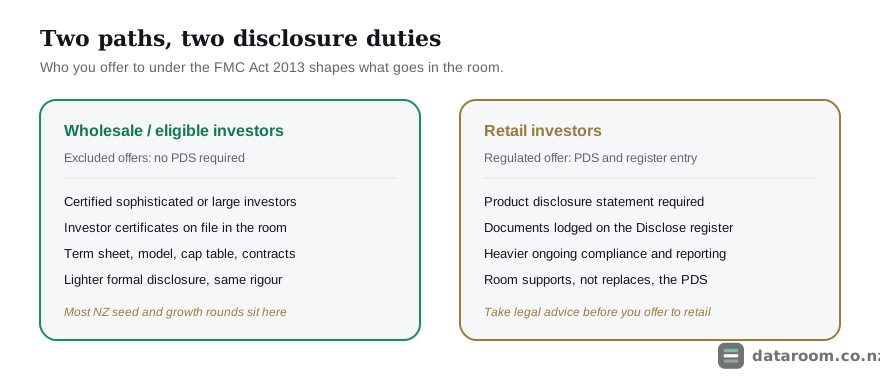
Most New Zealand rounds are offered only to wholesale or eligible investors: angels, family offices, funds, and high-net-worth individuals who certify their status.
Under the Financial Markets Conduct Act 2013, an offer made only to wholesale investors is an excluded offer. It does not need a product disclosure statement.
That is lighter, not lawless. You still have to certify those investors correctly and keep the paperwork, because if you get the investor status wrong you can accidentally make a regulated retail offer without the disclosure it demands, which is a genuinely expensive mistake. “Wholesale” is a defined test, not a vibe: it covers investment businesses, large entities, and individuals who meet asset or turnover thresholds or self-certify as eligible with sign-off.
Every one of those routes leaves a document, and that document belongs in the room.
Store signed investor certificates, NDAs and subscription agreements in a dedicated legal folder, so the evidence that your offer qualified as wholesale sits right alongside the offer itself. When an investor’s lawyer later asks how you confirmed status, you want to point at a folder, not search an inbox.
Retail offers and the Disclose register
A retail offer is a different animal.
It needs a product disclosure statement lodged on the Disclose register, and it carries heavier ongoing obligations. This is where a green-hydrogen venture crowdfunding from the public, or a horticulture co-op inviting hundreds of growers, ends up. The government’s plain-English overview of raising funds and your obligations is a sensible first read, and anything approaching a retail raise warrants proper legal advice before you open the room to anyone.
Transparency is not the same as opening every folder to everyone on day one. In a capital raise, staged, permissioned access is how you look open and in control at once, and control is what closes rounds.
What does a raise-ready room cost in NZD?
Less than founders fear, and far less than a stalled round. Pricing tracks the shape of the raise, not the size of the company.
The table below sizes a sensible monthly spend by stage. Two adjustments apply to every row: vendors usually quote in USD, and New Zealand adds 15% GST on top.
| Raise stage | Typical investors | Key documents | Sensible monthly spend |
|---|---|---|---|
| Angel / pre-seed | 3 to 15 | Deck, cap table, model, key contracts | $99 to $250 flat |
| Seed / Series A | 10 to 30 | Full financials, contracts, IP, board papers | $99 to $350 flat |
| Growth / private placement | 20 to 60 | Detailed diligence set, forecasts, legal | $350 to $700 |
| Large placement / pre-IPO | 40+ | Extensive, tightly controlled disclosure | Quote-based, $700 to $2,200+ |
| Retail offer / NZX listing | Public | PDS-grade disclosure, controlled access | Quote-based, $2,000+ |
The pattern mirrors what we see across the market in our virtual data room pricing in New Zealand guide. Under roughly $350 a month buys a capable flat-rate room for most equity rounds, and only large or regulated raises push into quote-based enterprise territory.
If cost is the deciding factor for a small round, is a virtual data room worth it for a small NZ deal? weighs the spend against the risk. The short version: for our Tauranga agritech raising $4 million, a $200-a-month room is a rounding error against the round, and the credibility it buys is not.
Compare data rooms for a New Zealand raise
Indicative NZD pricing, charging models and trials for every provider we track, side by side.
How do you stage investor access without killing momentum?
Founders often reach for the wrong instinct here. Transparency wins trust, they think, so open the whole room to anyone who signs an NDA.
That is both a security risk and a signal problem.
Your most sensitive material, detailed customer contracts, employee data, board minutes, the full cap table, does not belong in front of a party still deciding whether to take a first call. Over-disclosure also buries the documents that actually move a decision under a pile of noise. The fix is to stage access in tiers, and to set those tiers per folder and per group so you can revoke one the instant a party passes.
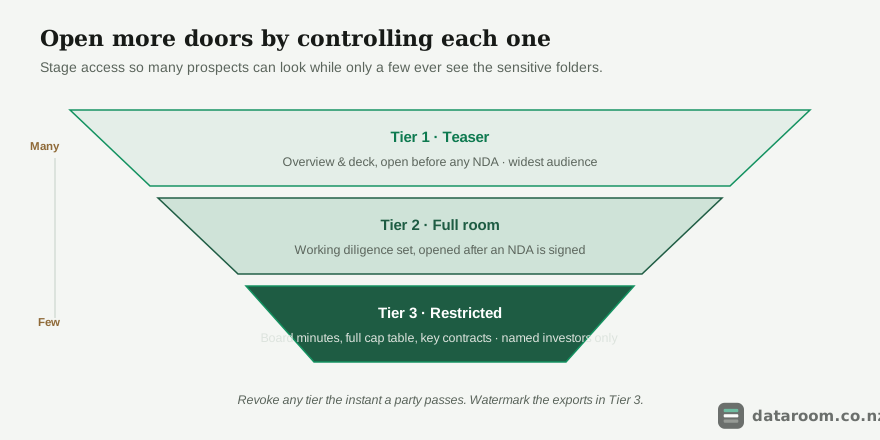
Read the funnel from the top. A Nelson seafood exporter raising growth capital can let ten prospects browse the teaser while only two serious buyers ever reach the supply contracts in the restricted tier. That is the counter-intuitive part of a good room: the features that feel like friction, permissions, watermarking, expiring links, are exactly what let you invite more prospects in with less risk.
Staging also protects you from the leak that matters most: a competitor posing as an interested party. Uncontrolled access is how confidential pricing or a key customer list ends up on a rival’s desk, and how you lose the ability to say precisely what any given investor saw.
Watermark the sensitive exports and set expiry on the links. If a Waikato dairy-tech founder passes on a fund after two meetings, one click should close the door behind them.
Our guide to what documents go in a data room maps the layers, and a clean data room folder structure makes staging effortless rather than manual.
Why won’t a shared drive or an inbox do the job?
Because a raise needs proof, not just storage.
Proof of who saw what. Proof you can pull access back. Proof, if an investor ever disputes it, of exactly what was disclosed at close. A shared drive gives you none of that, and a set of email attachments gives you even less.
| Capability for a raise | Email attachments | Shared drive | Virtual data room |
|---|---|---|---|
| Per-folder, per-investor permissions | ✗ | ✗ | ✓ |
| Full audit trail of who viewed what | ✗ | ✗ | ✓ |
| Dynamic watermarking on exports | ✗ | ✗ | ✓ |
| Revoke access instantly after a pass | ✗ | ✗ | ✓ |
| Structured diligence Q&A | ✗ | ✗ | ✓ |
| Staged access tiers for outreach | ✗ | ✗ | ✓ |
| Locked archive of what was disclosed | ✗ | ✗ | ✓ |
Two rows do quiet, strategic work. The audit trail is not a vanity metric: when it shows an investor spent twenty minutes on the churn tab and re-read the customer contracts, it tells you where their concern sits, so you can address it before they raise it. The other row is security, because for anyone raising from institutional or repeat investors, permissions and watermarking are table stakes rather than paranoia.
For a small raise, the free tool is a false economy the first time something goes wrong.
We spell out the gap in virtual data room vs Google Drive and virtual data room vs Dropbox, and cover what to demand in virtual data room security.
How do you build a raise-ready room before the first meeting?
Here is the discipline most founders miss. “Raise-ready” is a state you reach before the first meeting, not a sprint you do after a term sheet lands.
A room takes preparation, because “ready” means complete, current and correctly permissioned, not merely uploaded. The scramble to assemble a cap table and redact sensitive fields while an investor waits is precisely the friction that stalls a round. Preparation is also where you catch the gaps, a missing shareholder agreement, an unsigned IP assignment, before an investor does.
Build a raise-ready room in six steps
Do this before your first investor meeting, not after a term sheet lands.
- 1
Choose the room and set the term
Pick a flat-rate plan sized to your raise stage, and match the minimum term to how long the round will realistically run. Use a free trial to pilot with real documents first.
- 2
Build the folder structure
Start from a proven layout: overview, financials, cap table and equity, legal and contracts, IP, team, and a data protection folder. A clear structure signals a well-run company.
- 3
Load current, complete documents
Upload the deck, model, historical accounts, key contracts, cap table and constitution. Check every file is the latest version; investors notice stale numbers immediately.
- 4
Set staged permissions
Create access tiers: a teaser group for early conversations, a full-room group after an NDA, and restricted folders for late-stage confirmatory diligence. Watermark sensitive exports.
- 5
Prepare the compliance folder
Store NDAs, investor certificates and draft subscription documents together, so the evidence your offer qualifies as wholesale sits with the offer. Take legal advice if you approach a retail offer.
- 6
Run a Q&A dry run and open access
Set up the Q&A workflow with owners for each topic, invite a trusted advisor to test the room, then release access to your first investors in the right tier.
See our startup fundraising room guide for the founder-specific version, and how to set up a virtual data room for the full mechanics.
What documents do investors expect inside?
Investors want a complete, current picture of the business, laid out so they can find things without asking. The core set is consistent across most New Zealand raises, though the depth scales with the round.
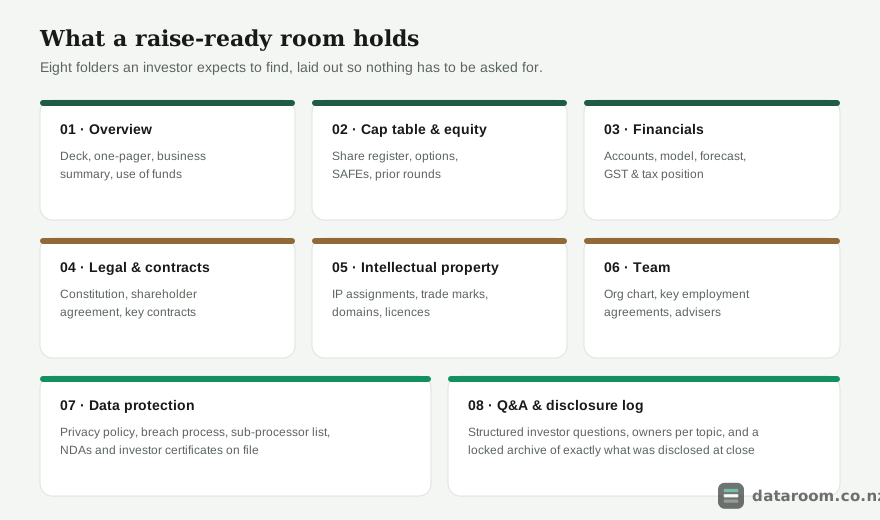
The core set
The eight folders above are the spine of almost every equity raise. At minimum, expect to hold the pitch deck and a short business overview, a capitalisation table and share register, the company constitution and shareholder agreements, two to three years of financials and a forward model, material customer and supplier contracts, IP ownership and assignment documents, key employment agreements and the org chart, and a legal folder for NDAs, investor certificates and subscription documents.
You can cross-check the register details investors will verify against the public Companies Office register at any time. Our what documents go in a data room checklist breaks the set down by deal type.
The currency test
For a founder, the discipline is ruthless currency.
One out-of-date cap table, or a contract missing a signature, does more damage to confidence than a missing document, because it makes an investor wonder what else is stale. A Christchurch robotics startup can have a brilliant model and still lose a Series A investor’s trust over a share register that does not tie to the constitution.
Fix the source of truth before you open the doors.
What does an investor actually read when they open your room?
They read two things at once: the numbers, and how you run the process.
The second read is where founders quietly lose ground. A handful of avoidable signals tell an experienced investor the diligence will be hard work, before they have judged the business at all. The numbers you can only improve slowly; the process signals you can fix this afternoon, which makes them the cheapest points on the board.
That is the whole argument for treating the room as a first impression rather than a filing cabinet. It is the one part of the raise where a weekend of tidying visibly changes how a stranger reads your company.
Which red flags make an investor wary before they judge the business?
Each of these is simple to fix once you know to look for it.
- A stale or contradictory cap table. If the share register in the room does not match the public record, expect the raise to stall while an investor reconciles the two. Fix the source of truth first.
- Unsigned or missing foundational documents. A shareholders’ agreement without signatures, or an IP assignment never executed, reads as a live risk rather than an oversight.
- A single “Documents” folder with fifty files in it. No structure signals no process. A clear folder layout does more for confidence than another slide.
- Q&A that goes quiet. Slow or scattered answers suggest a stretched team. Running Q&A without losing control keeps momentum and shows the company is organised under pressure.
- Over-broad access. If everyone can see everything, a careful investor wonders how your customer data and board minutes will be handled once they are a shareholder.
None of these are about the quality of the business.
They are about whether the founders look ready to be accountable to outside capital, which is exactly the question a raise puts on the table.
Can deal analytics really change how you run the raise?
Yes, and this is the capability founders underuse most.
A shared drive tells you nothing about intent. A real room shows you which investors are genuinely working the material and which documents draw the most attention, so you can spend your limited outreach energy on the prospects actually leaning in. When the analytics show a fund re-reading the churn tab and the customer contracts, you know their concern before the call, and you can walk in with the answer rather than being caught flat.
Silence is a signal too.
An investor who never opens the financials after a week of access has probably passed in their head, whatever the polite emails say. That lets you stop chasing and reallocate time, which in a live round is the scarcest thing you have. Founders who ignore this are negotiating blind.
How does the room fit your Privacy Act 2020 duties?
A raise moves personal information around: employee records, customer data, sometimes health or financial details buried in contracts. That triggers duties under the Privacy Act 2020, and a room is where you meet them cleanly.
The Act expects you to hold personal information securely, share it only for a proper purpose, and be able to account for who accessed it. Per-folder permissions, watermarking and a full audit trail map almost one-to-one onto those expectations, which is why a room is easier to defend than a shared drive if a question ever arises.
Two practical moves keep you tidy.
First, minimise: redact or aggregate personal details in diligence documents where the investor does not need the raw record, so you are not exposing more than the decision requires. Second, keep a data protection folder with your privacy policy, breach process and sub-processor list, so an investor’s counsel can see you take the obligation seriously rather than having to ask.
How long does the data-room phase take, and what does keeping it open cost?
Longer than most founders plan for, which is another argument for building the room early.
The variable you control is how ready the room is when diligence begins. A complete, well-organised room compresses the window, because investors are not waiting on documents or chasing answers through email; a half-built one stretches it, because every gap becomes a request and every request becomes a delay. The table below gives realistic ranges from full access to a signed subscription.
| Round type | Typical diligence window | Keep the room live for |
|---|---|---|
| Angel / pre-seed | 1 to 3 weeks | The round plus ~1 month |
| Seed / Series A | 3 to 8 weeks | The round plus 1 to 2 months |
| Growth / private placement | 6 to 12 weeks | The round plus a quarter |
| Pre-IPO / regulated offer | 3 months or more | Through to listing and beyond |
A flat monthly plan means an eight-week diligence phase, plus a few weeks of documentation and signing, sits comfortably inside a rolling term. Avoid signing a 12-month lock-in for a round you expect to close in three.
Budget for the room to stay live a little past close, as well. Investors sometimes want post-completion access to the final signed set, and a locked archive of exactly what was disclosed is worth keeping should a warranty question surface later.
Our guide to how long due diligence takes in New Zealand gives realistic timeframes you can plan a raise around, and a due diligence checklist for New Zealand deals makes sure nothing an investor will ask for is missing.
What mistakes stall a raise most often?
The same handful, in almost every round we see.
Building the room after the term sheet lands, rather than before the first meeting, so the founders are visibly assembling documents while the investor waits. Opening everything to everyone in the name of transparency, which buries the decision-making documents and exposes the sensitive ones. Letting the cap table in the room drift out of step with the Companies Office record, so an early reconciliation eats a week. And signing a long lock-in for a short round, then paying for months of an idle room.
None of these are hard to avoid.
They are all upstream of the business itself, which is the good news: a founder who reads this list can fix every item before an investor ever notices. That is the quiet advantage of treating the room as part of the raise strategy rather than a place to dump files at the end.
See our current pricing for a raise-ready room
A flat monthly plan and a 14-day free trial, so you can pilot the room with real documents before outreach.
Data rooms for capital raising: FAQ
Do I need a data room for a small capital raise in New Zealand?
For anything beyond a handshake round, yes. Even a small angel raise involves sharing a cap table, financials and contracts with multiple parties, and a data room gives you permissions, an audit trail and the ability to revoke access that a shared drive cannot. A capable flat-rate room starts around NZD $99 a month, which is modest against the credibility and control it buys.
How much does a data room cost for a capital raise?
Indicatively, most New Zealand equity rounds run on a flat plan of about NZD $99 to $700 a month depending on stage, with 15% GST on top and figures often quoted in USD. Large private placements and pre-IPO or retail offers move into quote-based enterprise pricing. See our NZ pricing guide for the full picture, and confirm any quote with the provider.
What is the difference between a wholesale and a retail offer?
Under the Financial Markets Conduct Act 2013, an offer made only to wholesale or eligible investors is an excluded offer that does not require a product disclosure statement, though you must certify those investors correctly and keep the records. A retail offer needs a PDS lodged on the Disclose register and carries heavier ongoing obligations. Most NZ seed and growth rounds are wholesale offers; take legal advice before approaching retail investors.
Should I give every investor full access at once?
No. Stage access in tiers: a light teaser for early conversations, a fuller room after an NDA, and the most sensitive folders only in late-stage confirmatory diligence with named investors. Staged, permissioned access protects confidential material and still lets you invite many prospects in, which is what actually speeds up a round.
When should I set up the room, before or after I have investor interest?
Before. Being raise-ready means the room is complete, current and permissioned before your first meeting, so investors never wait on documents. Preparing early also surfaces gaps, like a missing shareholder agreement or unsigned IP assignment, before an investor finds them.
Does a capital raise trigger Privacy Act 2020 duties?
Often, yes. Diligence documents can contain employee, customer or other personal information, which you must hold securely and share only for a proper purpose. A data room's permissions, watermarking and audit trail help you meet those duties, and keeping a data protection folder with your privacy policy and breach process shows an investor you take the obligation seriously.