
Best Data Room for Oil & gas in New Zealand (2026)
Compare virtual data rooms for oil & gas in New Zealand (2026): stage a Taranaki farm-out, share reserves and decommissioning data, indicative NZD pricing.
Best data rooms for Oil & gas in New Zealand
Our shortlist for this use case, ranked after review. Independent, with indicative NZD pricing. Compare them all in the full table.
- 1
The modern data room. Live in minutes on a 14-day free trial.
Visit site SponsoredView profile - 2

Built in Australasia; AI deal tools, strong local support.
- 3

The original VDR, built for large, complex financial transactions.
- 4
Enterprise M&A standard; deep audit trails.
A mid-cap operator holds an onshore petroleum mining permit near Ngaere, in the eastern Taranaki foothills. It decides to farm down a third of its interest while keeping operatorship.
It wants an incoming partner to carry the next appraisal well. To price that, the partner needs enough subsurface, commercial and liability data, without seeing the whole permit history of a company it has not yet signed anything with.
That single tension, share enough to close but not a page more than the stage warrants, is the whole job of an upstream data room in New Zealand. This guide builds one for a Taranaki farm-out, then stretches it to a full asset sale or a JV realignment.
What sits in the permit file before a farm-out opens?
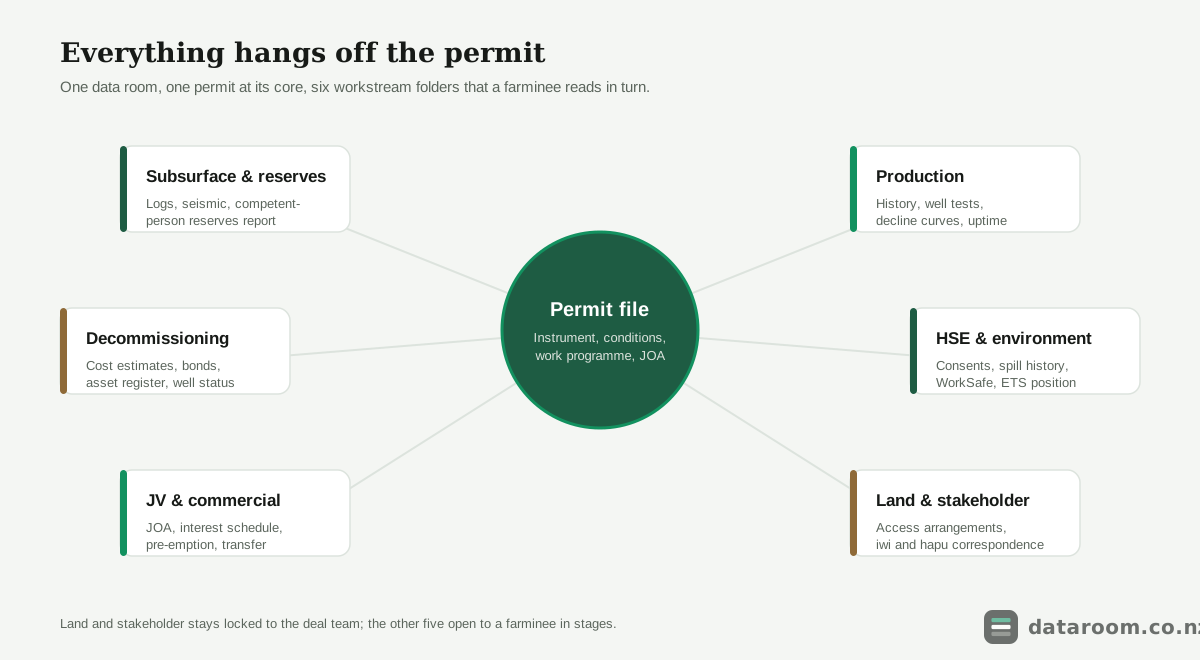
Everything in an upstream deal hangs off the permit. So the permit file is the first folder you build and the first one a partner opens.
Under the Crown Minerals Act 1991, a petroleum permit is held on conditions administered by New Zealand Petroleum & Minerals. An incoming party reads the permit instrument before it reads anything geological.
It wants three things confirmed fast: the permit is in good standing, the work programme is met, and nothing in the consent history bites the interest it is buying.
Get these in the folder before you invite anyone in.
- The permit instrument and its conditions, plus every variation, extension and change of conditions granted by NZP&M since grant.
- The work-programme status, showing which committed wells, seismic and studies are done and which remain, because an unmet commitment transfers as a live obligation.
- The JV operating agreement (JOA) and the current participating-interest schedule, so the buyer sees exactly what percentage it is taking and how costs and votes split.
- The consent-to-transfer position. A permit transfer needs the Minister’s consent through NZP&M, and pre-emption rights under the JOA may let existing partners match the deal.
- Annual and technical reports already lodged with NZP&M, because a partner will cross-check your data against what the Crown already holds.
If a work-programme item is behind or a variation is pending, note it as outstanding rather than leaving a silent gap. A carried partner reads an honest “extension applied for” line far better than a hole its lawyers find on their own. The wording of the Act is on legislation.govt.nz, worth pointing a partner to directly.
What a farminee requests first
A farminee’s opening data request is predictable. Before it touches a single log, it nearly always asks for:
- the current reserves statement and the production history behind it,
- the decommissioning cost estimate and any Crown financial-security position,
- the permit standing and the work-programme status,
- the HSE, consents and incident record,
- the JOA and the participating-interest schedule.
How do you stage the room across the JV parties and the regulator?
An upstream deal has more distinct audiences than a plain business sale. Several are entitled to see completely different slices of the same room.
Group-level permissions let all of them work in one place, without any group seeing another’s workspace.
- The incoming farminee sees the technical and commercial pack once an NDA is signed, but not your internal economics or board papers.
- Existing JV partners need visibility for pre-emption and JOA-consent purposes, and they must not see the incoming party’s own submissions.
- NZP&M and other Crown touchpoints may need a defined, read-only view for the transfer-consent process.
- Iwi, hapu and rohe interests engaged under the permit’s conditions or an access arrangement have correspondence that stays tightly held.
- Lawyers and reserves auditors touch nearly everything and generate most of the Q&A.
That separation is not cosmetic. Your room holds personal information, from landowner and iwi contacts to staff HSE records, and that stays your responsibility under the Privacy Act 2020 even inside a third-party tool.
An exportable audit log of who opened what is how you evidence that you controlled access. Our note on data room security in New Zealand covers the accountability point in depth.
Keep one rule in mind while you set the groups up: it is far easier to open a folder later than to claw back one a party has already downloaded. Start each group tighter than feels polite and loosen it as the NDA position advances.
Which subsurface and reserves data reprices a deal?
Subsurface data is where an upstream valuation is won or lost, and it is also the bulkiest content the room will ever carry.
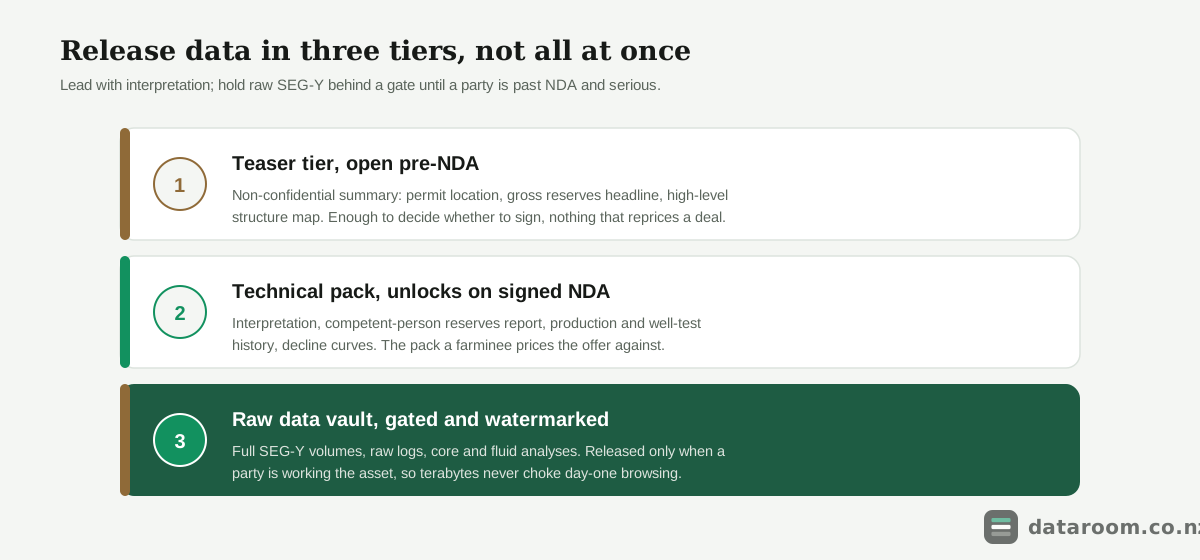
Well logs, deviation surveys, core and fluid analyses, seismic volumes and the interpretation projects behind them can run to terabytes. Two rules keep that mass from either sinking the room or leaking your best data.
Stage native volumes behind the interpretation
Few buyers pull full SEG-Y volumes on day one. Most start with the interpretation, the reserves report and the production history, then request the raw data once they are serious.
Decide up front what goes in as a report and what waits as native large format. Gate the heavy files so they release only when a party is genuinely working the asset.
Make the reserves statement the anchor document
Whether it follows PRMS or another framework, a competent-person or independent reserves report drives the number both sides argue about. It earns the top of the technical folder.
Put the current production data, well-test results and decline history next to it, so a partner can rebuild the type curve rather than take yours on faith.
A stale or thin reserves section invites the question of what you are not showing, and that question reprices a deal faster than any dry hole.
If the report is more than a year old, say so and note what has changed since. A dated number presented honestly reads better than a fresh one a partner cannot reconcile against the production history one folder over.
Where do decommissioning liabilities hide in the data room?
Decommissioning is the liability New Zealand upstream buyers now scrutinise hardest, and the room has to be honest about it from the first folder.
Since the 2021 amendments to the Crown Minerals Act, holders carry explicit decommissioning obligations, the Crown can require financial security, and liability can reach back to former holders when the current holder cannot pay.
An incoming partner is buying a share of that tail. It reads the decommissioning folder as closely as the reserves report, sometimes more closely.
The reason the scrutiny sharpened is not abstract. When the Tui field operator became insolvent, the Crown funded decommissioning at a cost widely reported around NZD $155 million, and that episode is the direct backdrop to today’s trailing-liability rules.
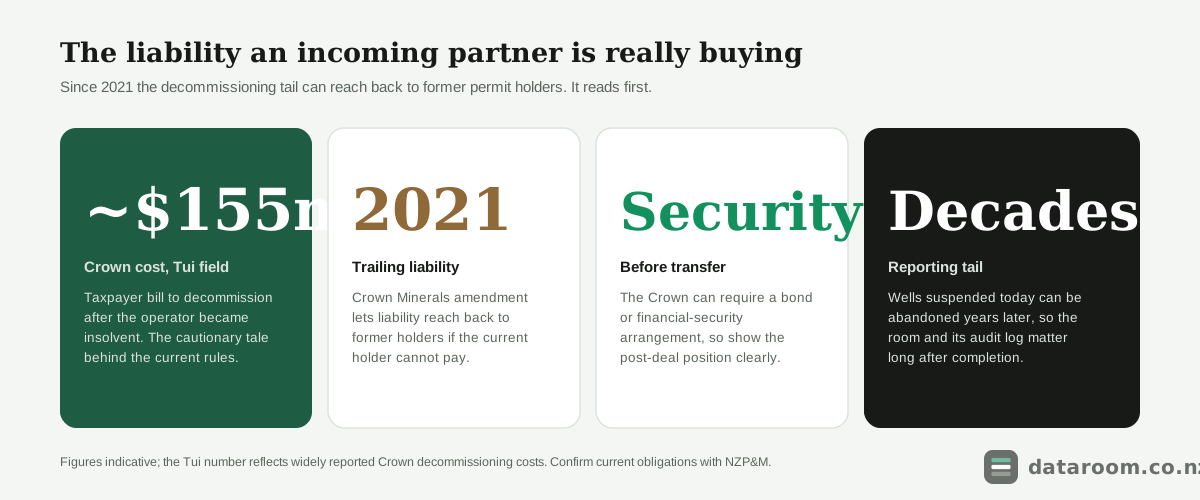
Give a partner the full picture rather than a comfortable one.
- Current abandonment and decommissioning cost estimates, with the assumptions and the date each was struck.
- Any financial-security or bond arrangements agreed with the Crown, and the post-deal position for the interest being sold.
- Asset registers for wells, platforms, flowlines and onshore facilities, with status (producing, suspended, plugged) for each.
- The suspension and abandonment history of individual wells, since a poorly abandoned legacy well is a real reopening cost.
Understating this section does not make the liability disappear. It moves the argument to the sale-and-purchase agreement, where it costs more and sours the room. For how buyers pressure-test liabilities across a transaction, see our guide to data rooms for mergers and acquisitions in NZ.
In New Zealand upstream, an empty decommissioning folder is not a clean record. It is the first thing a buyer’s lawyers will assume you are hiding.
What HSE and environmental records does a buyer read first?
Health, safety and environmental performance is a gating item now, not a footnote. New Zealand has a specific consent map a buyer will check line by line.
Offshore activity in the exclusive economic zone runs under the EEZ Act and marine consents from the Environmental Protection Authority. Onshore activity sits under regional and district plans and the Resource Management Act.
Process-safety and worker-safety records fall under WorkSafe and the petroleum regulations, and emissions sit under the NZ ETS. A buyer wants to see that the licence to operate is intact and that no incident is about to become a cost.
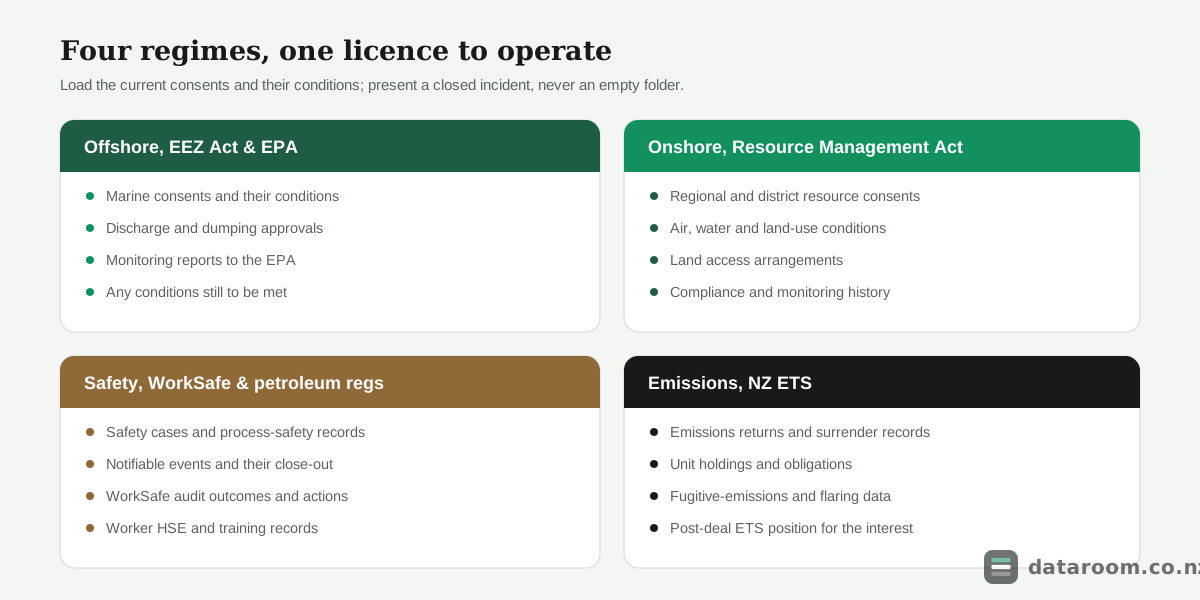
Load the current marine or resource consents and their conditions, the emissions and discharge records, any spill or loss-of-containment history with the remediation that followed, WorkSafe notifications and audit outcomes, and the ETS reporting position.
Present the clean record plainly and the incident record with its close-out. A documented, closed incident reassures a buyer far more than a suspiciously empty folder.
Every producing asset with a long history has had events. The question a buyer is really answering is whether you manage them or bury them.
How do you map each workstream to the group that reads it?
The fastest way to lose an upstream room is to dump everything into one tree and let a farminee hunt. Map each workstream to the group that needs it before you upload a file, and the room almost builds itself.
Decide the workstream, the folder and the group in one pass, so a document never lands somewhere its audience cannot reach or a rival can.
| Workstream | Core documents | Who reads it first |
|---|---|---|
| Permit & tenure | Permit instrument, conditions, variations, work-programme status | Farminee, JV partners, NZP&M |
| JV & commercial | JOA, participating-interest schedule, pre-emption and transfer terms | Farminee, existing partners, lawyers |
| Subsurface | Well logs, seismic, interpretation, competent-person reserves report | Farminee's technical team |
| Production | Production history, well tests, decline curves, facility uptime | Farminee, reserves auditor |
| Decommissioning | Cost estimates, financial-security arrangements, asset register, well status | Farminee, lawyers |
| HSE & environment | Marine and resource consents, spill and incident history, WorkSafe records | Farminee, environmental adviser |
| Land & stakeholder | Access arrangements, landowner and iwi agreements and correspondence | Deal team only |
| Finance & tax | Joint-venture accounts, cash calls, royalty and ETS position | Farminee, lawyers |
Keep the land and stakeholder folder locked to the deal team throughout. Most of what a farminee needs to price the deal lives in the technical, decommissioning and HSE folders, and there is rarely a reason to surface sensitive iwi correspondence to price an appraisal well.
What does an upstream data room cost in NZD?
Upstream rooms carry more heavy data and stay open longer than a typical business sale. Budget for the size of the archive and the length of the process, not just a headline monthly rate.
The ranges below are indicative NZD figures to frame a conversation, not quotes, and they are usually GST-exclusive. Always confirm a written quote and compare the current shortlist in the main comparison table and on the pricing page.
| Deal shape | Indicative NZD range | What drives it |
|---|---|---|
| Single-permit farm-out, light data | from ~$300/mo | User count and process length |
| Active farm-out, full seismic and structured Q&A | ~$800 to $1,800/mo | Storage volume and Q&A workflow |
| Multi-permit portfolio or full asset sale | ~$2,000 to $5,000+/mo | Data volume, users, longer window |
| Post-close JV or reporting room, mostly read-only | ask per dormant room | How the provider prices a quiet room |
Two traps are worth naming. Storage-metered pricing can outrun a flat monthly rate badly once raw seismic goes in, so on a data-heavy asset a flat figure is usually the safer number to plan around.
The post-close reporting room, where a JV keeps sharing operator reports for years, is where a headline rate and the real cost diverge most. Ask about it specifically before you sign anything.
A 14-day free trial, where a provider offers one, lets you build and shape the pack before you commit to a monthly plan. That matters more on an upstream room than a simple sale, because the folder structure alone takes real work.
See flat monthly pricing for a farm-out room
A predictable per-room rate and a 14-day free trial, with no per-page metering to model against terabytes of seismic.
Shared drive, data room, or enterprise platform: which fits?
Not every deal needs the same tool, and matching the tool to the shape of the farm-out saves both money and grief.
The decision tree below runs the three realistic choices against the questions that separate them: whether more than one party is involved, whether there is seismic worth protecting, and whether the deal is a single permit or a portfolio.
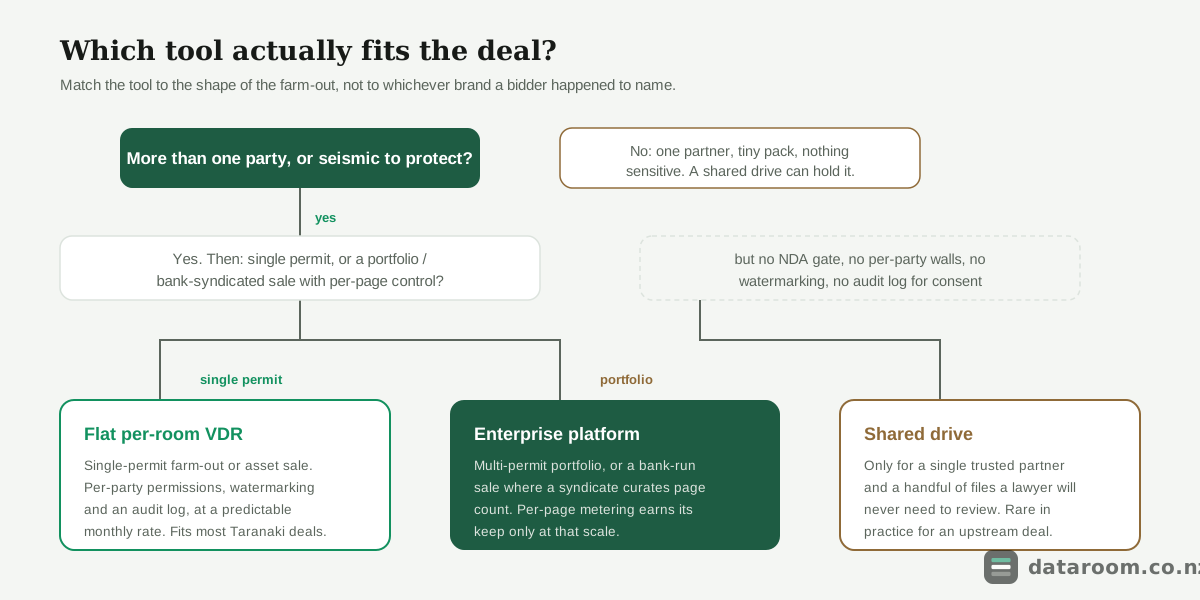
Where a shared drive quietly fails
For one incoming partner and a tiny pack, a shared drive can technically hold the files.
What it cannot do is gate the reserves report behind an NDA, wall the farminee off from your JV partners, watermark leak-prone seismic, or keep the audit log the transfer-consent record will want. For anything a lawyer reviews, those four gaps are the whole reason to use a room.
What the tiers give you at each price
The matrix below shows what tends to ship as standard, and it reads in both directions.
Use it to check that a lean plan has not dropped something a farminee will demand on day one, and that an enterprise tier is not charging you for bank-grade metering a single-permit farm-out will never touch.
| Capability | Shared drive | Flat per-room VDR | Enterprise platform |
|---|---|---|---|
| Per-party permission groups | ✗ | ✓ | ✓ |
| NDA-gated release of the technical pack | ✗ | ✓ | ✓ |
| Dynamic watermarking on seismic | ✗ | ✓ | ✓ |
| Full, exportable audit log | ✗ | ✓ | ✓ |
| Structured Q&A with assignment | ✗ | ✓ | ✓ |
| Handles terabyte-scale native seismic | ✗ | ✓ | ✓ |
| Per-page metering and redaction suite | ✗ | ✗ | ✓ |
| Dedicated onboarding and account manager | ✗ | ✗ | ✓ |
The honest read is that most Taranaki farm-outs land in the middle column.
The enterprise platform earns its per-page meter only when a portfolio or a bank-run sale needs page-by-page control. Paying for that on a single-permit deal is the most common way an operator overspends here.
How do you build the room in the right order?
Sequence matters as much as content. A room built in the wrong order either leaks early or stalls the deal while you retrofit permissions.
These six steps put the structure and the walls in before a single external party sees anything.
Build the room in six steps
Get the structure and the permissions right before any external party is invited in.
- 1
Assemble the permit file first
Load the permit instrument, conditions, variations, work-programme status and the JOA. Note any pending variation or unmet commitment as outstanding rather than leaving a gap.
- 2
Design the folder tree by workstream
Mirror the workstream map: permit, JV, subsurface, production, decommissioning, HSE, land and finance. Decide now which folders open pre-NDA, post-NDA and only on request.
- 3
Set the permission groups before uploading widely
Create separate groups for the farminee, existing partners, the Crown view and the deal team. Start each tighter than feels polite; it is easier to open a folder than to recall one.
- 4
Tier the subsurface data
Put interpretation and the reserves report in the post-NDA pack, and gate raw SEG-Y and native logs behind a request step so terabytes never load on day one.
- 5
Turn on watermarking and the audit log
Watermark leak-prone seismic and confirm the audit log is exportable, since it evidences how information was shared for the NZP&M consent and any later dispute.
- 6
Run a dry pass before you invite anyone
Log in as each group and confirm it sees only what it should. Fix cross-visibility now, because the first thing a lawyer tests is whether the walls actually hold.
How long should the room stay open after completion?
Often for years, as a read-only JV reporting room, because operator reports, cash calls and decommissioning updates keep flowing to partners long after the ink dries.
An upstream room rarely closes at completion the way a business sale does. It changes gear from a deal room into a standing reporting channel.
That longevity is exactly why the audit log is worth preserving. JV and liability disputes can surface years after completion, and a decommissioning question can arrive a decade later when a suspended well finally comes up for abandonment.
Confirm how the provider prices a mostly dormant room and how exports work before you sign, because the quiet years are where a headline rate and the real cost diverge most.
What mistakes reprice a farm-out room?
A handful of avoidable errors do most of the damage to an upstream room, and they cluster at the two edges of the process rather than the busy middle. Naming them is cheaper than repeating them.
Four mistakes cause most of the pain:
- A thin reserves or decommissioning folder. Presenting the asset at its best is the wrong instinct in a room, because a partner that senses a curated gap discounts the whole deal, not just the missing page.
- Loading raw seismic on day one. It chokes the room and hands your most valuable data to a party that has not yet committed to anything.
- Treating personal information casually. Landowner, iwi and staff records carry Privacy Act 2020 obligations that do not stop at the door of a third-party tool; access control and logging is the baseline, not a premium feature.
- Signing a long minimum term or a per-page meter for a room whose real shape is a nine-week farm-out with a multi-year read-only tail.
That last mismatch, not the brand on the login page, is what turns a sensible spend into a wasteful one.
Compare upstream-ready data rooms side by side
See indicative NZD pricing, charging models and trials for every provider we track, in one table.
Questions Taranaki operators ask about farm-out rooms
Do I really need a data room for a single-permit farm-down?
For one incoming partner and a small pack, a shared drive can technically hold the files, but it gives you no NDA gate on the reserves report, no per-party permissions to keep the farminee and your existing JV partners apart, no watermarking on leak-prone seismic and no audit log for the transfer-consent record. For anything a lawyer will review, those are the reasons to use a room over a drive.
How do I keep an incoming partner from seeing another bidder's submissions?
Put each party in its own permissioned workspace inside one room. They all see the shared technical and commercial pack; none sees another party's questions, offers or correspondence. This is standard practice and the main reason a competitive farm-out runs in a VDR rather than a folder.
How does NZP&M transfer consent affect the room?
A permit transfer needs ministerial consent through New Zealand Petroleum & Minerals, and pre-emption rights under the JOA may let existing partners match the deal. Neither changes how you build the room, but both belong in the permit folder from day one so the buyer prices the timeline correctly. A clean audit log also helps evidence how information was shared if the Crown asks.
Should raw seismic go straight into the room?
Usually not on day one. Lead with the interpretation, the reserves report and the production history, and stage the raw SEG-Y and well data for release once a party is past NDA and genuinely working the asset. It keeps the room fast and keeps your most valuable data behind a gate until it needs to move.
Who now carries the decommissioning liability?
The current permit or licence holder carries it, but since the 2021 Crown Minerals amendment the liability can reach back to former holders if the current holder cannot meet it, and the Crown can require financial security. That is why an incoming partner reads the decommissioning folder, and the post-deal security position, as closely as the reserves report.
How long should the room stay open after completion?
Often for years, as a read-only JV reporting room, because operator reports, cash calls and decommissioning updates keep flowing to partners. Confirm how the provider prices a mostly dormant room and how exports work before you sign, because JV and liability disputes can surface long after completion and a preserved audit log is worth keeping.
Explore other use cases
A data room fits more than one kind of deal. See our other New Zealand guides.
Consumer & retail
How a virtual data room fits consumer & retail deals in New Zealand.
See the guideDue diligence
How a virtual data room fits due diligence deals in New Zealand.
See the guideFinancial institutions
How a virtual data room fits financial institutions deals in New Zealand.
See the guideHealthcare & life sciences
How a virtual data room fits healthcare & life sciences deals in New Zealand.
See the guideIndustrials
How a virtual data room fits industrials deals in New Zealand.
See the guideM&A
How a virtual data room fits m&a deals in New Zealand.
See the guideRenewable energy
How a virtual data room fits renewable energy deals in New Zealand.
See the guideReal estate
How a virtual data room fits real estate deals in New Zealand.
See the guideStartup fundraising
How a virtual data room fits startup fundraising deals in New Zealand.
See the guideTechnology, media & telecom
How a virtual data room fits technology, media & telecom deals in New Zealand.
See the guide