
Best Data Room for Consumer & retail in New Zealand (2026)
Compare virtual data rooms for consumer and retail sales in New Zealand (2026): store leases, franchise, supplier terms, brand IP and NZD pricing.
Best data rooms for Consumer & retail in New Zealand
Our shortlist for this use case, ranked after review. Independent, with indicative NZD pricing. Compare them all in the full table.
- 1
The modern data room. Live in minutes on a 14-day free trial.
Visit site SponsoredView profile - 2
Flat-rate value for advisors and mid-market deals.
- 3
An M&A project-management platform with a data room built in, for teams that run the whole deal lifecycle in one place.
- 4

Built in Australasia; AI deal tools, strong local support.
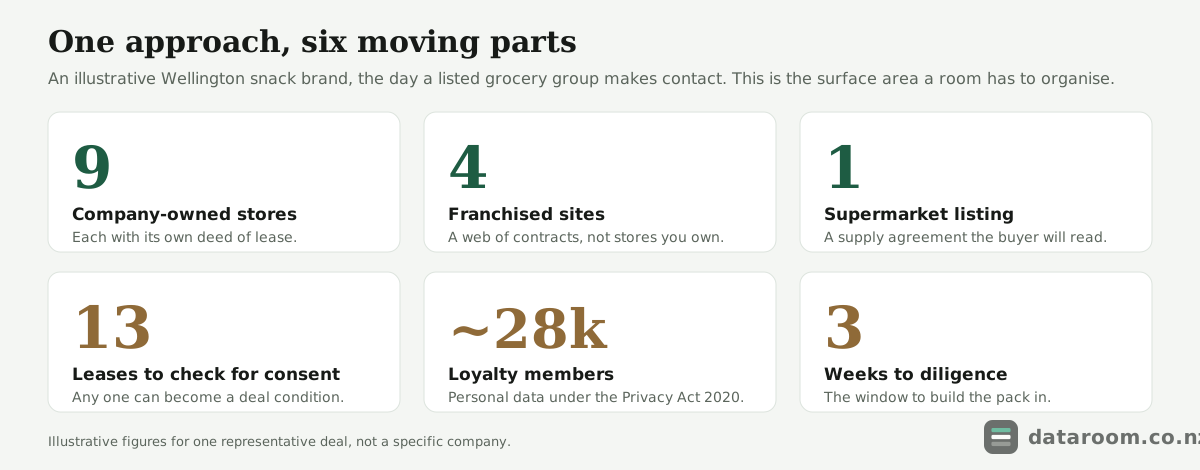
A Wellington snack brand gets an approach from a listed grocery group. Nine company stores, four franchised sites, a supermarket listing, one tidy loyalty app. The founders have three weeks before the acquirer’s advisers want to start diligence.
The brand is real. The revenue is real. And yet the deal is about to slow to a crawl.
The leases live in a filing cabinet in Petone. The supplier terms are in someone’s inbox. Nobody is quite sure whether the trademark was renewed.
This is where a retail data room earns its keep. Not because retail diligence is harder than an infrastructure deal, but because it is spread across more places and more people. A buyer’s confidence drains fast when answers arrive in dribs.
This guide is about the shape of a consumer and retail sale in New Zealand: the store estate, the franchise layer, supplier and inventory terms, brand and trademark IP, and the loyalty data behind the app.
Selling a brand rather than a single asset? This is the workflow to plan for. For the document-by-document view, see what documents go in a data room. A single owner-operated store is lighter; the small-business data room guide covers that end.
What does a buyer actually diligence in a retail brand sale?
Not one thing. A buyer is not reading a single P&L. It is testing whether it can keep trading, and on what terms, across five layers at once.
Name the layers before you build a folder. Keeping them straight is the room’s whole job.
- Store estate. Can I keep trading from these sites, and does any lease block a change of ownership?
- Franchise layer. Am I buying stores I control, or a web of contracts with other operators?
- Supply and inventory. Are the supplier terms transferable, and how much of the stock is really saleable?
- Brand and IP. Do I get the trademarks, domains and artwork clean and unencumbered?
- Customer and loyalty. What is the database worth, and can I legally use it the way my business case assumes?
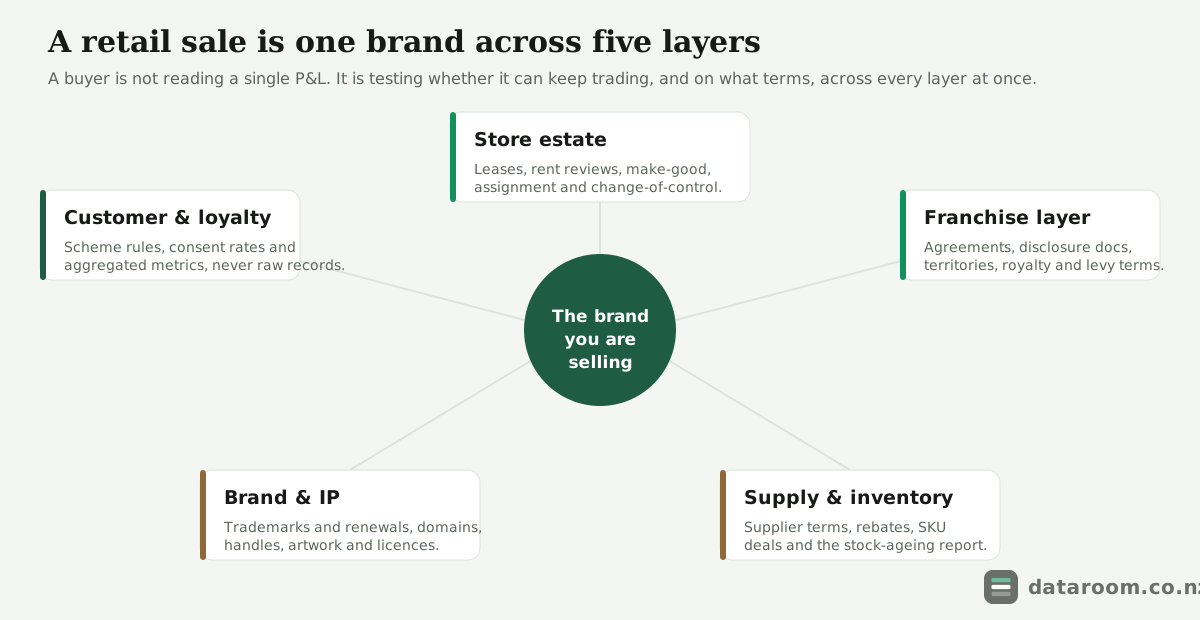
This framing matters because of sequencing. Each layer answers a different reviewer.
The fastest rooms open all five at once behind separate permission groups, rather than making a legal reviewer wade through supplier pricing to reach a lease. Wall the layers before you upload, and no document sits in the open while you decide who sees it.
Why do the store leases decide the pace of the sale?
In most retail deals the biggest source of diligence questions is not the accounts. It is the leases.
A brand with a dozen sites has a dozen landlords: a dozen expiry dates, a dozen rent-review and assignment clauses, and a dozen make-good obligations lurking at the end of each term.
What belongs in the lease pack?
Put every deed of lease in complete, and add a schedule at the top so a buyer reads the estate in one page:
- The deed and its variations, with rent-review records, guarantees and any personal guarantee the founders gave.
- The assignment and change-of-control clause, which matters most. If a lease needs landlord consent to assign or to change control, that consent becomes a live condition of the deal.
- Make-good obligations, because an end-of-term reinstatement cost is a real liability a buyer will price.
- A one-page lease schedule: site, landlord, current rent, next review, expiry, right of renewal, assignment trigger.
A buyer who reads the estate on one page stops firing questions and starts building an offer. The alternative, finding a landlord-consent clause in week four, resets the clock on the whole deal.
Personal property and the PPSR
Personal property is the other half of the store picture. Fit-out finance, EFTPOS and equipment leases, and any security on the Personal Property Securities Register all shape what actually transfers.
Pull a current PPSR search for each entity, cross-checked against the Companies Office register, and put it in the room. Financing charges are then visible before anyone asks, not a surprise on a machine the buyer assumed it owned.
What goes in the room, workstream by workstream?
Retail diligence runs across parallel workstreams, and the fastest rooms are built by workstream, not by document type. Map each pile to its folder before you upload anything.
| Workstream | Core documents | Where it sits |
|---|---|---|
| Store estate | Deeds of lease, variations, rent reviews, guarantees, make-good schedules, PPSR searches | Property, open to lawyers |
| Franchise | Franchise agreements, disclosure documents, territory maps, royalty and levy records | Franchise, open to lawyers |
| Supply & inventory | Supplier agreements, key SKU terms, rebate deals, stock-on-hand and ageing report | Supply chain, NDA-gated |
| Brand & IP | Trademark registrations and renewals, domains and social handles, packaging artwork licences | IP, open wide |
| Customer & loyalty | Scheme rules, privacy statement, aggregated database metrics, never raw records | Customer, restricted |
| People | Employment agreements, key-person terms, restraint clauses, payroll and holiday-pay position | People, HR and legal only |
| Financials | Management accounts, same-store sales, gross margin by channel, inventory writedowns | Financials, open to advisers |
Two of these piles hide the most risk, so stage them early rather than answering under pressure later:
- The holiday-pay position. The Holidays Act 2003 has caught many New Zealand retailers with variable-hours and casual staff, and a buyer prices in any remediation exposure it smells. Get the payroll assessment into the People folder before the room opens.
- The inventory ageing report. It tells a buyer how much of the stock on the balance sheet is really saleable, the number a grocery or apparel acquirer will test hardest.
Three piles draw the most questions in a retail room. Tick each off before you open:
| Pile | Pull and check | Buyer-ready when |
|---|---|---|
| Leases | Every deed, variation, rent review, guarantee and make-good schedule | A one-page schedule covers each site and its assignment trigger |
| Supplier terms | Key supply agreements, rebate deals and change-of-control clauses | Transferability is confirmed and sensitive pricing is aggregated |
| Inventory | Stock-on-hand and an ageing report by SKU or category | Slow and dead stock is flagged and written down honestly |
Grounding the abstraction in the deal we opened with makes the surface area concrete:
How do franchise and multi-site structures widen the pack?
A pure company-owned chain is the simple case. The moment franchisees enter, diligence widens: the buyer is acquiring a web of contracts, not a set of stores it controls.
New Zealand has no franchise-specific statute, so the general law and the voluntary Franchise Association code do the work, set out on business.govt.nz. The contracts themselves carry the weight.
Franchise disclosure and any pre-sale marketing also sit under the Fair Trading Act, which the Commerce Commission enforces. A buyer checks that nothing in the brand’s claims oversteps it.
Load each franchise relationship in full, and add a structure chart above it:
- The franchise agreement, with its disclosure document, territory definition, and royalty and marketing-levy terms.
- The change-of-control clause, because a franchisee’s consent, or at least their non-objection, can become a condition of the sale in the same way a landlord’s can.
- A corporate structure chart at the top of the room, showing which entity holds which lease, which employs the staff, and which owns the brand. Where sites run under different entities, this one page saves a hundred questions.
Group-level permissions keep this manageable inside one room. The property lawyers work the lease and franchise folders. The commercial team lives in supply and financials. The founders keep raw customer data locked away until signing is close.
One room, several walled workspaces, a single audit log of who opened what.
Who is allowed to see the loyalty and customer data?
This is where retail deals differ most from an M&A textbook. A loyalty scheme is often the crown jewel a grocery or FMCG buyer is paying for. It is also a pile of personal information governed by the Privacy Act 2020.
You cannot drop the customer table into a folder and let a competitor’s team browse it.
The safe pattern is to disclose the shape of the database, not its contents, and to release detail in stages:
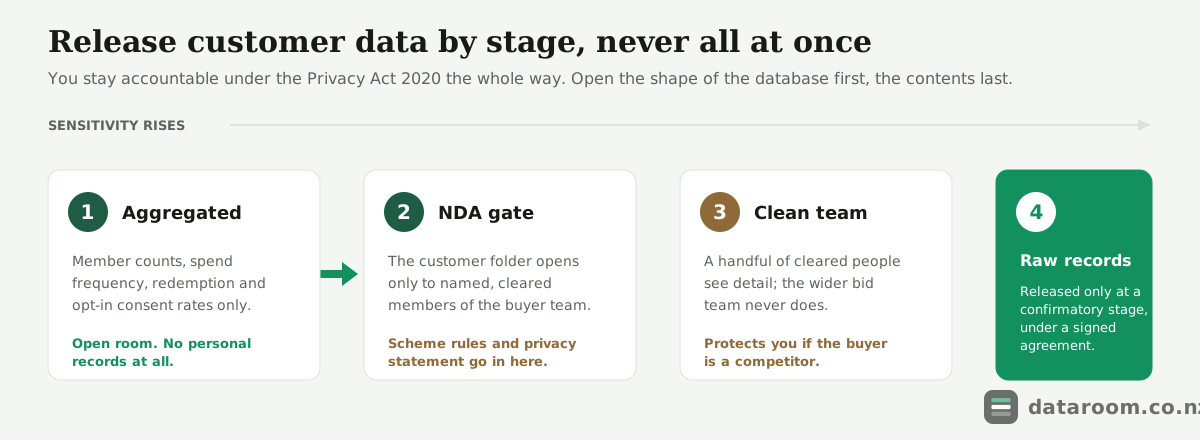
- Aggregated first. Active member counts, spend frequency, redemption rates, opt-in consent rates and churn tell a buyer what the scheme is worth without exposing a single person.
- Rules and consent wording next, behind an NDA gate. A buyer needs to know whether the data can legally be used the way its business case assumes, so the scheme’s own privacy statement belongs in the room.
- Raw records last, at a confirmatory stage under a signed agreement, and even then through a clean-team arrangement where only cleared individuals ever see names, emails and purchase histories.
Accountability for the loyalty data stays with you even after it sits inside a buyer’s third-party tool. Disclose the shape of the database first, and release the contents only when the deal has earned it.
The Office of the Privacy Commissioner expects reasonable security safeguards over the personal information you hold, and that duty does not pause because a deal is on.
How do you keep the brand and trademark IP clean?
Treat brand IP with the same care as the loyalty data, but in the opposite direction: here you want it maximally visible. A buyer paying for a brand needs to see it is genuinely yours to sell, unencumbered and current.
Open the IP folder wide and make it complete:
- Trademark registrations and renewal certificates for New Zealand and any export markets. A lapsed renewal is cheap to fix before the room opens and expensive to explain mid-diligence.
- Domain names and social handles, with proof of who controls each account, since a brand whose Instagram sits on a former contractor’s login is not clean.
- Packaging artwork, photography and design licences, confirming you have the right to use every asset the brand trades on.
- Any coexistence agreements or oppositions, because a buyer would far rather read about a prior dispute than trip over it.
The audit log does quiet work here too. Because you want this material seen, the log shows exactly which IP documents the buyer opened and when.
That protects you if a later dispute surfaces about what was disclosed. A well-lit IP folder is one of the few places in a retail room where more visibility, not less, is the safer setting.
What does a retail data room cost, and which controls earn their place?
Retail sales tend to be brisk once the pack is complete, so the room is often open for a few busy months, not years.
Two questions decide the spend: how heavy is the deal, and which controls it actually needs. Take the controls first.
Read the matrix in both directions. Check that a lean plan has not dropped something your bidders will demand, and that an enterprise tier is not charging for tooling a short trade sale never touches.
| Control | Single brand, few sites | Multi-site with franchise | Trade sale to a listed acquirer |
|---|---|---|---|
| Group-level permissions per workstream | ✓ | ✓ | ✓ |
| Full audit trail and access logs | ✓ | ✓ | ✓ |
| NDA gate on customer and supply folders | ✓ | ✓ | ✓ |
| Dynamic watermarking on artwork and terms | ✗ | ✓ | ✓ |
| Structured Q&A with assignment | ✗ | ✓ | ✓ |
| Clean-team / restricted-view workspace | ✗ | ✓ | ✓ |
| Bulk upload and auto-indexing | ✗ | ✓ | ✓ |
| Dedicated NZ-hours support desk | ✗ | ✗ | ✓ |
Now the money. The figures below are indicative NZD to frame a conversation, not quotes. Always confirm a written quote, and compare the shortlist on our pricing page and in the main comparison table.
| Deal shape | Indicative NZD | What drives it |
|---|---|---|
| Single brand, few sites | from ~$150/mo, flat | Capped users, short window; a 14-day free trial lets you build the pack first |
| Multi-site chain with a franchise layer | ~$400 to $900/mo | Structured Q&A and group permissions while diligence runs |
| Larger brand or trade sale to a listed acquirer | ~$1,000 to $2,500+/mo | Longer window, more bidders, heavier audit needs |
One trap is worth naming: storage-metered pricing on an image-heavy brand deal. Years of packaging artwork, store photography and marketing assets can outrun a flat monthly rate quickly.
For most retail vendors a flat monthly figure is the safer number to plan around.
See flat monthly pricing for a brand sale
No per-page or per-gigabyte metering to model against an image-heavy room, and a 14-day free trial to build the pack first.
How do you stage the pack before you open the room?
Staging should not swallow the three weeks you have before the acquirer’s advisers arrive. Sequence it so the slow items are ordered first and the fast ones fill in around them. Open only when the room is buyer-ready.
Stage the room in five moves
Order the slow items first, build the permission walls before you upload, and open only when the outstanding list is honest.
- 1
Confirm the trademark and lease consents
Check every trademark renewal and read each lease and franchise agreement for a change-of-control clause. These are the slow items, since a lapsed mark or a landlord consent can take weeks, so start them before anything else.
- 2
Build the workstream tree and walls
Create the seven workstream folders and their permission groups before you upload a single file, so the customer and supply folders are walled the moment the first document lands.
- 3
Load the lease schedule and estate spine
Populate the one-page lease schedule, the deeds and the PPSR searches first. This is the workstream a buyer's property lawyer opens on day one, so it should never be the thin one.
- 4
Aggregate the loyalty data, hold the raw records
Put the database metrics and scheme rules behind an NDA gate and keep every raw customer record out of the room entirely until a signed confirmatory stage.
- 5
Publish the outstanding list, then open
Mark anything mid-renewal or in progress as outstanding inside the room. An honest gap dated for follow-up beats a silent hole a reviewer finds first.
Weighing a full trade sale against a partial sell-down? The pack is largely the same; only the permission design changes. Our mergers and acquisitions use case covers where a trade sale turns into a full merger.
Consumer and retail data room FAQ
Do I really need a data room to sell a small chain?
For a single owner-operated store sold to one buyer, a well-organised folder can cover it. Once you have multiple leases, a franchise layer or a loyalty database, a shared drive stops being safe: you need per-group permissions, an NDA gate on customer data, watermarking on packaging and supplier files, and an audit log. A buyer's lawyer reads a bare shared link as a warning sign.
How do I stop a competitor buyer seeing my supplier pricing?
Gate the supply-chain folder behind an NDA and open it only to cleared members of the buyer's team, and redact or aggregate the most sensitive rebate and cost-price terms until the deal is advanced. If several parties are bidding, group-level permissions keep each one in its own workspace with no sight of the others or of your raw terms.
What about the loyalty database itself?
Never in the open room. Disclose aggregated metrics first, release detail only at a confirmatory stage under a signed agreement, and consider a clean-team arrangement so only a few cleared people ever see raw records. You stay accountable under the Privacy Act 2020 for that information the whole way through.
We franchise some sites. Does that change the timeline?
Usually yes. Franchise and landlord consents can each become conditions of the sale, so surface every change-of-control clause on day one rather than late. New Zealand has no franchise-specific statute, so the agreements themselves carry all the weight and a buyer will read each one closely.
How long should we keep the room open after the sale?
Longer than the deal itself. Warranty and indemnity claims, and lingering supplier or franchisee questions, can surface after settlement, so keep a dormant, read-only room for the audit trail and ask the provider how that is priced before you sign. It is far cheaper than reconstructing what was disclosed if a dispute lands.
Explore other use cases
A data room fits more than one kind of deal. See our other New Zealand guides.
Due diligence
How a virtual data room fits due diligence deals in New Zealand.
See the guideFinancial institutions
How a virtual data room fits financial institutions deals in New Zealand.
See the guideHealthcare & life sciences
How a virtual data room fits healthcare & life sciences deals in New Zealand.
See the guideIndustrials
How a virtual data room fits industrials deals in New Zealand.
See the guideM&A
How a virtual data room fits m&a deals in New Zealand.
See the guideOil & gas
How a virtual data room fits oil & gas deals in New Zealand.
See the guideRenewable energy
How a virtual data room fits renewable energy deals in New Zealand.
See the guideReal estate
How a virtual data room fits real estate deals in New Zealand.
See the guideStartup fundraising
How a virtual data room fits startup fundraising deals in New Zealand.
See the guideTechnology, media & telecom
How a virtual data room fits technology, media & telecom deals in New Zealand.
See the guide