

Is a virtual data room worth it for a small NZ deal?
A Central Otago cherry orchard and export packhouse goes to market at about NZD $1.4 million. Three parties circle it: an Australian produce group, a local grower cooperative and a private investor. The folder they all want holds water consents, Asian export supply contracts, seasonal-worker records, spray diaries and five years of accounts.
The seller’s instinct is to email a Dropbox link and get on with harvest. That instinct is where small NZ deals quietly go wrong. The question was never “can I share these files cheaply.” It is “what happens to the orchard’s confidential core when a losing bidder keeps a copy.”
Hold the orchard in mind. Its value tracks three things, none of them deal size: how sensitive the documents are, how many outside parties touch them, and whether you will ever have to prove what you disclosed. This brief puts NZD figures on both sides of that ledger, then hands you a scorecard and a route to the comparison.
What does a room cost, and what does skipping one cost?
Price is the first objection. So put honest ranges on both columns, because the fee is the small number here.
Rooms that fit a small NZ deal sit far below the enterprise platforms built for cross-border M&A. Confirm the live figure and GST with each provider; most publish in USD, bill annually, and quote larger deals by tender.
| Tier | Typical monthly cost (NZD) | Best fit |
|---|---|---|
| Light sharing tools | $20 to $60 | One-to-one sharing, early teasers |
| Entry data room | $99 to $250 | A single small sale, raise or diligence |
| Mid-market room | $430 to $700 | Multi-party diligence, tighter security |
| Enterprise / quote-based | $900 to $2,200+ | Large or cross-border M&A, NZX work |
For the orchard, and almost any small deal, you shop in the first two rows. A room from around NZD $99 a month, billed monthly with a 14-day free trial, carries a sale end to end and switches off at settlement. Three anchors keep that bill honest:
- Rolling monthly beats annual on a one-off deal. You pay only for the weeks the room is live.
- Flat per-room beats per-page when you scan a lot of paper, and consents and employment files are paper-heavy.
- GST of 15% is usually added on top; a GST-registered seller claims it back as an input.
Now the other column. The downside of running a confidential deal from email and a shared drive is not the fee. It is a specific, ordinary failure:
- A cached financial model left on a losing bidder’s laptop.
- A seasonal-worker wage schedule forwarded to the wrong Gmail.
- No proof of what you disclosed when a warranty claim lands months later.
- A competitor who “just had a look” now holding your export pricing.
None of it is exotic. All of it is routine when confidential files live in a folder.
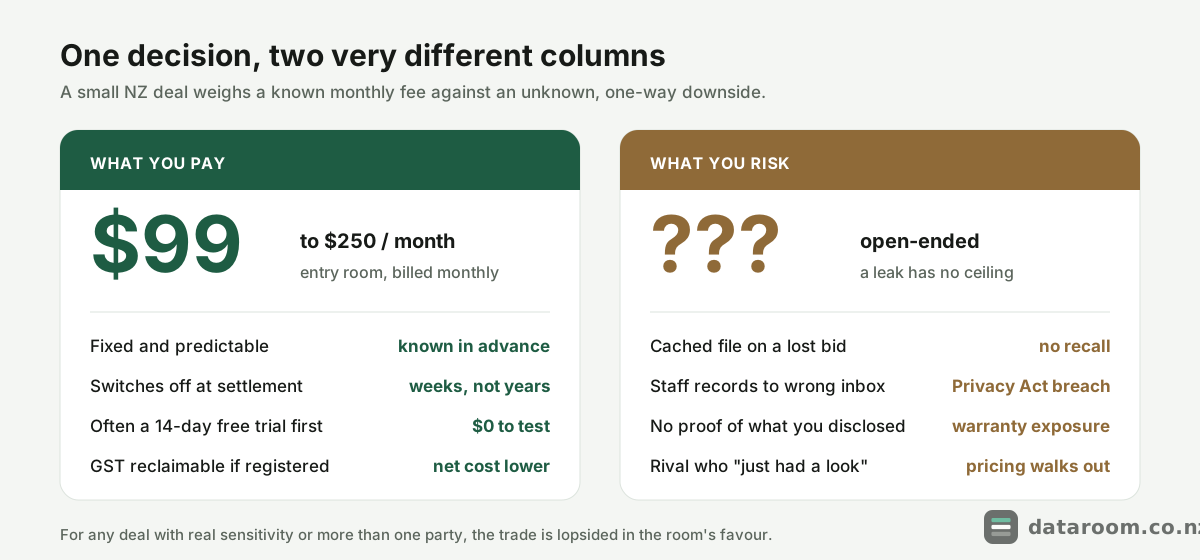
There is also a legal floor. Staff records, customer lists and shareholder details are personal information, so you carry duties under the Privacy Act 2020 to keep them secure and to notify a serious breach. The Office of the Privacy Commissioner sets out those duties on privacy.org.nz, and CERT NZ publishes practical guidance on protecting business data. A room is not automatic compliance. It is a far stronger control than an open drive if a breach is ever examined.
See what a room actually costs for your deal
Model per-user and per-room pricing in NZD, with the free-trial options that fit a small sale or raise.
What can a room do that a shared folder cannot?
Storage is nearly free. Dropbox and Google Drive give you gigabytes for a few dollars. The fee on a data room buys four things a folder structurally cannot replicate.
| Capability that protects the deal | Email + shared drive | Consumer cloud folder | Virtual data room |
|---|---|---|---|
| Per-file view, print and download controls | ✗ | ✗ | ✓ |
| Dynamic watermarks on every page | ✗ | ✗ | ✓ |
| Full audit trail of who opened what | ✗ | ✗ | ✓ |
| Revoke or wipe access after exit | ✗ | ✗ | ✓ |
| NDA gate before the sensitive folder | ✗ | ✗ | ✓ |
| Structured, logged Q&A | ✗ | ✗ | ✓ |
Map those rows back to the orchard and the abstract turns concrete:
- Control at the file level. Gate the export-contract folder until each buyer signs an NDA. Let the cooperative preview accounts without downloading them. Watermark every page with the viewer’s name so a leaked spray diary traces straight back.
- Evidence. Every open, download and login is logged. If a warranty claim over water rights lands six months after settlement, the audit trail is your record of exactly what was disclosed, and when.
- Reversibility. Two bidders drop out. One click revokes their access, and many rooms wipe anything cached on their devices. A shared link, once out, is out.
- Speed and order. Bulk upload, auto-indexing and a controlled question-and-answer workflow stop three buyers’ questions collapsing into a hundred stray emails.
For most sellers, that last point, the time and the order, ends up mattering as much as the security.
The fee is not for storing files. It is for knowing exactly who saw what, and being able to take it all back the moment a deal falls over.
The deeper tool-by-tool comparisons in data room vs Dropbox and data room vs Google Drive show where each folder runs out of road, and the alternatives guide covers the middle-ground options.
Is it worth it for your deal? Run five checks
Skip the theory. Score the deal in front of you against five checks. Three or more pointing to a room, and the case is close to decided.
Five checks to run on your own deal
Answer each honestly for the deal in front of you. Three or more pointing to a room means it is almost certainly worth it.
- 1
1. How sensitive is the data?
Financials, customer contracts, IP, staff records or anything covered by the Privacy Act mean control matters. Trivial or already-public material does not need a room.
- 2
2. How many parties will see it?
One trusted buyer is folder territory. Two or more bidders, investors or advisers reviewing at once is where per-party permissions and an audit trail start to pay for themselves.
- 3
3. Do you need to prove what you disclosed?
If a warranty, earn-out or later dispute could turn on what a buyer saw and when, the audit trail alone can justify the fee. Folders leave you nothing to point to.
- 4
4. Will parties come and go?
Competitive processes lose bidders. If you need to revoke access cleanly when someone walks, a room does it in one click; a shared link cannot be recalled.
- 5
5. What is the deal worth to you?
Weigh the room against the deal value and the cost of it going wrong. On a six-figure sale, a hundred dollars a month is a rounding error against the downside.
The orchard scores four of five: sensitive files, three parties, a live warranty risk over consents, and bidders who will drop out. Verdict, a room. The same logic renders as one picture below, routing a deal to a room, a free trial or a folder from the first three answers.
The decision in one flow
-
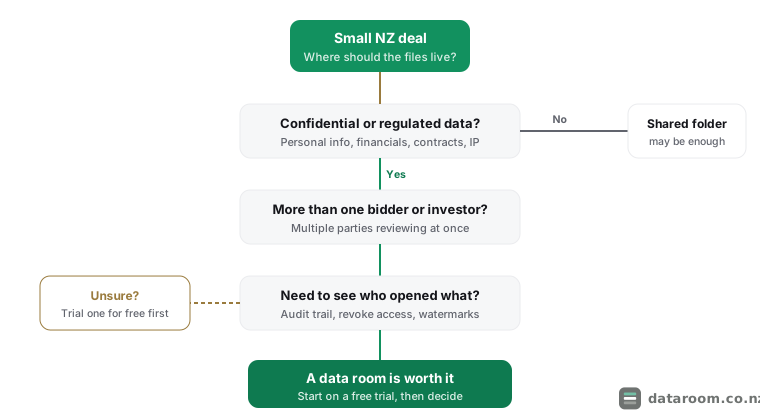
Confidential data plus more than one party plus a need for a record routes to a room. A free trial is the middle path when you are unsure.
Compare the rooms that fit a small NZ deal
See entry and mid-tier options side by side on price, security and free trials, then shortlist in minutes.
How would the orchard actually run its room?
A room only earns its fee if it is used well. For the three-buyer sale, that means tiered access, not one open pile of files. The setup takes an afternoon and moves through three stages.
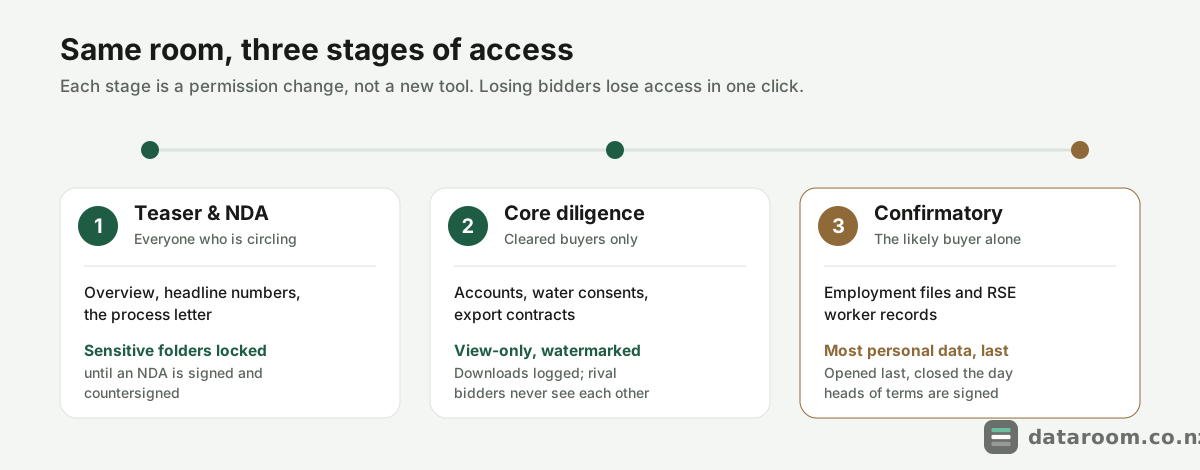
Read the stages top to bottom, opening the most personal information last:
- Stage one, teaser and NDA. Everyone sees an overview, headline numbers and the process letter. The sensitive folders stay locked until an NDA is signed and countersigned.
- Stage two, core diligence. Cleared buyers reach accounts, water consents and export contracts, view-only and watermarked. Downloads are logged; the cooperative and the Australian group never see each other.
- Stage three, confirmatory. The likely buyer alone reaches employment files and the RSE worker records, the most personal information in the deal, opened last and closed the day heads of terms are signed.
Each stage is a permission change, not a new tool. The losing bidders lose access in one click, and the Q&A workflow keeps every question attached to the right document rather than lost in a thread. Keep the set tight while you are at it; our folder-structure template is built to help, and a lean room reviews faster and costs less.
When is a room not worth it, and how small is too small?
Being honest about the exceptions is what makes the framework trustworthy. Start with a lighter tool, or no room at all, when the deal looks like this:
- A single, trusted counterparty. Selling to family, a long-standing partner or an employee, with no competing bidders, removes most of the reason to control access party by party.
- Low-sensitivity files. If nothing you share would hurt if it leaked, and it carries no personal information, the security premium buys you little.
- A very small, fast transaction. On a sub-$50,000 asset sale that closes in a fortnight, setup effort can outweigh the benefit.
Even then, “no room” is not “no discipline.” Lock the folder with a password, share view-only links, and delete access the day the deal closes.
There is no dollar threshold below which a room is automatically pointless. Sensitivity and party count drive it harder than size. A rough NZD guide, read top to bottom as the case strengthens:
- Single buyer, low-sensitivity asset sale, under NZD $50,000. A secured folder is usually enough.
- Small business sale with a few interested buyers, NZD $150,000 to $1.5m. Room is worth it; competing bidders and real financials tip it.
- Seed or angel raise with several investors, NZD $250,000 to $2m. Room is worth it; a cap table and founder agreements sit in front of many eyes at once.
- Property syndication or a public capital raise, NZD $1m and up. Room, plus disclosure discipline.
Two structural notes sharpen the size question. A share sale, where buyers inherit the company’s liabilities under the Companies Act, invites far deeper diligence than a clean asset sale, which pushes toward a room. A syndication raising from the public runs the room alongside its Financial Markets Authority disclosure obligations, not instead of them. Notice the pattern: once more than one outside party is involved, the verdict flips to worth it well before the numbers get large.
The best way to settle it for your specific deal is to spend nothing and find out. Most reputable rooms run a free trial, commonly 14 days, enough to load your real documents, invite one adviser and walk the actual workflow, often with no sales call. If the trial confirms a room but the price stings, bill monthly and prefer per-room over per-page, where small-deal budgets get ambushed.
Strip it all back and the calculation is simple. On one side, a monthly fee that lands between two coffees and a decent dinner. On the other, the confidential heart of your business, exposed to people you are still deciding whether to trust, with no record of who saw it and no way to take it back. For any deal with real sensitivity or more than one party, that trade is lopsided in the room’s favour. For the handful that are genuinely small, simple and single-party, keep your money and lock the folder down. Either way, run the five checks first, then let the comparison do the shortlisting. The government’s plain-English overview of selling or closing a business is a useful companion for the wider process, and the buyer’s guide to choosing a room walks the criteria in order once you have decided.
Is a virtual data room worth it? Common questions
Is a virtual data room worth it for a deal under NZD $100,000?
It depends on sensitivity and party count more than size. A sub-$100,000 sale to a single trusted buyer with low-sensitivity files can usually run from a secured folder. The same deal with two or more bidders, or with staff and customer records in play, justifies an entry room at roughly NZD $99 to $250 a month.
How much does a data room cost for a small New Zealand deal?
Entry rooms suited to small deals run roughly NZD $20 to $250 a month, indicative and worth confirming with the provider. Mid-tier rooms with tighter security sit around $430 to $700. Many bill annually or quote larger deals by tender, and most offer a free trial so you can test before paying.
Can I just use Dropbox or Google Drive instead?
You can share files that way, but you lose per-file permissions, watermarks, an audit trail and the ability to revoke access cleanly. For a low-sensitivity, single-party deal that can be acceptable. For a confidential or multi-party deal it leaves real gaps, which our data room versus Dropbox and versus Google Drive guides set out in detail.
Do I have a legal reason to use one in New Zealand?
If your documents contain personal information, and most deal files do, the Privacy Act 2020 requires you to keep it secure and to report serious breaches. A data room is not automatic compliance, but it is a far stronger control than an open shared drive and a better position to be in if a breach is ever examined.
How do I try one without committing?
Start a free trial, commonly 14 days, and load your real documents. Invite one adviser, walk the workflow and see whether the control and speed justify the fee for your deal. If it does, choose monthly billing so you only pay while the deal is live.