

Virtual data rooms for NZ startup fundraising
Picture a Hawke’s Bay agritech startup, four people and a soil-sensor product, opening a NZD $1.4 million seed round. The founder has warm intros to a Wellington angel syndicate, one Auckland fund and a couple of high-net-worth orchardists who like the sector. Week one, the deck goes out as an email attachment. By week three it has been forwarded to people she has never met, the “final” financial model in circulation is two versions stale, and she genuinely cannot tell you which of nine investors is close and which was only being kind. That fog, not the product and not the market, is what most first-time raises actually die of, and it is exactly what this guide is built to clear. Everything below follows that raise from the first spreadsheet to the closing wire, in New Zealand dollars and under New Zealand rules.
How much does a fundraising data room cost by NZ raise stage?
Start with the money, because the numbers settle most of the anxiety before the strategy even begins.
A typical New Zealand pre-seed round lands somewhere between NZD $100,000 and $500,000. A seed round runs roughly $500,000 to $2 million. A Series A in this market usually sits between $2 million and $10 million or more. Against any of those figures, a room that costs $99 to $250 a month for the eight to twelve weeks a raise stays open is not a line item worth a second thought. The table below anchors the entire guide: it maps the raise stages you will actually run to the room budget that fits, and everything after it interprets what those numbers buy.
| Raise stage | Typical round size (NZD) | Investors in the room | Sensible room spend (NZD/mo) |
|---|---|---|---|
| Pre-seed / friends and family | $100k to $500k | 2 to 8 | $0 to $99 flat |
| Seed | $500k to $2M | 5 to 20 | $99 to $250 flat |
| Series A | $2M to $10M+ | 10 to 30 | $250 to $500 flat |
| Growth / bridge | $5M and up | 15 to 40 | $350 to $700 |
| Convertible note top-up | $250k to $1M | 3 to 12 | $99 to $250 flat |
Read the last column and one thing jumps out: the room budget barely moves while the round grows twentyfold. That is the whole economic argument in a single line.
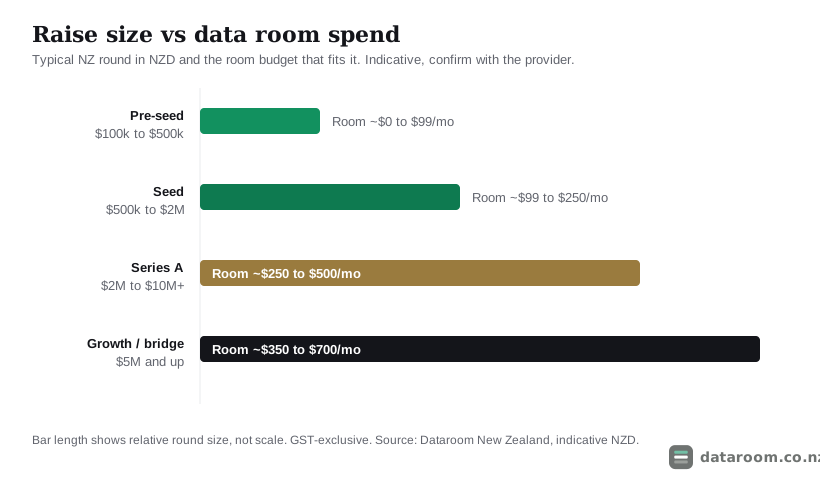
A virtual data room is a secure online space where you share confidential documents with controlled, audited, revocable access. For a raise, that means investors see a curated set of files, you see exactly who looked at what, and nobody keeps a copy on their laptop after a deal falls over. Treat every figure above as indicative and GST-exclusive. Providers negotiate on term length, and most publish in US dollars, so the landed New Zealand cost drifts with the exchange rate rather than sitting at a fixed number.
Notice what the table deliberately does not do. It does not push our Hawke’s Bay founder raising $1.4 million toward an enterprise per-page platform built for a bank-led acquisition. At early stage your document set is measured in dozens of files, not tens of thousands of pages, so the per-page and per-user machinery that suits a large mergers-and-acquisitions deal is simply cost you will never use. Our virtual data room pricing in New Zealand guide explains the four charging models in full, and best virtual data rooms for NZ startups compares the tools founders actually shortlist.
Two adjustments turn the sticker figure into your real bill. If the provider is registered for New Zealand GST or supplies remote services here, 15% is generally added on top, though a GST-registered startup can usually claim it back as an input rather than carry it as a cost. Currency is the quieter one: a plan quoted at USD $150 a month is not a fixed NZD number, and a swing in the rate over even a short raise moves the total by more than founders expect. Where a provider bills in NZD on a monthly rolling term, that predictability is worth a little on a room you only need open for a season.
So ask for the rate itemised, in NZD where you can, and confirm there is no minimum term longer than your raise.
There is a hidden cost worth naming too, and it is not on any invoice. It is the founder time a badly chosen tool burns. A platform designed for a fifty-person deal team, with granular per-document permission matrices and a formal Q and A escalation workflow, takes hours to configure and re-explain to every angel who logs in confused. For a four-person startup those hours are the scarcest resource in the building, more precious than the $150 a month. The right tool at this stage is one a non-technical co-founder can set up in an afternoon and an investor can navigate without a phone call, and that usability is worth paying a small premium for even when a cheaper, clunkier option exists.
The question, then, is never really “can we afford a room?” It is “will the room make this raise faster, tidier and easier to close?”
Where do investors actually spend their time in the room?
Founders assume investors read everything. They do not. They triage.
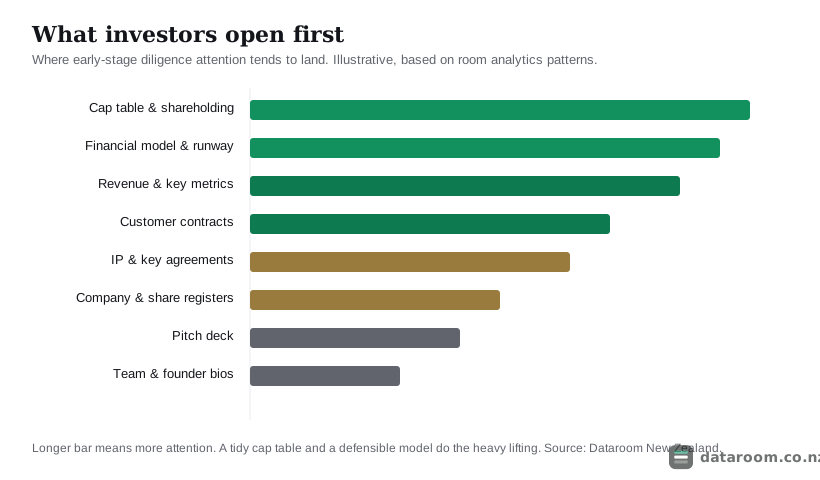
The chart ranks where diligence attention lands. The cap table and the financial model draw the most time, followed by revenue and key metrics, then contracts and IP. Team bios, which founders often agonise over, come last, because by the time an investor is inside the room they have already decided they like the team. Now they are pressure-testing the business, and the documents that answer “is this real and does the ownership make sense?” get the minutes.
This is where the analytics stop being a security feature and start being a sales tool.
If your lead spent forty minutes in the model and the metrics folder two nights running, that is a buying signal, and it is the moment to ask for a call. If a Christchurch angel who verbally committed has not logged in three weeks after you granted access, that is a quiet no you can stop chasing. A room turns a foggy pipeline into something you can actually manage: a live map of who is warm, who is cooling, and who was only ever being polite.
The trick is reading the signals honestly rather than flattering yourself. Total time in the room means little on its own; a single long session on the model means far more than ten scattered minutes across a fortnight. The table below is the rough translation key our editors use when founders send us their analytics screenshots and ask what to do next.
| What the analytics show | What it usually means | Your next move |
|---|---|---|
| Repeat deep sessions in the model and metrics | Genuine intent, building conviction | Ask for a call and a timeline this week |
| Opened the deck once, never returned | Polite pass, or waiting on a lead | One warm nudge, then deprioritise |
| Downloaded everything on day one, went quiet | Info-gathering, possibly a competitor scan | Watermark sensitive files, keep access tight |
| Long time on cap table, none on the model | Worried about ownership or dilution | Send a clean conversion schedule, offer a call |
| Access granted, zero logins after two weeks | Not real, whatever they said verbally | Stop chasing; reinvest the time in warm leads |
For a founder, the most valuable thing a data room produces is not security. It is knowing which investor spent twenty minutes in the financial model last night, and which one has not logged in since the pitch.
Picture the pattern in practice.
A Nelson hardware startup running a $1.2 million seed granted eight investors summary access after their first meetings. Within a week the analytics had sorted the room into three groups: two leads deep in the model and metrics most evenings, three browsers who skimmed the deck once and closed it, and three who never logged in at all. The founder booked calls with the two, sent a gentle nudge and the detailed financials to the browsers, and quietly stopped emailing the silent three. The round closed on one of the two engaged leads, and none of that clarity had existed a fortnight earlier in the inbox.
Discipline is what turns that insight into leverage. Load documents in stages rather than all at once. Give a first-meeting investor the deck, the summary financials and a high-level cap table; reserve the detailed model, signed customer contracts and any employee data for parties who have shown real intent. Staged disclosure protects your most sensitive material, keeps a tighter audit trail, and, not incidentally, gives you a reason to book a second conversation when you grant the next tier of access.
What documents belong in the room at each round?
Investors work through a predictable set of material, and the depth they expect grows with the stage. A pre-seed angel wants proof the company legally exists, clarity on who owns it, and a founder who can model a credible path to revenue. A Series A lead will want signed customer contracts, a defensible financial model and clean employment and IP paperwork.
The matrix below shows what typically belongs in the room at each stage. Build the pre-seed set first; it is the spine of every later round, and a Dunedin medtech raising Series A on top of a tidy seed room moves faster than one rebuilding from a folder of email attachments.
| Document | Pre-seed | Seed | Series A |
|---|---|---|---|
| Pitch deck and one-pager | ✓ | ✓ | ✓ |
| Cap table and shareholding | ✓ | ✓ | ✓ |
| Company registration and constitution | ✓ | ✓ | ✓ |
| Financial model and forecast | ✓ | ✓ | ✓ |
| Historical accounts and management reports | ✗ | ✓ | ✓ |
| Founder and key employment agreements | ✗ | ✓ | ✓ |
| IP assignments and key contracts | ✗ | ✓ | ✓ |
| Signed customer contracts and pipeline | ✗ | ✓ | ✓ |
| Prior SAFE or convertible note terms | ✓ | ✓ | ✓ |
| Board minutes and shareholder resolutions | ✗ | ✗ | ✓ |
| Detailed KPI and cohort data | ✗ | ✗ | ✓ |
Documents are only half of it. Where they sit matters just as much, because an investor forms a judgement about your company from the shape of the room before they read a single number.
The diagram below is the folder skeleton we hand founders as a starting point. Six top-level folders, a predictable place for everything, and a one-page read-me at the top so nobody has to email you asking where the accounts live. Clone it once and you reuse it every round.
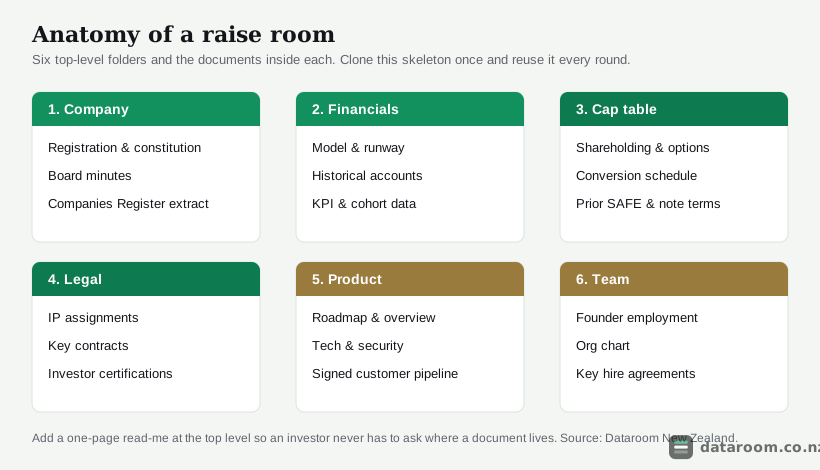
Two rows in the matrix deserve a note.
The cap table is the document investors open first, and a messy one, with unrecorded SAFEs or ambiguous option promises, is the single fastest way to stall a raise. The prior-instrument row matters for the same reason a year later: a badly papered friends-and-family round can haunt you at Series A, when a new lead has to untangle what everyone actually owns before they will wire a cent. For the full picture across deal types, what documents go in a data room breaks it down by scenario, and data room folder structure: a template for NZ deals gives you a ready index to clone.
Most New Zealand pre-seed and seed rounds are papered as SAFEs or convertible notes rather than priced equity, which keeps the legals cheap but pushes the ownership question down the road. That is a perfectly reasonable trade, provided the room makes the eventual conversion legible. Keep a single schedule that lists every instrument with its cap, discount and trigger, so a later lead can see at a glance what converts and when. The founders who lose weeks at Series A are almost always the ones who cannot answer “who owns what after everything converts?” straight from the documents in the room.
One honest caveat on completeness. A pre-seed room does not need to be exhaustive, and stuffing it with half-finished forecasts and speculative pipeline documents does more harm than an obvious gap would. It is better to have six current, confident files than twenty where a third are drafts. If a document is not ready, leave a short note in the read-me saying it will follow, rather than uploading something you would wince to have diligenced.
Compare data rooms built for a startup raise
See indicative NZD pricing, trials and the features founders actually use, side by side.
Why doesn’t emailing a deck work once the raise scales?
Most founders start a raise by attaching a deck to an email. It works right up until it does not.
The deck goes to one angel, who forwards it to a syndicate partner, who saves it to a shared drive, and now a confidential financial model is sitting in three inboxes you cannot see and cannot recall. Multiply that across a dozen conversations running in parallel and you have lost the two things a raise most needs: control over your sensitive material and a clear read on who is genuinely interested.
A data room fixes four things that break the moment a raise stops being one conversation and becomes twenty.
- Control. You decide who sees the sensitive material, and you can revoke it. When an investor passes or a term sheet lapses, one click closes the door rather than leaving a copy loose forever.
- Audit trail. Every view, download and login is logged, so if a question about who saw what ever arises, you have the record instead of a guess.
- Signal. A room that opens to a clean index, sensible folders and current documents tells an investor you run a tight ship. Diligence is partly a test of whether you are organised enough to be trusted with their money.
- Insight. The analytics show you which investors opened the model, how long they spent on the cap table, and who never logged in at all. Founders underrate this until the first time it saves them a fortnight of chasing the wrong person.
Email has one more failure mode founders rarely think about until it bites: version drift. When the model lives as an attachment, every recipient holds a frozen copy from the day you sent it. Fix a formula on Tuesday and the angel still diligences Monday’s numbers, and if two investors compare notes over coffee they find two different runway figures with your name on both. A room holds one live document that everyone opens in place, so a correction propagates to the whole round the moment you upload it, and there is never a stale version circulating with your credibility attached to it.
If you are weighing a room against a consumer file-sharing tool to save a few dollars, read virtual data room vs Google Drive and virtual data room vs Dropbox first. The gap that matters is not storage; it is granular permissions, watermarking and a real audit trail, none of which a generic drive gives you.
How do you build the room before you start pitching?
A good raise room is boring in the best way. An investor lands, understands the layout in ten seconds, and finds everything without sending you a single “where do I find the accounts?” email.
Structure it once, properly, in the quiet week before you start pitching, and it serves every conversation in the round. Build it while an interested investor waits and you set the tone with scramble: the stale model, the half-finished cap table, the folder named “Final_v3_actually_final”.
Set up your raise room in six steps
Build it before you start pitching, not while investors are waiting. A day of setup saves weeks of back-and-forth.
- 1
Build the folder skeleton first
Create top-level folders for Company, Financials, Legal, Product, Team and Prior rounds before you upload a single file. A clear structure is the first thing an investor judges.
- 2
Get the cap table right
Make sure the cap table reflects every SAFE, convertible note and option promise. This is the document investors open first, so any ambiguity here costs you credibility immediately.
- 3
Load a clean financial model
Include a current model with clear assumptions and a runway figure. Name it plainly and remove old drafts so nobody diligences a stale version.
- 4
Set permissions by investor stage
Give early-meeting investors the summary set and reserve sensitive contracts and employee data for parties who have shown intent. Use view-only and watermarking on anything you would not want forwarded.
- 5
Prepare the index and a short guide
Add a one-page read-me at the top of the room explaining where things live and who to ask. It removes the most common first email an investor sends.
- 6
Run Q and A inside the room
Keep investor questions and your answers in one threaded place rather than scattered across email, so every party sees consistent answers and you keep control of the narrative.
Timing decides your budget as much as the plan does, because a fundraising room is priced by the month and a raise is a season, not a single event.
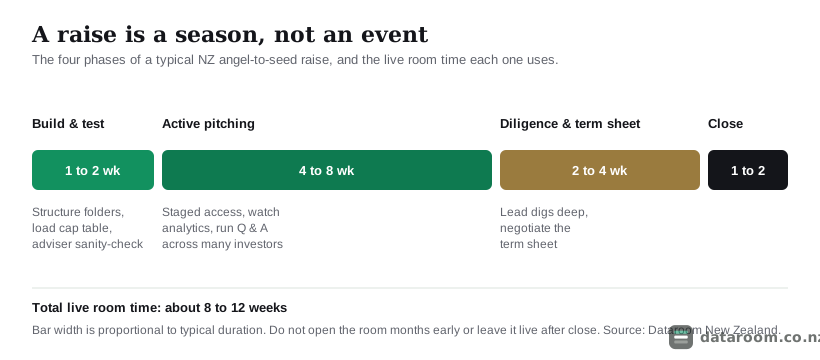
Walk the timeline left to right. Build and pressure-test takes one to two weeks: structure the folders, load the cap table and model, and invite a trusted adviser to sanity-check before any investor sees it. Active pitching runs four to eight weeks of staged access, analytics-watching and Q and A. Diligence and the term sheet add two to four weeks with the lead. Close and tidy up is one to two weeks of revoking access and archiving the final state. Add it up and the whole raise usually occupies eight to twelve weeks of live room time, which is exactly the window the pricing in this guide assumes.
Two rules fall out of that. Do not open the room months early and pay for empty rooms.
And do not leave it live out of inertia once the round closes, because every extra month is spend you are not using and an audit surface you no longer need. There is a cheaper habit that works better: keep the structure and content maintained offline between raises, and only spin up the paid, shareable room when you are days away from sending the first invite. If diligence itself is what you are trying to size, how long does due diligence take in New Zealand? sets the realistic ranges, and how to set up a virtual data room walks the full mechanics.
What NZ rules apply when you share investor data?
A fundraising room is full of personal information: employee records, customer details, founder data. Uploading it does not suspend your obligations.
You remain responsible under the Privacy Act 2020 for handling that information reasonably, keeping it secure, and not disclosing more than the purpose requires. The Office of the Privacy Commissioner’s guidance at privacy.org.nz is the plain-English reference, and it is precisely why staged disclosure and revocable access matter beyond mere tidiness. Least-privilege access is not just good deal hygiene; it is how you meet a legal standard when a Wellington climate-tech founder loads a spreadsheet of pilot-customer contacts into a room a dozen strangers can open.
Data location is the question founders forget to ask. Most room providers store files on offshore infrastructure, often in Australia, the United States or the European Union, and the Privacy Act allows that provided the information stays protected to a comparable standard. Practically, that means checking where a provider hosts, whether it will commit to a region, and what its breach-notification process looks like, because under the Act a privacy breach that causes serious harm must be reported to the Commissioner and to the people affected. If you handle health, financial or particularly sensitive personal data, the general security guidance from CERT NZ on protecting business information is a sensible cross-check before you pick a platform.
A raise room is not just a sales asset. The moment you upload an employee file or a customer list, the Privacy Act is in the room with you, and revocable, least-privilege access is how you honour it.
Who you can raise from is a separate question, and a legal one rather than a paperwork one.
Most early-stage rounds rely on exclusions in the Financial Markets Conduct Act 2013, such as the wholesale or eligible-investor category, which let you raise without a full regulated disclosure document. The Financial Markets Authority sets out how those exclusions work, and it is worth confirming with your lawyer that every investor you admit to the round actually qualifies. Getting this wrong is not a formatting slip; it can unwind the round.
The two exclusions founders lean on differ in how they are proven. A wholesale investor meets a size or investment-activity test written into the Act, while an eligible investor self-certifies that they understand the risk, with sign-off from a lawyer, accountant or authorised financial adviser. Keep each investor’s certification in the room’s legal folder next to the cap table, because that paperwork is part of diligence too, and a Series A lead’s counsel will look for it before they will look past it.
One last piece of housekeeping. Your shareholding and director details on the Companies Register should reconcile with the cap table in your room, because investors do check, and a mismatch reads as carelessness at exactly the moment you want to look buttoned-up. If you have never had to think about director duties or share issuance mechanics before, the plain-language explainers on business.govt.nz are a useful primer before your first term sheet lands.
See our pricing for a straightforward raise room
A flat monthly plan, a 14-day free trial, and no per-page metering to model against your round.
How is a raise room different from an M&A or syndication room?
The building blocks are the same. The emphasis is not.
In an acquisition, the buyer’s lawyers drive a long, adversarial diligence process against a fixed target, so the room leans on exhaustive documentation and a heavy Q and A workflow. A raise is a different animal, and the contrast is sharpest when you put the three transaction types side by side.
| Dimension | Startup raise | M&A / acquisition | Property syndication |
|---|---|---|---|
| Shape of the deal | One-to-many, many investors at once | One-to-one, a single buyer | One-to-many, many passive investors |
| Room's main job | Build conviction and sell | Survive adversarial scrutiny | Disclose a fixed offer clearly |
| What matters most | Staged access and analytics | Exhaustive docs and Q and A | Consistent disclosure to all |
| Document volume | Dozens of files | Thousands of pages | A defined offer pack |
| Lifespan | 8 to 12 weeks, then reused | Weeks to months, then closed | Length of the raise period |
Read across the table and the raise column tells one story: it is a sales process as much as a legal one.
The room’s job is partly to build conviction, not merely to survive scrutiny, which is why the order you reveal documents and the story your index tells are worth real thought. And it repeats: the room you build for seed becomes the foundation for Series A, so keeping it clean and current between rounds beats rebuilding from scratch every eighteen months.
That reuse is worth planning for from the first round. Keep the folder skeleton stable, archive each closed round in its own dated folder rather than deleting it, and update the cap table and financial model as the live source of truth between raises. When the next round opens you are refreshing a known structure, not reconstructing history from a shared drive, and the eighteen months of updates read as a company that has been run deliberately rather than assembled the week before pitching.
Property syndication sits between the two, inviting many passive investors to a single offer. If a Bay of Plenty aquaculture syndication is closer to your situation than a venture raise, virtual data rooms for property syndication and the broader capital raising in New Zealand guide are the better fit, and virtual data rooms for M&A in New Zealand covers the acquisition end.
What mistakes stall a raise at the first click?
Most raise-room failures are unforced. They are cheap to avoid and expensive to ignore, and nearly all of them are visible in the first sixty seconds an investor spends in your room.
- A messy cap table. Unrecorded SAFEs, vague option promises and stale versions stall the round at the very first document an investor opens. Fix it before you send a single invite.
- Dumping everything at once. Loading every file for every investor removes your ability to disclose in stages and inflates the audit surface for no benefit. Curate instead of tip out.
- Stale documents. An old financial model or a superseded contract left in the room makes an investor quietly wonder what else is out of date, and that doubt is hard to walk back.
- No permission discipline. Giving every prospect full access, including to employee and customer data, is a Privacy Act risk and a negotiating one.
- Ignoring the analytics. The data telling you who is engaged and who is cold is right there; founders who chase the loud investor over the one quietly living in the model waste weeks.
- Leaving the room open forever. When the round closes, review access and revoke what is no longer needed rather than letting it drift.
There is a subtler mistake beneath all six: treating the room as an afterthought bolted on the day you start pitching, rather than the operating record of the company. The founders who raise fastest keep the cap table, model and legal folder current as a habit, so when a round opens the room is already ninety per cent there. The ones who struggle rebuild it in a panic each time, and the panic shows. Investors are pattern-matchers, and a room assembled the night before reads exactly like a company run the same way.
The fuller list, across every deal type, is in 10 data room mistakes that slow down NZ deals. If your Q and A is where things tend to descend into chaos, running data room Q&A without losing control is the guide for the part of a raise founders most often mishandle.
Is a data room worth it for a tiny pre-seed round?
For the smallest rounds, honesty is warranted. A two-investor friends-and-family raise may not need a dedicated room on day one, and pretending otherwise would be a sale rather than advice.
But the threshold is lower than most founders assume. The moment you are pitching more than a handful of investors, sharing a financial model or employee data, or fielding diligence questions from a syndicate, the control and analytics a room provides start paying for themselves in saved time alone. The decision tree below is the quick version of that judgement.
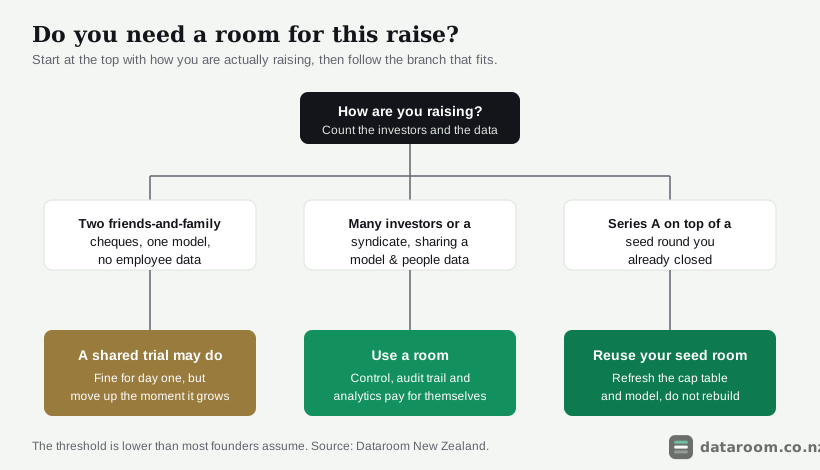
A pre-seed round can often run on a free trial for the short window it stays open, which removes even the cost objection. Follow the middle branch of that tree, though, and you land on a room for almost any raise that has grown past two cheques, because the failure modes it prevents are the expensive ones.
And the economics are hard to argue with once you weigh both sides of the ledger. A raise room at $99 to $250 a month, open for the eight to twelve weeks of an active round, is a few hundred dollars against a raise of hundreds of thousands. Set that against one confidential model leaking, one term sheet you cannot cleanly walk back, or two weeks lost chasing an investor who was never engaged, and the room is plainly the cheap side of the trade.
There is a softer return worth naming too. A room that opens cleanly, discloses in stages and answers questions in one place makes a founder look like someone who has done this before, even on a first raise. That impression compounds: the investor who found your seed room easy to work through is the one who takes your Series A call quickly, and the one who introduces you to the next fund. Our is a virtual data room worth it for a small NZ deal? guide runs the same maths for other transaction types.
Come back to our Hawke’s Bay founder. Had she opened a $99-a-month room in week one, indexed six folders, staged access and watched who actually read the model, she would have known by week three which three of her nine investors were real, closed on one of them, and shut the door on the rest with a single click. The room would not have made her product better. It would have made her legible, and at seed stage legible is most of the battle.
Startup fundraising data room FAQ
How much does a data room cost for a startup raise in New Zealand?
For most pre-seed to Series A raises, a flat per-room plan of about NZD $99 to $250 a month covers everything you need, and pre-seed rounds can often use a free trial for the short window they are open. Figures are indicative and GST-exclusive; confirm the current quote with the provider. See our NZ pricing guide for the full picture.
What should go in a fundraising data room?
At minimum: the pitch deck, a clean cap table, company registration and constitution, and a current financial model. Seed and Series A rounds add historical accounts, employment and IP agreements, signed customer contracts and prior SAFE or note terms. Build the pre-seed set first as the spine for every later round.
Do I really need a data room, or can I just email a deck?
You can email a deck to two investors. Once you are running a raise across many conversations, a room gives you control you cannot get from email: revocable access, an audit trail, one live version of every document, and analytics showing which investors are actually engaged. It is also a credibility signal in diligence.
What NZ law applies to sharing investor data?
The Privacy Act 2020 governs any personal information you upload, such as employee or customer data, so share only what the purpose needs and keep access revocable. Who you can raise from is governed by the Financial Markets Conduct Act 2013 and the FMA's wholesale and eligible-investor rules. Confirm investor eligibility with your lawyer.
Where is my data room hosted, and does that matter under NZ law?
Most providers host offshore, often in Australia, the United States or the European Union. The Privacy Act 2020 permits this if the information stays protected to a comparable standard, so ask a provider where it stores files, whether it will commit to a region, and how it handles breach notification. Serious privacy breaches must be reported to the Privacy Commissioner.
How do room analytics help a founder raise faster?
They show which investors opened the model, how long they spent on the cap table, and who never logged in. That turns a foggy pipeline into a live map of intent, so you can push the warm investors and stop chasing the cold ones. It is the most underrated benefit of a raise room.
Can I reuse the same data room for my next round?
Yes, and you should. The room you build for seed becomes the foundation for Series A. Keep the cap table, financials and legal folders current between rounds rather than rebuilding, and prune access when each round closes.