

Best virtual data rooms for NZ startups
The best virtual data room for a New Zealand startup is almost never the one a lawyer used on a nine-figure trade sale, and copying that choice is the single most expensive habit founders bring to a raise. The myth this guide sets out to kill is that a bigger platform signals a more serious company. It does the opposite: it signals a founder who bought machinery the round will never run, on a term far longer than the deal, before a single investor asked for anything.
Picture an Ōtautahi agritech company raising its first priced round. Terms are signed with a Christchurch fund, a lead is about to open diligence, and someone forwards the name of the platform their lawyer used on a $40 million trade sale. The quote comes back at four figures a month on a twelve-month term before the round has even opened. That is the wrong starting point, and the most common one. A virtual data room is simply a secure online space for sharing confidential documents with controlled, audited access, and the best one for a startup is the cheapest tool that still gives you that control at the stage you are actually raising.
Which data room actually fits a startup raise?
Three archetypes sit on almost every founder’s shortlist, and telling them apart is most of the decision. There is a tracked link tool built to share a deck, a modern flat-rate data room built for a raise, and a full enterprise transaction platform built for large, controlled deals. Each is good at the job it was designed for and clumsy at the others, so the useful question is not which is best in the abstract but which fits the conversation you are having this week. The matrix below scores the three on what an early-stage company needs, deliberately ignoring the long tail of features that only matter at exit.
| What a startup needs | Link-share tool | Flat data room | Enterprise platform |
|---|---|---|---|
| Deck view analytics (who read what) | ✓ | ✓ | ✓ |
| Granular per-file permissions | ✗ | ✓ | ✓ |
| Structured Q&A workflow | ✗ | ✓ | ✓ |
| Full audit trail for the board | ✗ | ✓ | ✓ |
| Self-serve setup, live same day | ✓ | ✓ | ✗ |
| Flat, predictable monthly price | ✓ | ✓ | ✗ |
| Free trial to pilot a real deck | ✓ | ✓ | ✗ |
| Priced for a whole exit / M&A | ✗ | ✗ | ✓ |
The shape of the answer is already visible in the middle column. A link tool is perfect for the earliest conversations and useless for anything that involves a cap table; an enterprise platform is overbuilt and overpriced for a raise, and it makes you wait for onboarding you do not have time for. The flat data room ticks the lines a founder actually cares about, which is why it is where most seed and Series A rounds land. The only genuinely hard question left is timing: when do you cross from one column to the next? The decision tree turns that into a single branch you can answer honestly in about ten seconds.
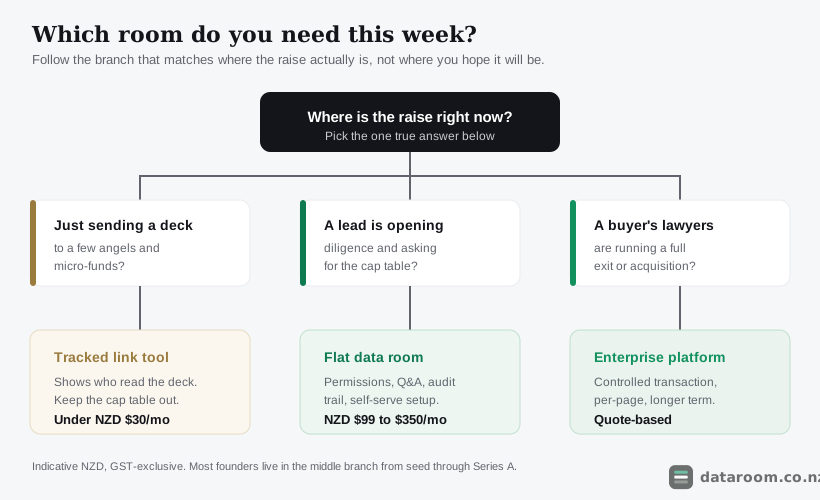
Read the tree by being strict about the word “now”. Founders lose money provisioning for the branch they hope to reach rather than the one they are standing on, and the enterprise column is where that optimism gets billed monthly. If you are sending a deck, you are on the left; if a lead has asked for the cap table, you are in the middle, and you will stay there through the whole raise. You only step right when someone else’s lawyers take control, and by then the acquirer’s counsel will tell you which platform to use anyway.
Compare startup data rooms side by side
See indicative NZD pricing, deck analytics, permissions and trials for every provider we track, in one table.
What separates the right room from an expensive one?
For a startup, “right” is the shortest feature list that still protects the round and tells you what is happening inside it, not the longest one a brochure can print. The temptation is to score a room the way you would score enterprise software, by counting capabilities, but at seed almost all of that surface area is dead weight. Six things carry nearly all the value at this stage, and a room that nails those clears the bar a lead investor sets regardless of what else it lacks. The card grid below is the scorecard we run every quote through.
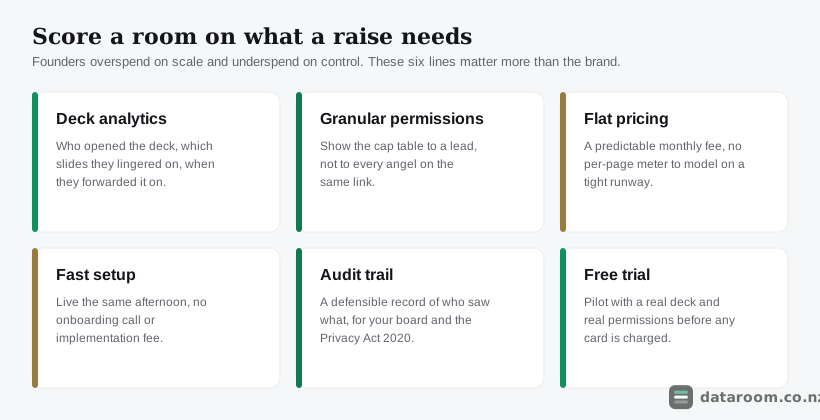
Deck analytics come first because they are pipeline intelligence, not vanity metrics. When you can see that a Wellington fund partner reread the financials twice but never opened the team folder, you know exactly which conversation is real and what to send next, and a silent inbox turns into a legible pipeline. Granular permissions come a close second: they let you show the cap table to a lead without exposing it to every angel on the same link, which is the difference between a data room and a shared drive. A clean audit trail gives your board, and later an acquirer’s counsel, a defensible record of who saw what and when.
The other three lines are about fit rather than security. Fast self-serve setup means the room is live the same afternoon instead of after an onboarding call you cannot fit into a raise already moving. Flat pricing keeps the cost off your runway model, so you are not forecasting a page count no startup can predict, and a real free trial lets you pilot with a genuine deck before any card is charged. Everything a brochure adds beyond those six, dedicated implementation, per-page metering, a named account manager, a redaction suite, is real value on a controlled transaction and noise on a seed raise. For the fuller reasoning, how to choose a virtual data room sets out a checklist you can run any quote through.
Founders overspend on scale and underspend on control. The enterprise platform your acquirer will love is the wrong tool for the round that gets you there.
How much should an NZ startup really pay?
Not much, if you buy for the stage you are at, and the numbers cluster into three bands that barely overlap. Most vendors publish in US dollars, negotiate hard on term length, and add GST on top, so the landed New Zealand figure moves with the exchange rate and the deal you cut rather than sitting on a fixed rate card. The table below sets out indicative monthly figures in New Zealand dollars for the tools founders realistically compare, and it is a starting point for your own quote, not a promise. Read it by stage rather than by brand, because the brand tells you far less than the band it sits in.
| Tool | Indicative from (NZD/mo) | Best for | Trial |
|---|---|---|---|
| DocSend | ~$20 | Sharing and tracking a pitch deck | Free trial |
| Ellty | ~$99 | A seed or Series A raise | 14-day free trial |
| Digify | ~$230 | A raise needing tiered controls | 7-day free trial |
| Onehub | ~$525 | A larger round, per-user tiers | Free trial |
| Ansarada | ~$430 (12-mo term) | Later-stage or exit diligence | 14-day free trial |
| iDeals | ~$900 (indicative) | Acquisition or NZX-track deal | Demo & trial room |
The stat board makes the same point in one glance: three price bands, and a wide gap between the middle and the top where most of the overspending happens. Under roughly $350 a month you are buying a flat, self-serve room that comfortably runs a seed or Series A. Above $430 you are usually buying a quote-based platform designed for a controlled transaction, with a sales process and a term commitment attached. A medtech company raising $2 million does not touch anything a $50 million acquisition needs, yet on the wrong plan it pays as though it did, and the difference is real runway.
Put the numbers in proportion and the case gets sharper. A typical New Zealand seed round lands somewhere between roughly $500,000 and $2 million, and it usually stays open for six to ten weeks from the first data-room invitation to a signed subscription agreement. Against a raise of that size, a flat room at $99 to $350 a month for two or three months is a rounding error, well under a tenth of one percent of the capital in, while a mispriced enterprise term can quietly consume a fortnight of a junior engineer’s salary for controls no investor will use. The right frame is not “what does the room cost” but “what fraction of the round am I spending to run it”, and at seed that fraction should be almost invisible.
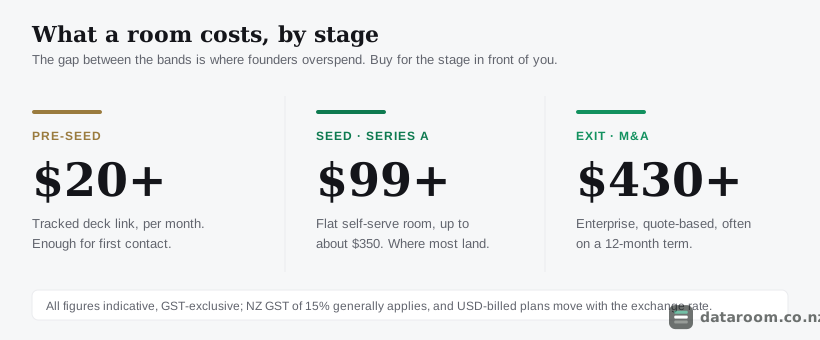
One caveat catches founders at renewal. Every figure here is indicative and GST-exclusive, so New Zealand GST of 15% generally applies on top, and a plan billed in US dollars is not a fixed NZD cost across a term. A USD $120 monthly plan can drift by real money over a twelve-month contract, and an introductory discount can lapse into a very different renewal rate. Get the quote itemised in NZD, ask what renewal looks like once any discount ends, and prefer a monthly rolling plan so the cost tracks the weeks you actually need it. Our virtual data room pricing in New Zealand guide breaks the market down by charging model, and cheapest virtual data rooms for NZ small deals drills into the bottom of the range.
Seed, Series A or exit: which room for which stage?
The single most useful move a founder can make is to buy for the stage in front of them rather than the company they hope to become, and the ladder below shows why each rung needs a different tool. At pre-seed you are sending a deck to a handful of angels and micro-funds, and you do not need a room at all, you need a tracked link. A tool that shows who opened the deck and how far they read turns a silent pipeline into a legible one for less than the cost of a team lunch, provided you keep the sensitive material, the cap table and the detailed model, out of that link entirely so a forwarded deck never leaks your ownership structure.
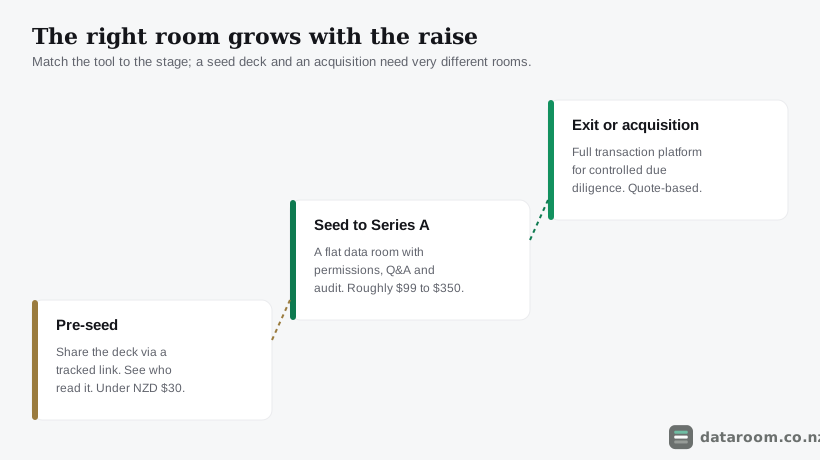
At seed to Series A, real diligence starts and the link tool runs out of road. A lead wants the cap table, the contracts, the financials and the founder agreements, and they want to send questions in a way that does not sprawl across a dozen email threads. This is the moment for a flat data room with granular permissions so different investors see different things, a structured Q&A workflow so questions stay in one auditable place, and an audit trail your board can rely on. A dedicated fundraising room is the workhorse here, and it rarely needs to cost more than $350 a month to do everything a seed lead expects of it.
Who sits on the other side of that room shapes how it gets used. A New Zealand seed lead is often an angel network such as Enterprise Angels, AngelHQ or the Icehouse-linked groups, or an early-stage fund investing alongside them, and several angels may diligence in parallel while one takes the lead. That is exactly the pattern granular permissions exist for: the lead gets the deep folders, the syndicate sees the deck and headline financials, and nobody outside the round sees the cap table. If a portion of your raise is a government-backed or R&D co-investment, expect a heavier paper trail on how funds will be used, and keep that correspondence inside the room so the audit log tells one consistent story.
A capital raise also carries a compliance wrinkle the room quietly handles. If you are raising from wholesale or eligible investors without a product disclosure statement, you rely on the exclusions in the Financial Markets Conduct Act 2013, which means collecting and storing wholesale-investor certificates that hold personal and financial information. Those belong behind permissions in the room, not in a shared inbox, and keeping them access-logged gives you one tidy record if the exclusion is ever questioned. At exit the dynamic flips again: a buyer’s lawyers run the process, the document set is large and tightly controlled, and the per-page platforms you skipped at seed finally earn their fee. Virtual data rooms for M&A in New Zealand covers that top rung, built for the last deal a startup does, not the first.
Security, the Privacy Act and what you can safely skip
Cheap and self-serve does not mean loose, and the moment you put investor names, employee records or customer contracts into a room you take on obligations under the Privacy Act 2020 that apply to a two-founder startup exactly as they do to a listed company. Information privacy principle 5 asks you to hold personal information with reasonable security safeguards, and a data room’s access controls are how you meet that bar in practice. The good news is that the controls the Act effectively expects are the same three a lead investor wants, so you are not doing security work and diligence work separately, you are doing one thing that satisfies both.
Three controls are non-negotiable even on a lean plan. Granular permissions keep personal information visible only to the people who need it. A full audit trail lets you show who accessed what if a question is ever raised, whether by the board, an investor or a regulator. And sensible authentication, meaning at least two-factor login for anyone entering the room, closes the most common gap of all. The Office of the Privacy Commissioner’s guidance at privacy.org.nz is the plain-English reference for your obligations, and CERT NZ’s advice at cert.govt.nz is a sound baseline for the security hygiene a room should support around them.
Certification is where founders can safely relax the standard, and knowing that saves real money. Full ISO 27001 and SOC 2 certification is genuinely reassuring, but at seed a well-run flat room with strong permissions and encryption in transit and at rest usually clears the bar an early investor sets, so paying a premium purely for the badge is rarely justified. Where certification does bite is sector: a cleantech or SaaS startup already fielding security questionnaires from enterprise or government customers often wants the badge earlier, because the same document that reassures an investor also unblocks a sales cycle. Our virtual data room security guide for New Zealand deals sets out what to demand and where a badge is a nice-to-have rather than a deal-breaker.
Standing up the room, and what belongs inside it
You can be live the same afternoon, and the trick is to prepare the content before you open the room so investors meet a tidy, complete set rather than a work in progress. A lead forms a judgement on your company from how legible that set is, sometimes before they read a single number closely, which means the folder structure is doing quiet persuasion work from the first click. The five steps below get a raise-ready room standing without an onboarding call, and they double as the order in which you should think about the room even if your provider does it differently.
Stand up a raise-ready room in five steps
Prepare the documents first, then structure and permission the room so a lead investor can move through it without friction.
- 1
Split the deck from the detail
Share the pitch deck through a tracked link for first contact, and keep the cap table, model and contracts inside the permissioned room. Not every viewer needs the sensitive material on day one.
- 2
Build a clean folder structure
Use a standard layout: corporate, cap table, financials, contracts, product and team. A tidy tree, like our data room folder structure template, signals a company that is easy to diligence.
- 3
Set permissions per investor group
Give a lead deeper access than a casual angel. Granular per-folder permissions are what separate a data room from a shared drive, and they protect personal information under the Privacy Act.
- 4
Turn on analytics and Q&A
Enable view tracking so you can see engagement, and use the structured Q&A workflow so investor questions stay in one auditable place rather than scattering across email threads.
- 5
Pilot on a free trial, then invite
Run a real dry run during a free trial, check the audit log records what you expect, and only then send invitations. Prefer a monthly rolling plan so you are not locked in past the raise.
What goes inside is rarely exotic at seed and Series A; the surprise is how much should already be tidy before the room opens. Six folders cover almost every early-stage New Zealand raise. Corporate holds your constitution, a current share register, the shareholders’ agreement and board minutes. Cap table holds a clean current table plus any SAFE or convertible-note terms and an option-pool summary. Financials holds management accounts, a simple model and your GST and tax position. Contracts holds key customer, supplier and channel agreements, plus anything carrying a change-of-control clause. Product and IP holds assignment of intellectual property from founders and contractors alongside a short technology overview, and Team holds employment agreements, key-person arrangements and the founder vesting schedule.
Two items get left out most often, and they are the two a lead chases hardest: a share register that reconciles to the cap table, and clean IP assignment from every person who ever wrote code. Keeping your Companies Office records current helps more than founders expect, because a lead will cross-check your share register against the companies register early in diligence, and under the Companies Act 1993 you are required to maintain an accurate register anyway. The IP gap is especially common in deep-tech and gaming studios that grew out of contractor work, where a single unassigned contribution can stall a term sheet. For the full walkthrough, how to set up a virtual data room, the data room folder structure template and the due diligence checklist for New Zealand deals work through the set line by line.
See our pricing for a raise-ready room
A flat monthly plan, a 14-day free trial, and no per-page metering to model against your runway.
Where founders waste money, and the bottom line
Founders miss the mark in two opposite directions, and both are avoidable once you have named them. The overspend is buying the exit platform for the raise: a per-page tool on a twelve-month minimum term, with an onboarding fee that rivals two months of a flat plan, for a round that closes in six to eight weeks. You pay for controlled-transaction machinery your investors never touch and sign a lock-in far longer than the deal, and because no startup can predict its page count, a per-page model is structurally the wrong fit, as our pricing guide explains. The underspend is the mirror image: running the whole raise out of a consumer file-sharing folder to save a few dollars.
As virtual data room vs Google Drive and virtual data room vs Dropbox both lay out, a shared folder gives you no granular permissions, no reliable audit trail and no defensible record when a Privacy Act question or an investor dispute surfaces. It looks costless right up to the moment it costs you the round’s credibility. A subtler version is the false economy of the wrong free trial: piloting a tool that cannot show an audit log or per-folder permissions proves nothing about the room you will actually raise in, so pilot the real thing on real documents. The government’s guidance for founders at business.govt.nz is a useful sanity check on the wider compliance picture your room sits inside.
So here is the bottom line for a New Zealand founder. Pre-seed runs on a tracked link. Seed and Series A run on a flat, self-serve room with analytics, permissions and an audit trail, comfortably under $350 a month, and that room quietly doubles as your compliance record for wholesale-investor certificates and personal information. The enterprise platform waits until an acquirer or a full exit brings the controlled-transaction machinery it is built for, and Ansarada vs iDeals compares two of the tools built for that day while virtual data room alternatives for NZ businesses widens the field. Buy for the round in front of you, keep the term short, and pilot on a free trial before you commit. Do that and the data room stops being a cost you resent and becomes the thing that makes your company look easy to diligence, which is worth more to a raise than any feature on the brochure.
Startup data room FAQ
What is the best virtual data room for a startup in New Zealand?
For most NZ startups the best fit is a flat-rate, self-serve room with deck analytics, granular permissions and a free trial, indicatively NZD $99 to $350 a month. At pre-seed a tracked link tool from about $20 to $30 a month is usually enough, and an enterprise platform only becomes worthwhile at an exit or acquisition. Confirm the current quote with the provider.
How much should a startup pay for a data room?
A seed or Series A raise rarely needs to spend more than NZD $350 a month on a flat room, and pre-seed deck sharing can start around $20 to $30 a month. Figures are indicative and GST-exclusive; New Zealand GST of 15% generally applies, and USD-billed plans move with the exchange rate. See our NZ pricing guide for the full breakdown.
Do I even need a data room to raise a seed round?
For the very first conversations, a tracked link to your deck is enough. Once a lead investor starts real diligence and asks for the cap table, contracts and financials, a proper room with granular permissions and an audit trail protects the round and your obligations under the Privacy Act 2020. A shared Google Drive folder does not give you that control.
Where should I store wholesale-investor certificates during a raise?
Inside the permissioned data room, not a shared inbox. Certificates collected under the wholesale and eligible-investor exclusions of the Financial Markets Conduct Act 2013 contain personal and financial information, so they need access controls and an audit trail. Keeping them in the room also gives you one tidy, logged record if the exclusion you relied on is ever questioned.
Is an enterprise platform like iDeals or Ansarada overkill for a startup?
Usually yes, for a raise. Those platforms are built for large, controlled transactions and price per page or per user on longer terms, so at seed you pay for machinery your investors never touch. They earn their fee at an exit or acquisition, which our M&A guide covers.
What security should a startup data room have?
At minimum: granular per-file permissions, a full audit trail, encryption in transit and at rest, and two-factor login. Full ISO 27001 or SOC 2 certification is reassuring but rarely a deal-breaker at seed, though a cleantech or SaaS startup selling to enterprise may want it earlier. The Office of the Privacy Commissioner sets out your privacy obligations regardless of company size.